

Divorce Splitting Assets: A Guide to Fair Property Division from Divorce Appraisers
Part of marital dissolution is dividing the couple’s shared assets fairly to ensure each spouse receives their rightful share as they part ways. Often, couples share complex assets, such as business interests, intellectual property, or investments that are difficult for the layperson to assign value to and divide equitably. A professional divorce appraisal can objectively determine the value of the couple’s joint assets and facilitate peaceful and equitable property division. In this informative guide, AVGI breaks down the topic of asset division in divorce, answering common questions and indicating where it may be wise to get a professional appraisal.
How are Assets Split in a Divorce?
How assets are split in a divorce depends primarily on the laws of your state. Most US states make a distinction between separate property and marital property. Separate property is usually not divided in a divorce, while marital property is split equitably between the spouses.

Separate Property
Separate property is generally property that each spouse brought into the marriage (for example, a car owned by one spouse before the marriage). Usually, each spouse retains the spouse’s separate property individually, and it is not considered in the divorce splitting of assets.
Marital Property
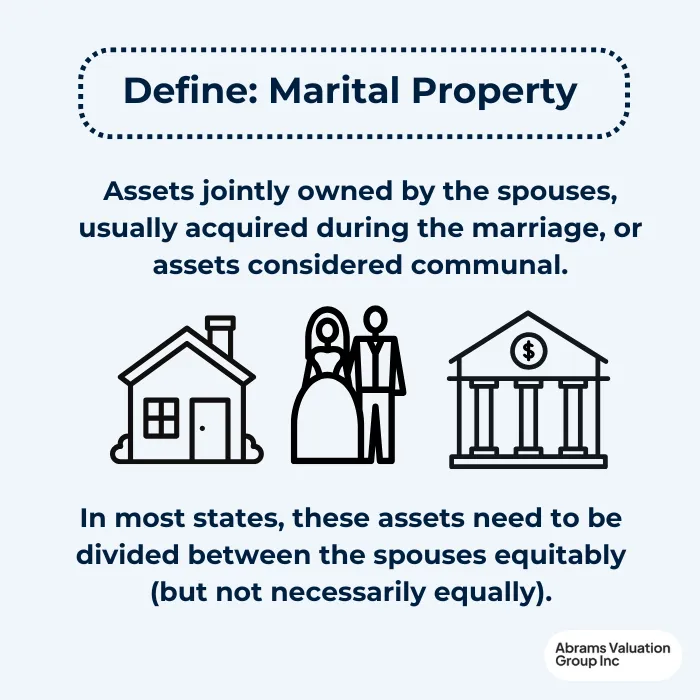
On the other hand, marital property includes assets jointly owned by the spouses, usually acquired during the marriage, or assets considered communal. These assets need to be divided between the spouses in a way that is deemed fair and equitable. This category includes bank accounts, retirement accounts, investment accounts, business interests, and real estate, among other property types.
Equitable Property Division
Most states work to divide property equitably rather than equally. This approach takes into account the financial well-being of each spouse after the divorce and examines the following factors in the division of property:
- the annual salaries of each of the spouses
- the health and medical conditions of each of the spouses
- which spouse is the primary caretaker of any minor children
- how responsible each spouse was with their finances and assets during the marriage
- how much debt and wealth each spouse will have following the divorce
- the tax implications for each spouse of splitting assets
States with Community Property Laws
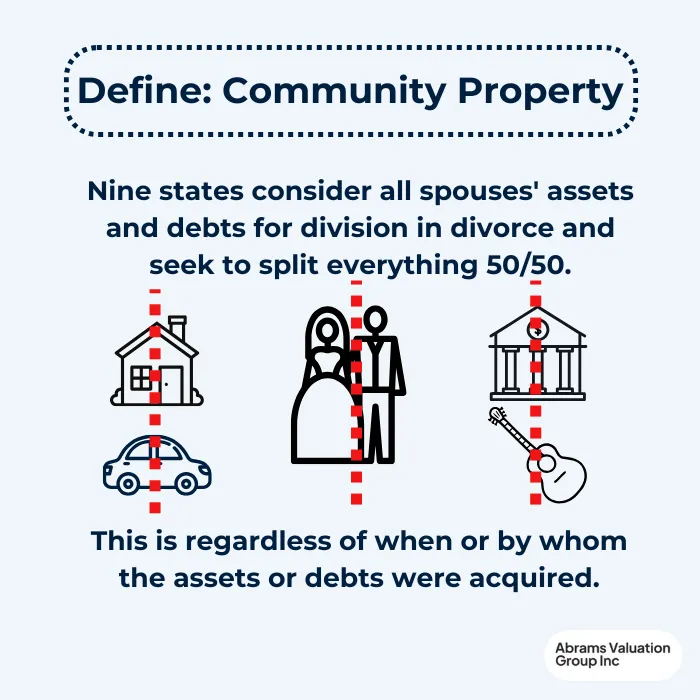
Nine states take a different approach to dividing assets in divorce than the above. These states use Community Property principles to split assets, and all spouses’ assets and debts are split 50/50, regardless of when or by whom they were acquired. These states include
- Arizona
- California
- Idaho
- Louisiana
- Nevada
- New Mexico
- Texas
- Washington
- Wisconsin
If you are going through a divorce, splitting assets with your ex-spouse in these states may leave you with a significant portion of unwanted debt, particularly if your ex was not the most financially responsible during the marriage.
Exceptions to Community Property Laws
There are certain exceptions to community property laws, although there are some variations among states. The main exceptions include
Property inherited by one spouse during the marriage
Property gifted to one spouse during the marriage
Property mentioned explicitly in a signed prenuptial agreement
Property acquired by one spouse while they were living in non-community property states
Property acquired by one spouse while separated (state laws differ on this point, so be sure to consult a qualified and experienced divorce lawyer if you have assets that fall into this category)

How do you Split a House in a Divorce?
Some significant assets, like homes, do not divide evenly down the middle. There are a few ways to handle splitting the family home. First, you’ll likely need to engage a real estate appraiser to assess the home’s value, particularly if it was purchased a long time ago. The house’s value may have significantly increased or decreased, which can affect how you choose to split the home with your spouse.
Once you have an appraised value of the home, there are 3 common ways divorcing couples split homes.
1. Sell the Home
In this scenario, the couple sells the home and divides the proceeds from the sale as part of their property agreements.
2. Buy out the other Spouse
One spouse can buy out the other spouse’s portion of ownership in the home to gain full sole ownership. If necessary, the acquiring spouse can refinance the mortgage to fund the acquisition.
3. Co-Ownership & Deferred Sale
If the couple chooses to defer the sale and division of the home until a later date, they can continue to co-own the home as part of their divorce agreement until they decide to sell it. The property agreement will outline who will handle mortgage payments and house maintenance costs. This scenario is common when minor children are at home, and one spouse wishes to continue raising the children in the family home. Once the children are grown, the couple then sells the home and splits the profits.

How to Split Business Assets and Interests in Divorce
Businesses and business interests can be particularly challenging to divide in a divorce since spouses often differ on handling the business after dissolving the marriage. For example, if a divorcing couple co-owns a small business, one spouse may wish to sell the business and receive their portion of the proceeds, while the other spouse may want to continue running the business. Furthermore, a business appraisal is critical, as the divorce can impact the company’s value. This can often be the case if one spouse holds a crucial position in the company and will leave the company following the divorce.
Obtaining a professional appraisal of the business’s value is a crucial starting point for splitting business assets in divorce. An appraisal provides a fair and impartial assessment of the business value and facilitates a quicker resolution to reaching a divorce settlement.
Once a business appraisal has been performed, there are different strategies for dividing property related to the business. The main ones include
1. Buying out the other spouse
Once spouse can buy out the other spouse’s share of the business or business interests to gain full ownership. This can be a good solution to scenarios where one spouse wants to continue running the business, but the other spouse wants a cash payout.
2. Selling the Business
The couple can choose to sell the business and split the proceeds of the sale. If the company has an ESOP, it is important to decide if a sale to an ESOP might be more profitable than a sale to a third party.
3. Alternative property agreement
If neither option is desirable, the couple can come to an alternative property agreement. Some examples can include one spouse running the company and the other spouse receiving a percentage of future business income. Ultimately, the property settlements are subject to court approval, and particulars of the arrangement have to be approved as a fair division of assets.

Dividing Retirement Benefits: Splitting 401k During Divorce
Although retirement plans are generally listed in each spouses’ separate name, courts typically treat retirement accounts as marital property, and aim to divide the benefits equitably.
In states following a community property system, the court will aim to divide the benefits equally between both you and your spouse.
In the case of a divorce dispute or custody challenge, one spouse may file a QRDO (Qualified Domestic Relations Order), which, if approved by the court, assigns a portion of one spouse’s retirement plan benefits to the other spouse, a dependent, or another recipient. A QRDO can only be issued on qualified retirement plans covered by ERISA regulations, such as ESOP distributions or 401(k) plans. IRA plans are not included.
Dividing Debts and Liabilities
Debts are usually treated as marital property to be divided between the spouses equitably (or equally in community property states). This means that both spouses will take on some responsibility for marital debts, even if the loan or credit card debt was incurred by only one party.
The entire process of divorce and splitting assets is often complex and emotional for both parties. It is highly advisable to engage professional help from qualified mediators, appraisers, or certified divorce financial analysts (CDFA). These professionals bring unbiased expertise to the negotiating table and can help resolve differences of opinion fairly without escalating the issues to formal court trial.
When navigating division of property in divorce, a qualified appraiser can be invaluable in determining the value of the property and facilitating the quick and fair division of the property. Furthermore, dividing marital assets can have significant tax implications for both spouses, who may find their financial situations and tax obligations post-divorce are vastly different than during the marriage.
Many couples rely on AVGI’s 30+ years of appraisal experience to help them divide complex marital assets quickly and fairly. Contact us for a divorce appraisal consultation with zero obligation to see how an appraisal can simplify and expedite the fair division of your assets.


