Group 1577705594
Group 6

Client Success Stories

Accurate Valuation Reduces Taxable Apparent Value by $80 Million

Reduced Apparent Value Featured Image AVGI

The Challenge

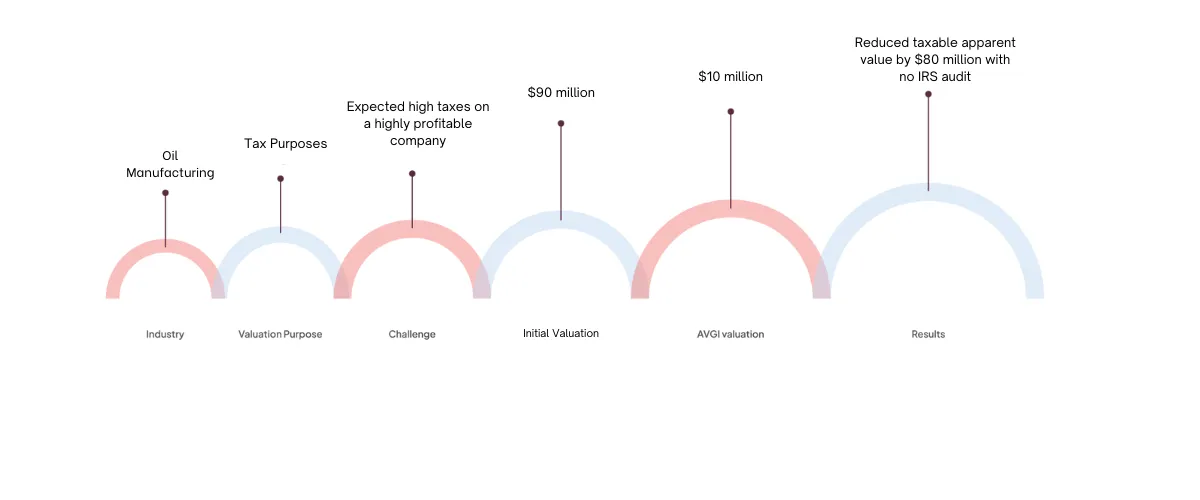
AVGI was contracted to perform a valuation of an oil company in the Midwest for tax purposes. The company had a very high apparent value, which would obligate them to pay high taxes even though the company was suffering from little growth or innovation.

Following our usual valuation process, we first valued the company using the Discounted Cash Flow method and then the market method. The numbers resulted in $25 million using the Discounted Cash Flow method and $90 million using the market method.

It is highly unusual to have such a large discrepancy between the two methods. In addition, it was disadvantageous for the company’s tax purposes to have such a high valuation because of higher taxes on “appeared value.” AVGI weighted the two methods 50/50, but AVGI was not satisfied with the accuracy of the results. AVGI’s appraisers took a closer look at the value drivers at play.

The Solution

AVGI’s valuation experts worked out a formula to infer the growth factor assumed in the market method based on the growth of other competitors in the field. This method, called the ADF-Annuity Discount Factor, calculates the present value of a finite stream of cash flows (with constant growth). 

The company itself was not growing much, with low sales and little innovation; any growth was due to rising oil prices, not really internal company growth. This was in high contrast to other competitors in the market, who were growing at a much faster rate.

The Discounted Cashflow Method yielded 2.5% growth in contrast to the market method, which yielded 9% or 16% growth, depending on how different factors. AVGI identified that this excessively high market growth rate inaccurately inflated the oil company’s value, as the company’s internal growth did not match the rates of peer companies.

Based on discovering the inaccurate value driver, AVGI could weight the market method valuation much less logically. This resulted in a much lower valuation of $10 million that more accurately represented the oil company’s low growth rate.

The Result

Shaving off $80 million of apparent taxable value allowed the company to drastically reduce an inflated tax obligation on the company’s apparent value that did not actually exist. 

Is your company overpaying taxes on an apparent value that doesn’t exist? AVGI can accurately and empirically assess your business value and tax obligation with an audit success rate of over 99%.

Group 12
Group 1577705590

How can our expert valuation insight
help reduce your company’s tax obligation?

Group 1577705590
Frequently asked questions

We’ve compiled a list of the most common questions our customers ask. If you can’t find the answer you’re looking for here, please don’t hesitate to contact our customer support team, and we’ll be happy to assist you.

A business evaluation is not necessarily the same as a business valuation. Business evaluation is a much broader term that can refer to auditing any aspect of a business, such as business processes, phone systems, or overall efficiency, but does not explicitly refer to evaluating the monetary value of the business.

In contrast, business valuation refers exclusively to establishing the firm’s monetary value. Colloquially, people often use the two terms interchangeably, so someone looking for a business valuation may search online for business evaluation services.