

GILTI as Charged? Understanding Global Intangible Low Taxed Income
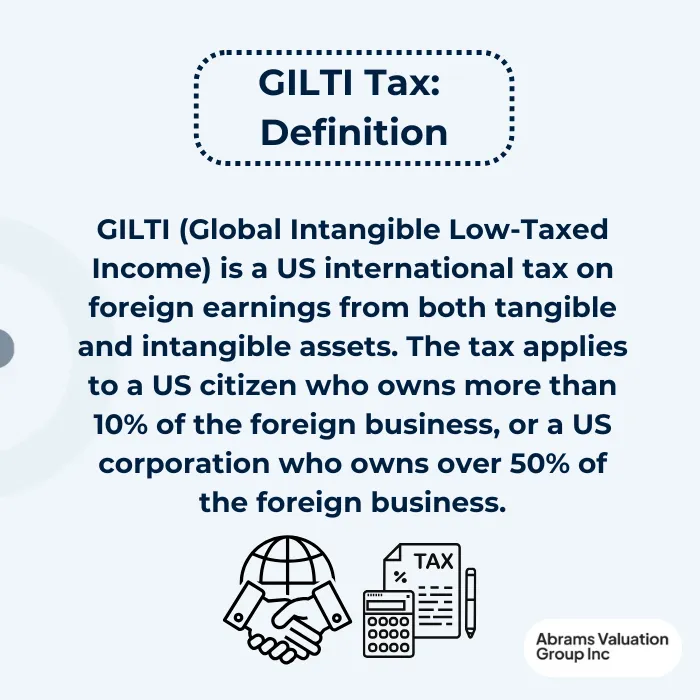
GILTI (Global Intangible Low-Taxed Income) is a US international tax on foreign earnings from tangible and particularly intangible assets. This tax was introduced in the 2017 TCJA Tax Cuts and Jobs Act to set a minimum tax in place on intangible assets held overseas by US taxpayers. AVGI experts delve into what the GILTI tax is, how it’s calculated, tax planning implications, and examples to help you make informed decisions.
GILTI Income Calculation
The GILTI regime imposes a global minimum tax on foreign earnings from controlled foreign corporations (CFCs), if a US citizen owns more than 10% of the CFC. GILTI tax applies to corporations that own over 50% of a foreign business. This broadly includes active foreign income from intangible assets like patents and trademarks. As it was designed to prevent shifting taxable income to low tax countries or no tax jurisdictions, this minimum tax applies to US shareholders of the company or IP, even if the foreign income is undistributed.
GILTI Tax Rate and Implications
GILTI tax rates vary based on shareholder type and applicable Internal Revenue Code provisions.
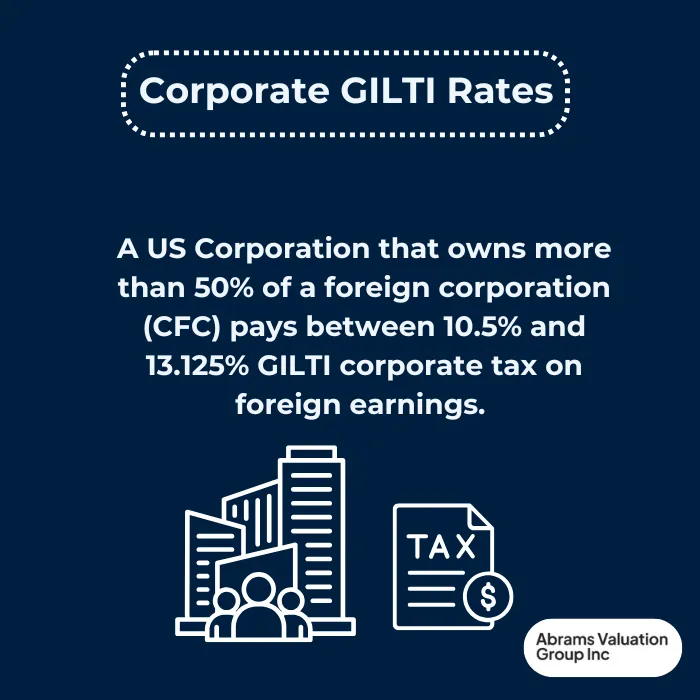
Corporate shareholders pay GILTI tax rates between 10.5% and 13.125%. These rates are set to increase in 2026 to 13.125%-16.406%.
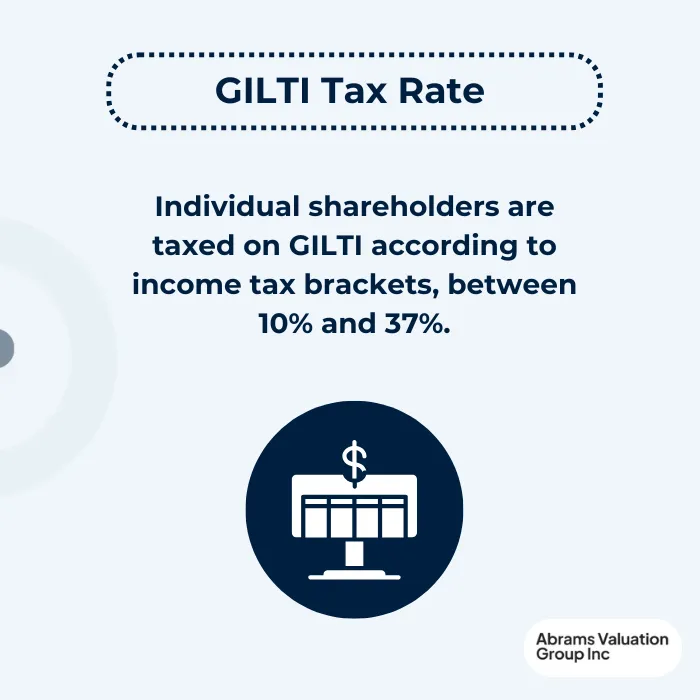
Individual shareholders are taxed on GILTI based on their income tax brackets, ranging from 10% to 37%.
Foreign Tax Credits and GILTI
Foreign tax credits (FTCs) provide some relief for the shareholders already paying foreign taxes. Shareholders can use FTCs to reduce their GILTI tax obligation, but the foreign tax credit is limited to 80% of the US tax liability. Although FTCs are meant to prevent double taxation, they are still limited under GILTI rules. For example, FTCs cannot fully offset US tax if foreign tax rates exceed thresholds. Limitations to FTCs can result in double taxation on foreign earnings, making a weighty tax liability impact.
Foreign Derived Intangible Income and GILTI
Foreign Derived Intangible Income (FDII) is a related concept that provides a tax deduction for certain foreign-derived income. The Section 250 deduction for FDII can reduce the effective GILTI tax rate by as much as 50%. However, this deduction is set to reduce to 37.5% in 2026, which will increase the effective tax rate. Corporate shareholders may claim this deduction to minimize their GILTI tax liability.
GILTI Tax Formula and Calculation
It can be slightly complex to calculate GILTI tax obligation. As with any tax matters, AVGI strongly advises obtaining assistance from a qualified tax professional for individualized guidance. Here is the general formula to calculate GILTI.
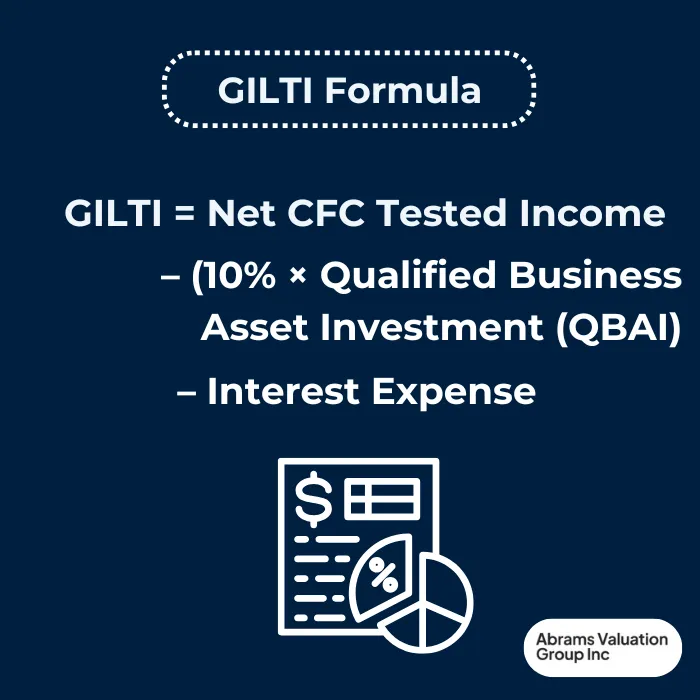
GILTI = Net CFC Tested Income – (10% × Qualified Business Asset Investment (QBAI) – Interest Expense)
Tested income is the gross income of a CFC minus deductions, calculated as if the CFC were a US person. QBAI represents the average adjusted bases of tangible property used to earn gross income. Interest expenses related to QBAI assets reduces the GILTI inclusion amount, lowering the tax obligation.
GILTI State Taxes
The application of the GILTI tax at the state level in the United States varies significantly. While GILTI is a federal tax provision designed to tax global intangible low-taxed income earned by controlled foreign corporations, individual states have adopted differing approaches to conforming—or not conforming—to the federal GILTI tax rules. This creates a complex landscape for taxpayers with foreign subsidiaries or investments, as state tax consequences may differ substantially from federal tax obligations.
State Conformity to Federal GILTI Rules
Some states fully conform to the federal GILTI tax rules, incorporating both the GILTI inclusion in taxable income and allowing deductions similar to the federal Section 250 deduction. These states treat GILTI as part of the taxpayer’s federal taxable income, ensuring consistency between federal and state tax calculations. This conformity simplifies tax compliance for corporations operating in these states.
Conversely, several states do not conform to the GILTI provisions at all, effectively excluding GILTI income from their corporate tax bases. These states may exclude GILTI income to avoid double taxation or due to policy decisions to not tax income derived from foreign subsidiaries. For taxpayers, this means that GILTI income reported on federal returns may not be subject to state corporate income tax in these jurisdictions.
Other states take a hybrid approach, conforming to certain aspects of the federal GILTI rules but disallowing specific deductions or requiring add-backs of federal deductions related to GILTI. This partial conformity can increase the state tax liability compared to the federal tax.
Impact on Taxpayers
The variation in state treatment of GILTI can lead to different tax consequences depending on the state or states where a taxpayer operates or is domiciled. Multistate corporations must carefully analyze each state’s rules to accurately compute state taxable income and avoid unexpected tax liabilities or compliance issues.
Summary Table of State GILTI Treatment
State | GILTI Addition Included in Taxable Income | GILTI Deduction Allowed | Notes |
|---|---|---|---|
Alaska (AK) | Yes | Yes | Full conformity including IRC §250 deduction |
California (CA) | No | No | Does not conform to federal GILTI rules |
Delaware (DE) | Yes | Yes | Conforms fully to federal treatment |
Florida (FL) | Yes | Yes | Allows subtraction for GILTI to extent not deducted federally |
Illinois (IL) | No | No | Requires add-back of federal GILTI deductions |
Massachusetts (MA) | Yes | Yes | Treats GILTI as dividend income with related deductions |
New York (NY) | Yes | Partial | Allows partial exclusion; recent changes limit deduction under IRC §250 |
Texas (TX) | No | No | Does not conform to GILTI addition or deduction |
Virginia (VA) | Yes | Yes | Full conformity including deduction |
Wisconsin (WI) | No | No | Decouples from GILTI tax regime |
Note: This table provides a snapshot of selected states and is not exhaustive. State tax laws and conformity to federal provisions can change, so it is important to consult current state tax guidance or a tax professional.
Conclusion on State-Level GILTI Tax
Understanding the differing state approaches to GILTI is essential for proper tax planning and compliance. Taxpayers should evaluate the GILTI tax rules in each state where they have nexus or operations and consider the impact of these rules on their overall tax obligations. Working with tax professionals familiar with both federal and state tax law can help navigate these complexities and optimize tax outcomes.
GILTI Tax Planning Strategies

There are several tax planning strategies that can help shareholders minimize their GILTI tax liability. It is crucial to consult with a qualified tax professional when navigating tax planning decisions.
Section 962 Election
The Section 962 election allows individual shareholders to elect to be taxed at corporate rates, potentially reducing their GILTI tax liability, particularly for high-income earners. Since GILTI rates for individuals go according to income tax brackets, a shareholder in a tax bracket above 13.1% (the highest Corporate GILTI rate) might benefit significantly from the Section 962 Election.
High-tax Exception This excludes income taxed at 18.9% or higher from GILTI taxation. This exception applies to income taxed in a foreign country at a rate that is higher than the US corporate tax rate.
Foreign tax credits. These credits can reduce the GILTI tax liability up until a threshold, at which point the tax credits are exempted from the GILTI calculation.
Taxpayers should carefully consider these strategies to minimize their GILTI tax liability.
GILTI Reporting Requirements
It’s important to stay up-to-date on reporting requirements to remain compliant. US shareholders of CFCs must file Form 8992 to calculate GILTI tested income and QBAI. Form 5471 reports ownership and detailed CFC financial information annually. Corporate shareholders claiming Section 250 deduction file Form 8993. Reporting involves complex rules on loss carryovers, QBAI exclusions, and state-level variations.
GILTI Regime and US Expats
The GILTI regime impacts US expats in particular who often own foreign corporations or have foreign income. US expats must consider the GILTI tax implications on their foreign income and assets and in their tax planning. The GILTI regime can cause double taxation on foreign earnings, and US expats must carefully plan to minimize their tax liability. US expats must also consider the foreign tax credit limitation and the high-tax exception to minimize their tax liability and meet their tax obligations.
GILTI and Tax Avoidance
The GILTI regime is designed to prevent tax avoidance by US taxpayers with foreign income or assets. The GILTI tax imposes a minimum tax on foreign earnings, reducing the incentive for tax avoidance. Taxpayers must carefully consider the GILTI tax implications on their foreign income and assets to avoid double taxation. The GILTI regime requires careful planning and consideration to minimize tax liability while meeting tax obligations.
GILTI: Valuation Implications
The GILTI regime is a complex and nuanced tax system that impacts US taxpayers with foreign income or assets, particularly US expats. Taxpayers must carefully consider the GILTI tax implications on their foreign income and assets to minimize their tax liability. Taxpayers must also consider the foreign tax credit limitation, the high-tax exception, and other tax planning strategies to minimize their GILTI tax liability.
If you hold valuable intangible assets abroad, or have more than 10% ownership in a CFC, GILTI tax obligations can affect the value of those assets. This is especially true when considering a sale of assets. Looking to preserve value and minimize GILTI valuation implications? Contact AVGI’s business valuation experts today.

