

Taxes on Sale of Business S Corp: Key Considerations
Not all business sales were created equal. The corporate structure of the business at the time of the sale plays a large part in determining the tax implications of the sale. Understanding the implications of selling all corporation stock is essential when selling an S Corporation. It’s crucial to be informed about the key differences in corporate structures and the repercussions of each to empower intelligent decision-making.
Making informed decisions throughout the process is crucial to ensure that the sale proceeds smoothly and profitably while limiting the tax implications for both parties as much as possible. AVGI delves into the topic of taxes on the sale of business S Corp- how it differs from selling a C Corp, expert advice, and key considerations for a seamless sale.

Overview of S Corporation Taxes
S corporations are a unique tax structure that allows corporations to elect for pass-through taxation, where the business income passes through to be taxed on shareholders’ personal tax returns. However, S Corporation shareholders are taxed on their share of the corporation’s income at the federal income tax rate, regardless of whether it is distributed. This is in contrast to more typical C Corporations, where the business’s income is taxed with a separate corporate tax; it is then taxed a second time as personal income when distributions are made to shareholders.
Besides the tax aspect, another significant advantage of S Corporations is that they offer greater liability protection to shareholders, shielding them from personal liability for business debts and obligations.
Just like S Corps qualify for special tax treatment while operating, there are also special tax rules that apply to selling an S Corporation. Understanding the tax implications of S corporations is crucial for making informed decisions in business succession planning.

Types of S Corporation Sales
An S corporation sale can be structured as either an asset sale or a stock sale. In an asset sale, the buyer selects the specific assets they want to buy from the corporation. In contrast, in a stock sale, the buyer acquires the stock of the S corporation along with all the corporation’s assets and liabilities. A deemed asset sale is a stock sale where both parties agree to treat it as an asset sale for tax purposes.
Tax Implications of Selling an S Corp
The type of deal structure that is ultimately negotiated affects the taxes on the sale of the S Corp for both the buyer and seller. Different forms of sales, such as stock vs. asset sales, have varying implications for federal income tax purposes, influencing how gains and losses are treated. Let’s examine the effects of each structure on the taxes on sale of business S Corp.
Taxes on Sale of S Corp Business: Asset Sale Structure
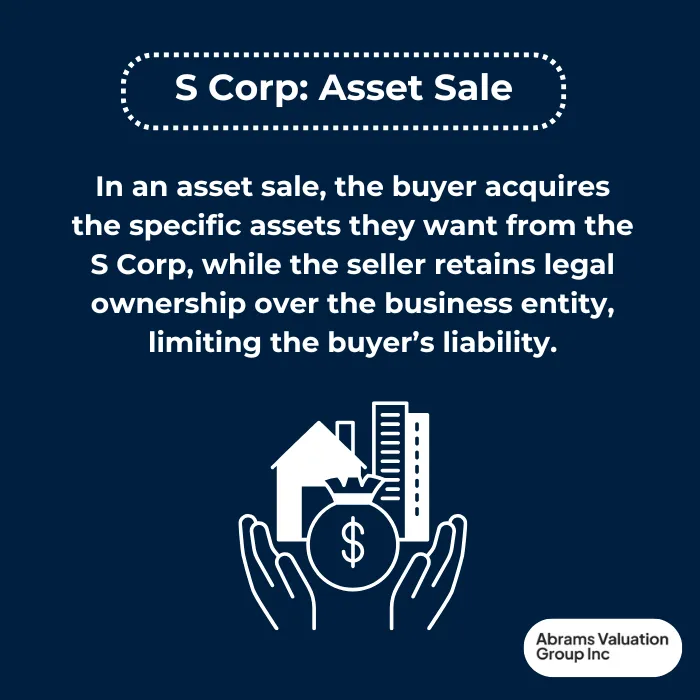
In an asset sale, the buyer can step up the tax basis of the acquired S corporation’s assets, which allows them to amortize and depreciate, lowering their future tax bills.
For the seller, an asset sale is generally less advantageous tax-wise. The profits from selling most of the company’s tangible assets are taxed at the higher income tax rate (certain intangible assets, like goodwill, are subject to lower capital gains tax rates instead). Additionally, if the S Corp restructures as a C Corp in anticipation of the sale, this can trigger BIG (built-in-gains) taxes, which add to the seller’s tax burden.
Taxes on Sale of S Corp Business: Stock Sale Structure
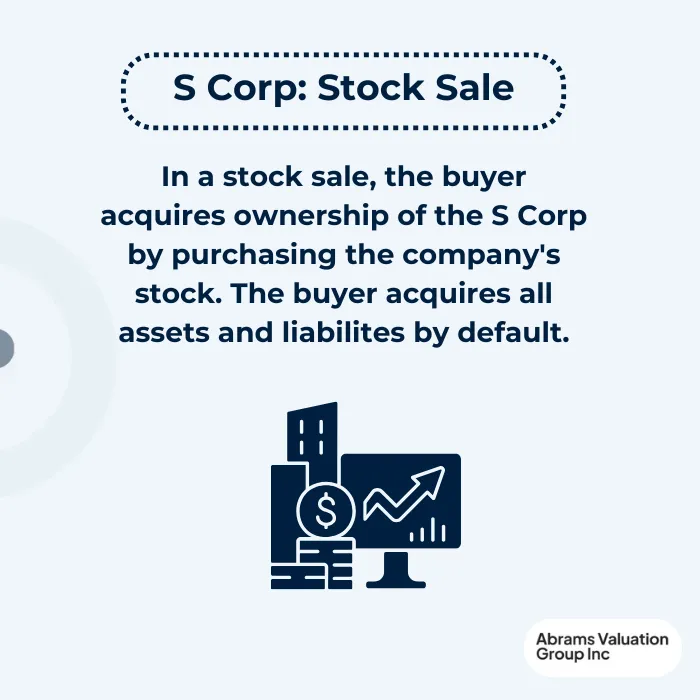
Stock sales are typically more advantageous for the seller. If the deal is structured as a stock sale, then the seller only pays capital gains taxes on the sale of the business S Corp, not ordinary income tax, regardless of the types of assets included in the sale. The federal income tax treatment of different types of gains and losses, such as capital gains, ordinary income, and section 1231 assets, is crucial to understand as it can significantly affect the financial outcomes of various transactions.
Taxes on Sale of S Corp Business to an ESOP
A third option for the business sale is creating an Employee Stock Option Plan (ESOP) and selling the S Corp shares to the ESOP. AVGI discusses this complex topic in detail to determine when it is more advantageous to sell to an ESOP vs a third-party buyer.
Capital Gains Taxes
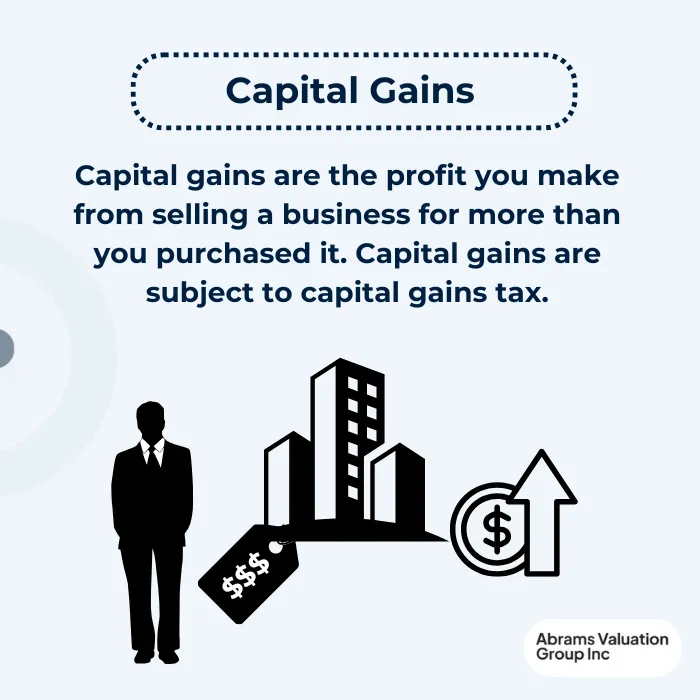
Capital gains taxes are a crucial consideration when selling an S corporation. A capital gain occurs when a capital asset, such as the S corporation’s stock or assets, is sold for a profit. The tax rate on capital gains depends on the length of time the asset was held and the taxpayer’s income level. Long-term capital gains, which occur when an asset is held for more than one year, are generally taxed at a lower rate than short-term capital gains.
For S corporations, the sale of the business can result in capital gains taxes for the shareholders. The gain is calculated by subtracting the tax basis of the stock from the sale price. The tax basis is typically the original purchase price of the stock plus any adjustments for income or loss of the S corporation.
To minimize capital gains taxes, S corporation shareholders may consider structuring the sale as a stock sale, which can qualify for long-term capital gains treatment. Additionally, the use of tax-deferred exchanges, such as a Section 1031 exchange, can help to defer capital gains taxes.
Built-in Gains (BIG) Tax
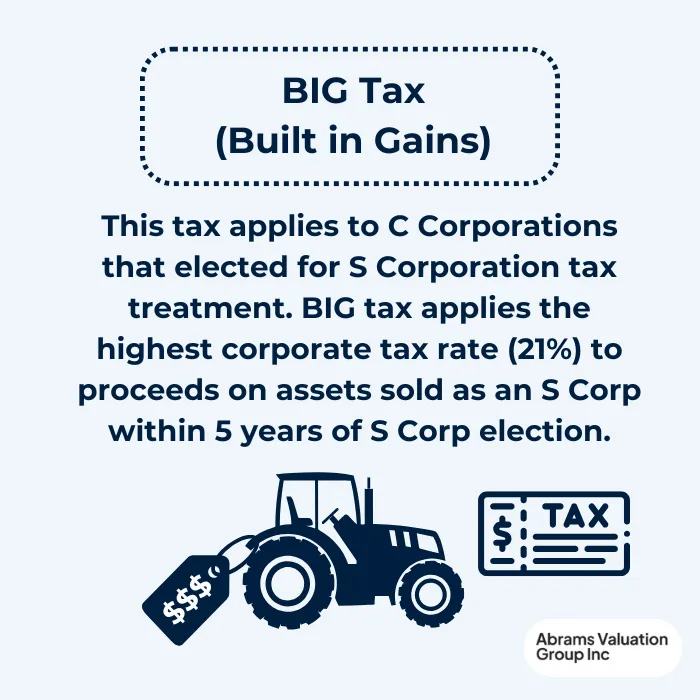
The built-in gains (BIG) tax is a potential tax liability that can arise when an S corporation sells its assets. The BIG tax is triggered when an S corporation was previously a C corporation and has built-in gains, which are the gains that would be recognized if the assets were sold at their fair market value.
The BIG tax can result in double taxation, as the S corporation is taxed on the gain at the corporate level, and the shareholders are taxed again on the distribution of the gain. To avoid the BIG tax, S corporations may consider structuring the sale as a stock sale, which can avoid the recognition of built-in gains.
Alternatively, the S corporation can make an election to recognize the built-in gains and pay the BIG tax, which can help to avoid double taxation. However, this election must be made carefully, as it can have unintended tax consequences.
Determining the Value of the S Corp
Determining the fair market value of the S Corp is crucial for accurately calculating the tax on the sale of an S Corp business, as well as the tax basis of the assets. The fair market value can be determined using asset-based, income-based, or market-based valuation methods, although not all approaches may be applicable to the company in question. Learn more about the business valuation process and methods here. Because of their unique tax treatment, S Corp stocks are eligible for specific valuation discounts related to the lack of marketability and lack of control inherent within a private company.
A business valuation expert specializes in determining the value of companies and can help ensure an accurate valuation. AVGI’s team of valuation experts has over 30 years of experience empirically valuing businesses and intangible assets for transaction, tax, and litigation purposes. Contact us today for a zero-obligation consultation.
Allocation of Purchase Price
The allocation of purchase price is a critical step in the sale of an S corporation, regardless of whether the deal is structured as an asset or stock sale. The purchase price must be allocated among the various assets of the business, including tangible assets, intangible assets, and goodwill.
The allocation of purchase price is typically done using the residual method, which requires the allocation of the purchase price to the various assets in a specific order. The residual method is used to determine the amount of gain or loss recognized on the sale of each asset, as well as the tax basis of the assets in the hands of the buyer.
The allocation of purchase price can have significant tax implications for both the buyer and the seller. For example, the allocation of the purchase price to goodwill can result in a long-term capital gain for the seller, while the allocation to tangible assets can result in ordinary income.
To ensure that the allocation of purchase price is done correctly, it is essential to work with a qualified tax professional who can help to navigate the complex tax rules and regulations surrounding the sale of an S corporation.
Net Investment Income Tax (NIIT) Considerations
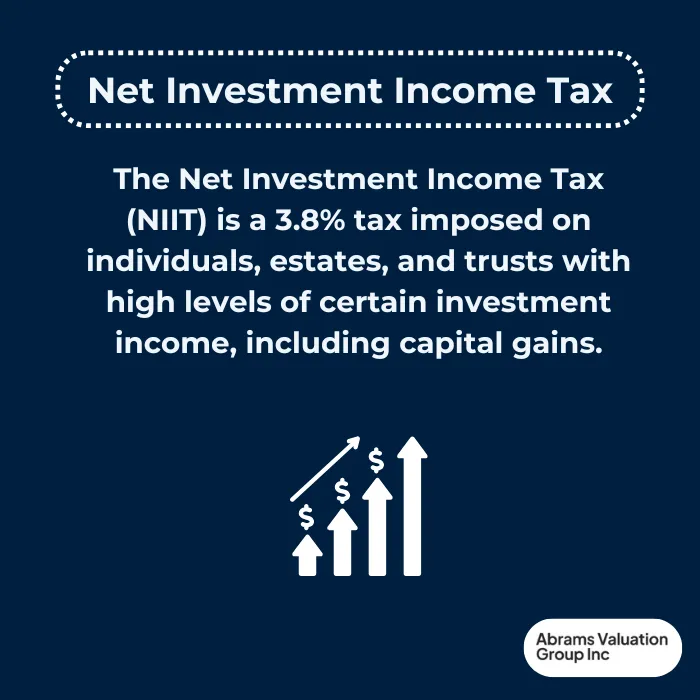
The Net Investment Income Tax (NIIT) is a 3.8% tax imposed on certain types of investment income and applies to individuals, estates, and trusts that have high levels of qualifying income. This tax can significantly influence the tax consequences associated with the sale of an S Corporation.
For instance, if an individual selling their S Corp realizes a gain of $1 million from the sale and their modified adjusted gross income exceeds the threshold for NIIT application, they would be liable to pay an additional $38,000 in taxes due to the NIIT. Therefore, understanding the implications of the NIIT is essential for minimizing overall tax liability when navigating such transactions.
Comparison to C Corporation Sales
In general, S corporations are more tax-efficient than C corporations. Unlike pass-through tax S Corps, C corporations are subject to double taxation, which can significantly impact the take-home profits on the sale of the business. However, C corporations can provide more flexibility in terms of ownership structure.
Shareholders can choose to restructure the business as an S or C Corp to maximize on tax benefits when selling the business, but restructuring comes with its own set of pros and cons. For example, restructuring an S Corp as a C Corp means that the S Corp loses its ability to step up its tax basis for assets. Buyers are usually keen on maximizing the stepped up tax basis for assets, and are willing to pay an average of 15% more for S Corps over C Corps for this reason. Furthermore, the C Corp would be liable to pay double taxes at the corporate and personal levels.
Understanding the differences between S and C corporations is crucial for determining which structure makes the most sense in anticipation of the business sale.
Reporting the Sale of an S Corp
The sale of an S corp must be reported on the corporation’s tax return, using Form 1120-S, U.S. Income Tax Return for an S Corporation. Shareholders also need to report their share of the gain or loss from the sale on their personal tax returns. Accurate valuation and reporting are crucial to avoid penalties and interest for all parties involved.
Strategies for Minimizing Tax Liability
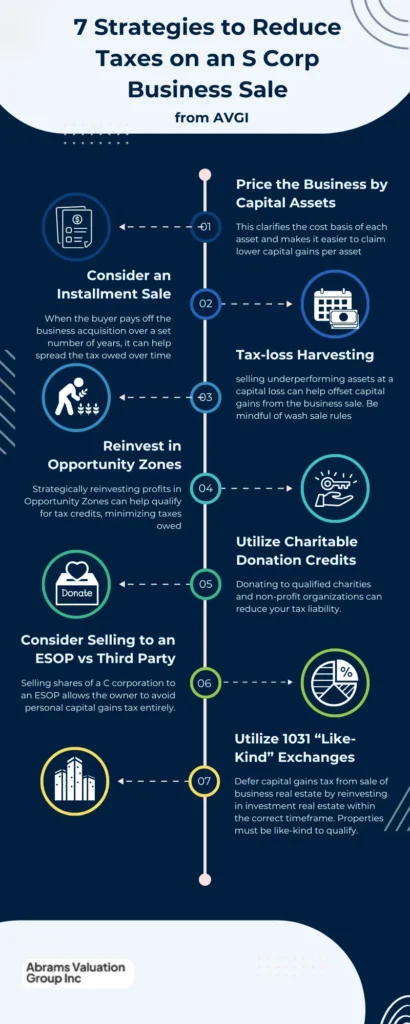
Minimizing taxes on the sale of an S Corp business requires careful planning and consideration. It is wise for shareholders to consult with an experienced tax planning professional to maximize available tax credits and strategies for reducing their tax burden. Here are some tax-efficient strategies that are generally effective in tax planning. Always consult with a qualified tax professional before applying any tax strategy to your personal situation.
- Tax-deferred exchanges
- Installment sales
- Charitable donations
- Qualified Retirement funds
- Opportunity Zones
Understanding the tax implications of the business sale is crucial for making informed decisions. AVGI strongly recommends consulting with a tax professional before the sale to minimize tax liabilities.
Taxes of Sale of Business: S Corp- In Conclusion
Selling an S corp can be a complex process with significant tax implications, both for the buyer and the seller. Understanding the tax implications is crucial for making informed decisions. Obtaining an accurate business valuation can help clarify the true value of the business and the most accurate tax obligations on the proceeds from the business sale. Careful tax planning with professional guidance can help further reduce the shareholders’ tax liability and ensure a successful and profitable sale. Contact AVGI today to start the business valuation process for your S Corp.


