

Monthly Recurring Revenue & Its Valuation Impact
Introduction to Recurring Revenue
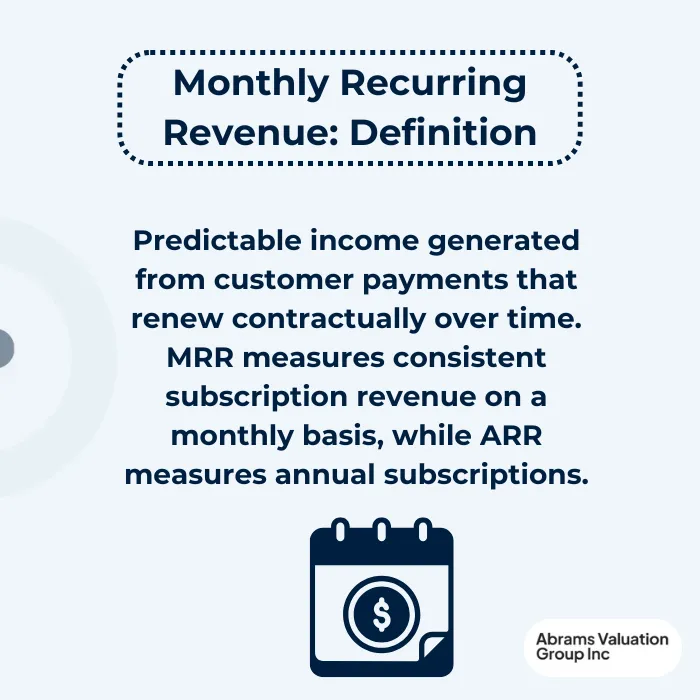
Recurring revenue refers to predictable income generated from customer payments that renew contractually over time. Specifically, MRR measures consistent subscription revenue on a monthly basis, while ARR applies to contracts with a minimum one-year term, excluding short-term subscriptions. Understanding recurring revenue is crucial for subscription-based businesses to forecast future revenue and identify growth trends. A steady income stream from recurring revenue helps businesses maintain financial health and plan for expansion. When valuing a SaaS or similarly modeled business, key metrics like Monthly Recurring Revenue (MRR) and Annual Recurring Revenue (ARR) provide insight into the company’s financial health, stability, and growth potential, all of which influence its valuation.
Why is Monthly Recurring Revenue Important in Valuation?
Monthly Recurring Revenue (MRR) plays a crucial role in the valuation of subscription-based businesses, particularly SaaS companies. A strong MRR indicates healthy, reliable recurring revenue streams that provide a solid foundation for predicting future growth. Because MRR reflects consistent revenue generated from customers who pay on a monthly basis, it offers investors and stakeholders a clear view of the company’s financial stability and business performance.
MRR helps quantify the predictable income generated each month, allowing businesses to forecast steady cash flow and plan their business strategy effectively. It also highlights the company’s ability to retain existing customers and acquire new customers, both of which contribute to sustainable revenue growth. Furthermore, a growing MRR signals successful customer retention rates and expansion MRR from the existing customer base, demonstrating strong product-market fit and customer satisfaction.
In valuation, MRR serves as a key metric to assess the health of recurring revenue streams and the overall scalability of the business. It reduces uncertainty by providing insight into the company’s future revenue potential, enabling more accurate financial forecasting and investment decisions. Ultimately, a robust MRR supports a higher valuation by showcasing a dependable and growing revenue model that investors can trust.
Calculating Monthly Recurring Revenue
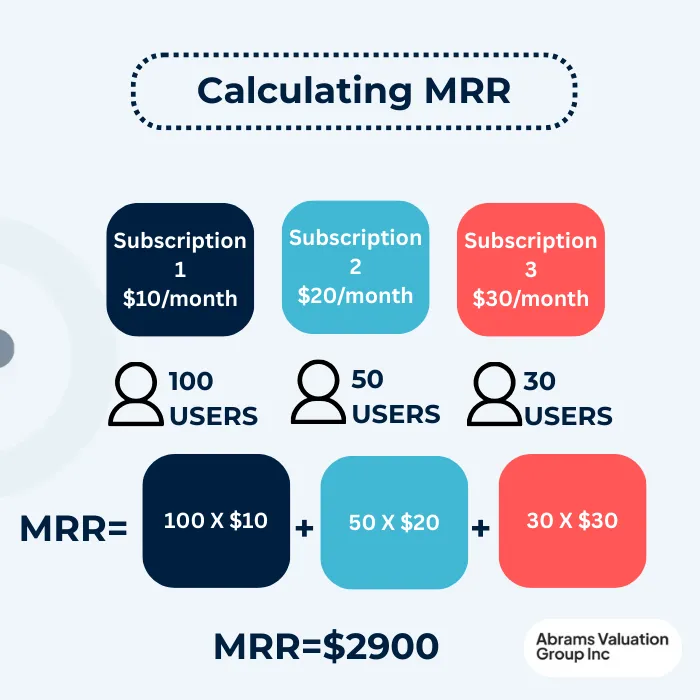
To calculate monthly recurring revenue (MRR), multiply the average revenue per user (ARPU) by the total number of paying customers. Alternatively, MRR can be calculated by summing the revenue generated from each subscription plan to find the total monthly recurring revenue. This calculation helps businesses understand their financial health, track revenue growth, and make informed decisions. Accurate MRR calculation is essential, as it may vary depending on the specific type of MRR being tracked, such as new MRR, expansion MRR, or churn MRR. By monitoring MRR, subscription-based businesses can predict future revenue, identify growth trends, and respond promptly to changes, ensuring steady recurring revenue and supporting long-term business success.
For example: MRR = (100 x $10) + (50 x $20) + (30 x $30) = $2,900 for three subscription plans.
Annual Recurring Revenue (ARR)
Annual recurring revenue (ARR) measures the expected yearly recurring revenue, providing a long-term perspective on company performance that smooths out monthly fluctuations. It is calculated by multiplying the monthly recurring revenue (MRR) by 12 (ARR = MRR x 12). Understanding ARR is essential for businesses as it enables them to predict future revenue more accurately and make informed strategic decisions based on a broader view of their financial health and growth potential.
Suppose a company has a Monthly Recurring Revenue (MRR) of $10,000 for a given month. To calculate the Annual Recurring Revenue (ARR), simply multiply the MRR by 12 (the number of months in a year):
ARR = MRR × 12
ARR = $10,000 × 12 = $120,000
This means the company expects to generate $120,000 in recurring revenue over the course of a year, assuming the MRR remains consistent. ARR provides a long-term view of the company’s revenue performance and is useful for financial forecasting and strategic planning.
Revenue Calculation Methods
There are different methods to calculate recurring revenue, each suited to varying business needs. One common approach is the cohort analysis method, which segments customers by pricing plans, customer cohorts, or other relevant groups to provide deeper insights into revenue patterns. Another straightforward method involves multiplying the average monthly revenue per user by the total number of monthly users, offering a simple yet effective calculation of monthly recurring revenue. Choosing the right revenue calculation method is essential for businesses to ensure accurate results that reflect their unique subscription models and support informed financial decision-making.
Common Mistakes in Revenue Calculation
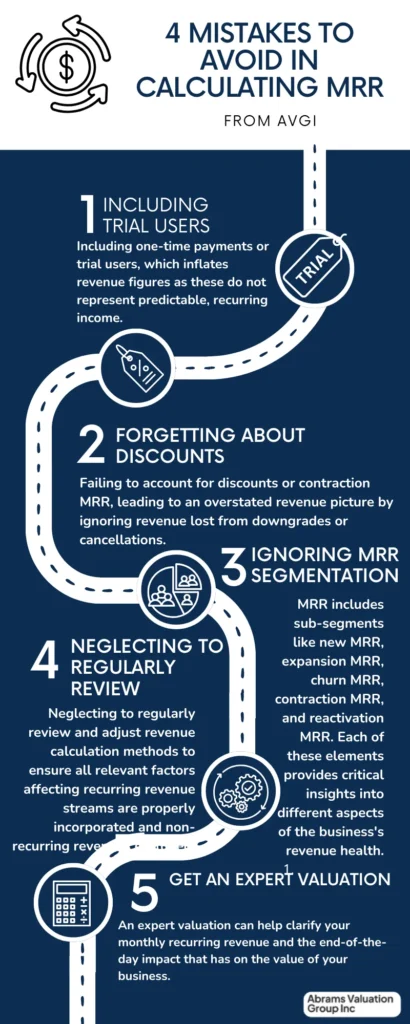
To avoid inaccuracies in Monthly Recurring Revenue (MRR) calculations, businesses should be aware of the following common mistakes:
Including one-time payments or trial users, which inflate revenue figures, as these do not represent predictable, recurring income.
Failing to account for discounts or contraction MRR, leading to an overstated revenue picture by ignoring revenue lost from downgrades or cancellations.
Ignoring important MRR components, which undermines the reliability of the metric and can mislead decision-making.
Neglecting to regularly review and adjust revenue calculation methods to ensure all relevant factors affecting recurring revenue streams are properly incorporated and non-recurring revenues excluded.
Average Revenue and Growth
Average revenue per user (ARPU) is a crucial metric for tracking revenue growth and customer acquisition, providing valuable insights into customer behavior and trends. Monitoring the average monthly revenue per user enables businesses to better understand how customers subscribe and engage with their offerings. Expansion MRR, which reflects additional recurring revenue generated from satisfied and retained customers, serves as a strong indicator of customer loyalty and business growth. By closely analyzing average revenue and growth patterns, companies can make data-driven decisions to optimize pricing plans and drive sustainable revenue growth.
Business Model and Revenue
The recurring revenue model is prevalent in SaaS, streaming services, and subscription businesses, where customers pay monthly fees to ensure a steady stream of recurring revenue. Maintaining and growing this revenue relies heavily on effective customer retention strategies, as retaining existing customers reduces churn rates and fosters revenue stability. Businesses focusing on excellent customer service, loyalty programs, continuous product improvements, and proactive customer communications build trust and encourage long-term customer commitment. By implementing these retention strategies, companies can maintain a steady customer base, minimize lost revenue from canceled subscriptions, and ultimately increase their monthly recurring revenue, supporting sustainable business growth.
Customer Retention Strategies
Excellent customer service and loyalty programs play a vital role in improving customer retention and reducing churn rates. Continuously enhancing products and services supports long-term customer satisfaction, while consistent customer communications and regular updates help build trust and encourage customers to remain loyal. By implementing these comprehensive customer retention strategies, businesses can maintain a steady customer base, minimize lost revenue from canceled subscriptions, and ultimately increase their monthly recurring revenue, fostering sustainable growth and financial stability.
Financial Health and Revenue
MRR provides valuable insights into a business’s financial health and scalability by enabling companies to monitor revenue growth, customer acquisition, and retention. Tracking MRR is essential for making informed decisions and planning for future growth, as it helps identify areas for improvement. By analyzing different components of MRR—such as new MRR from new customers, expansion MRR from existing subscribers upgrading their plans, churn MRR from lost customers, and reactivation MRR from returning customers—businesses gain a detailed understanding of revenue dynamics.
This granularity allows companies to pinpoint sources of growth or revenue loss, optimize marketing efforts, and tailor sales team strategies to improve customer acquisition cost and customer lifetime value. As a critical metric for SaaS businesses, MRR supports accurate revenue forecasting and strategic decision-making related to product development, resource allocation, and scaling operations. Regularly reviewing MRR trends empowers businesses to respond quickly to market changes and customer preferences, ensuring steady cash flow and sustained growth.
Cross Selling and Upselling
Cross-selling involves promoting related products or add-ons to existing customers, while upselling encourages customers to purchase higher-priced products or services to increase monthly recurring revenue (MRR). For example, businesses might offer upgrades from monthly subscriptions to yearly plans or add features such as extra storage and advanced analytics. These strategies effectively enhance recurring revenue by maximizing the value derived from the current customer base, contributing to sustained revenue growth and improved financial health.
Monthly Recurring Revenue Benefits
Monthly Recurring Revenue (MRR) plays a vital role in helping businesses predict future revenue and identify growth trends. A steady increase in MRR enables companies to forecast significant revenue milestones, such as doubling their income, which supports strategic planning in hiring, product development, and marketing efforts. Conversely, a decrease in MRR serves as a warning sign of potential customer loss, prompting businesses to investigate the causes and implement retention strategies. Overall, MRR provides a predictable income stream that empowers businesses to make informed decisions and maintain financial stability.
Revenue Growth Strategies
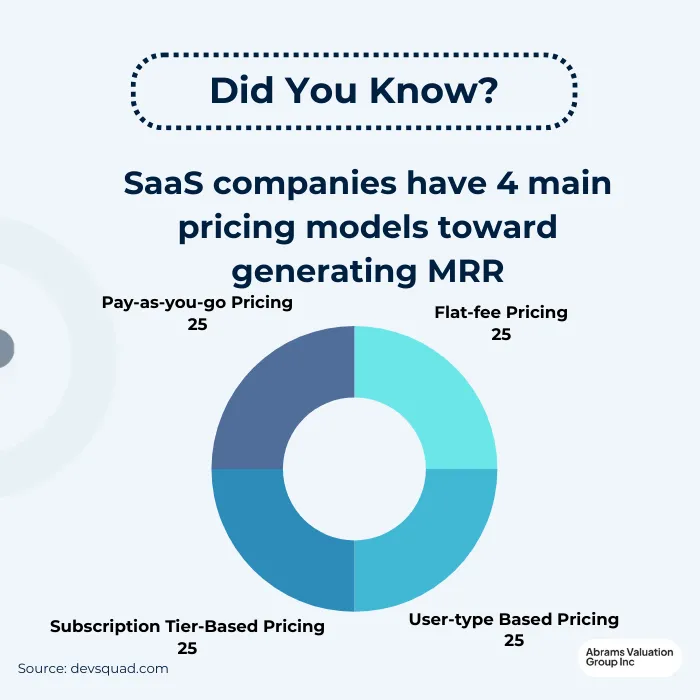
To increase Monthly Recurring Revenue (MRR), businesses should optimize their pricing strategies by offering tiered pricing plans that cater to different customer segments, thereby maximizing revenue while minimizing churn. Leveraging upselling and cross-selling techniques can further boost revenue by encouraging existing customers to upgrade or add complementary products.
Focusing on effective customer acquisition and retention tactics is essential for sustainable growth in recurring revenue. Additionally, diversifying revenue streams and implementing robust subscription management solutions can enhance MRR. Utilizing data and analytics to continuously monitor performance allows businesses to identify areas for improvement and refine their revenue optimization strategies, ensuring consistent and maximum revenue growth over time.
Conclusion
Accurately calculating, maintaining, and growing Monthly Recurring Revenue (MRR) is essential for subscription-based businesses seeking financial stability and long-term success. By closely monitoring MRR and its components, companies can gain valuable insights into their revenue health, customer retention, and growth opportunities. A strong and steadily increasing MRR not only supports reliable cash flow but also enhances a company’s valuation by demonstrating predictable income and scalable business performance. To maximize the benefits of MRR in your valuation process and ensure your business is positioned for growth, contact the experts at AVGI. Our experienced team will provide a comprehensive valuation tailored to your unique recurring revenue model, helping you unlock your company’s full potential.


