

Valuation of IT Company: Exploring How To Value Tech Companies
Business valuation determines a company’s economic value, which is vital information in preparation for a sale, merger, investment, internal growth, or litigation. IT companies in particular often experience rapid growth, startup investment, and business sales, so an accurate tech company valuation is essential to ensure the transactions are completed fairly for all parties. Abrams Valuation Group, Inc. explores the unique aspects and considerations for the valuation of it companies to give actionable insights to both owners and potential investors or buyers.
How are Tech Companies Valued?
Valuation is a complex process that considers many various factors, including financial statements, revenue growth, market trends, and both financial and non-financial elements such as intangible assets and intellectual property, to determine a tech company’s fair market value. Understanding different business valuation methods is essential for tech companies to make informed decisions about their business strategies and exit plans.
Discounted cash flow analysis estimates a company’s value based on its expected future cash flows, making it particularly useful for tech companies with high growth potential. Revenue multiples, especially relevant for companies with recurring revenue streams like SaaS businesses, are also commonly used as an initial starting point, although they fall short of a full-scope valuation. Various valuation methods such as discounted cash flow, comparable company analysis, and precedent transaction analysis each offer unique insights and benchmarks for determining value, although the valuation methods will vary depending on the company’s background and the valuation purpose.
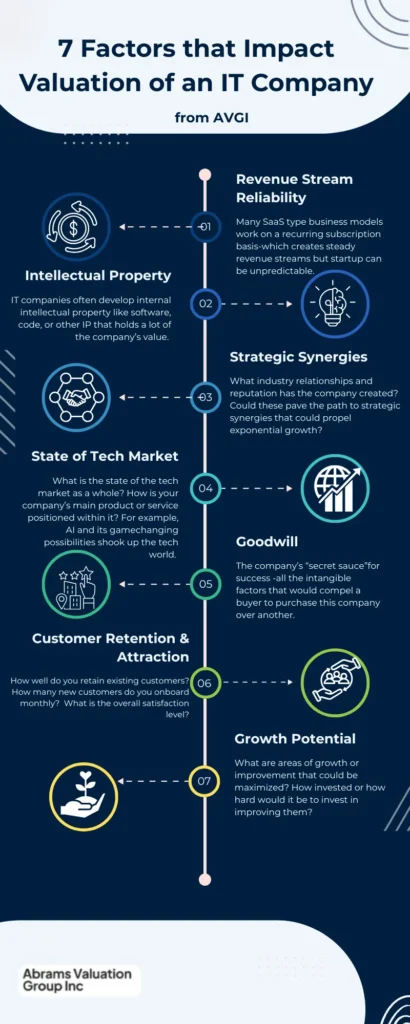
Company-specific characteristics like revenue growth, customer acquisition costs, and retention rates significantly impact valuation, with high-growth companies boasting low acquisition costs and strong customer retention generally creating more value. Market dynamics, competition, and the overall state of the tech industry further influence valuation, as companies operating in growing markets with limited competition and those well-positioned to capitalize on emerging trends tend to command higher value.
Leveraging growth through innovative marketing strategies and expansion into new markets enhances valuation by attracting investment and fueling further growth. Finally, demonstrating synergies and strategic value—such as complementary products, problem-solving capabilities, and strategic partnerships—can increase a tech company’s attractiveness to potential acquirers, leading to more favorable exit opportunities.
Company Characteristics
Company characteristics that affect valuation include revenue growth, customer acquisition costs, and retention rates, all of which are critical for tech companies. Those with high revenue growth rates and low customer acquisition costs tend to be more valuable than their counterparts with slower growth and higher acquisition expenses. Additionally, customer retention plays a vital role, as it influences a company’s ability to generate recurring revenue and maintain a stable customer base. Companies exhibiting strong customer retention and low churn rates generally command higher valuations compared to those facing significant customer turnover.
Valuation Factors
Valuation factors for tech companies encompass market dynamics, competition, and the overall state of the tech industry, all of which significantly influence their growth potential and valuation. Companies operating in expanding markets with limited competition tend to be more valuable than those in declining markets facing intense rivalry. Additionally, the broader health of the tech industry affects the availability of funding and the demand for technology products and services, further impacting the it company valuation. Tech companies that are well-positioned to capitalize on emerging trends and technologies generally command higher value, reflecting their potential to thrive in a rapidly evolving landscape.
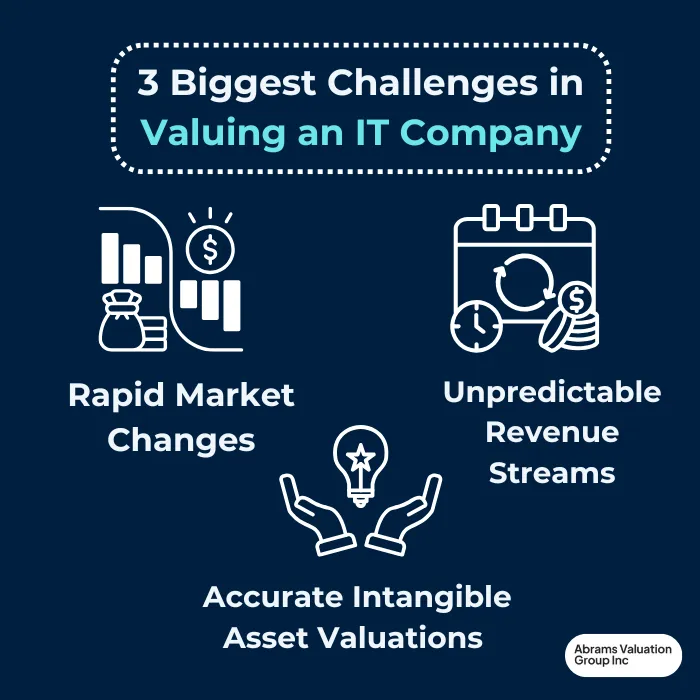
Top 3 Challenges in Valuing IT Companies Compared to Other Businesses
Valuing IT companies presents unique challenges that distinguish them from traditional businesses. These difficulties stem from the fast-paced nature of the tech industry, the intangible assets involved, and the variability in business models. Here are the top three main challenges:
1. Intangible Assets and Intellectual Property Valuation
Unlike many traditional businesses, IT companies often derive significant value from intangible assets such as software, patents, proprietary algorithms, and intellectual property. Accurately quantifying the worth of these assets can be complex, as they do not straightforwardly appear on balance sheets. Moreover, the value of these intangibles can fluctuate rapidly due to technological advancements, competitive pressures, or changes in market demand, making their valuation both an art and a science.
Luckily, AVGI specializes in accurately quantifying intangible asset value and has helped many software companies place a serious price tag on their IP or services. Getting this part of the puzzle right is an area where many less-experienced appraisers fall short- which could be costing your company in value. Speak to AVGI experts today to ensure your IP is accurately valued and accounted for.
2. Unpredictable Revenue Streams and Business Models
Many IT companies, especially early stage tech companies and SaaS companies, operate with business models that involve recurring revenue streams like monthly recurring revenue (MRR) but may also experience initial negative earnings or reinvest heavily in growth. This can result in volatile or minimal positive cash flow, complicating the use of traditional valuation methods that rely on stable earnings or cash flows. Additionally, rapidly evolving business models and pricing strategies require valuation approaches that can accommodate such variability.
3. Rapid Market and Technology Changes
Technology businesses face constant shifts in market share, emerging competitors, and evolving customer expectations. This dynamic environment makes projecting future growth and discounting future cash flows particularly challenging. Discounted cash flow valuation and other forward-looking methods require assumptions about future growth rates and market conditions that are inherently uncertain. As a result, valuing IT companies often involves greater risk assessment and sensitivity analysis compared to more stable traditional businesses.
Addressing these challenges requires a tailored valuation process that incorporates both quantitative financial metrics and qualitative assessments of technology, market position, and strategic value. Engaging experts familiar with technology companies and current valuation trends can help ensure a more accurate and fair valuation.
Leveraging Growth
Leveraging growth is critical for tech companies because it enables them to increase their valuation and attract more investment, which can then be used to fuel further expansion. Companies that demonstrate high growth potential and a clear path to profitability are generally more valuable than those without such prospects. Additionally, tech companies that successfully leverage their growth to enter new markets and expand their customer base tend to command higher valuations. Innovative marketing strategies, including growth hacking, play a vital role in helping these companies maximize their growth and enhance their overall value.
Synergies and Strategic Value
Synergies and strategic value play a critical role in enhancing the valuation and attractiveness of tech companies to potential acquirers, often leading to more favorable exit opportunities. Tech companies that can demonstrate synergies with other businesses—such as offering complementary products or services—tend to be valued higher than those that cannot. Additionally, companies that create strategic value by addressing critical problems or fulfilling significant market needs are generally more desirable. Leveraging partnerships and collaborations further amplifies these synergies and strategic value, helping tech companies strengthen their market position and appeal to acquirers.


