

Can I Use AI for Business Valuation? Pros & Cons
As artificial intelligence (AI) tools like ChatGPT, Claude, and Gemini become more accessible by the day, more business owners are experimenting with AI to estimate their companies’ value. But how accurate are these AI-driven valuations, and what should owners consider before relying on them? AVGI’s experts present the pros and cons of using AI for business valuation, and how to best leverage AI as a valuation tool.
AI for Business Valuation: Why Business Owners Use It
AI’s role in the business valuation process is to enhance accuracy, efficiency, and objectivity by leveraging advanced algorithms and machine learning, making valuations more reliable and accessible for business owners.
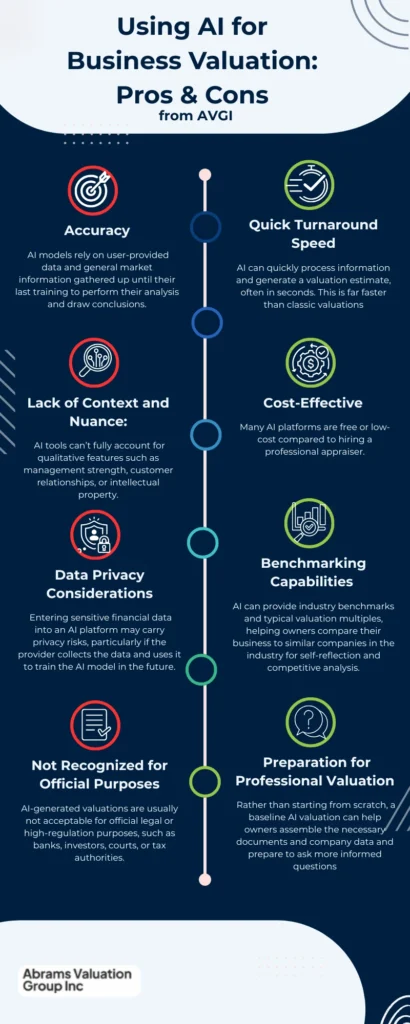
1. Turnaround Speed AI can quickly process information and generate a valuation estimate, often in seconds. This is far faster than classic valuations, which can take days, weeks, or even months. AI agents are excellent at identifying patterns and trends at scale, which can be very useful for quickly assessing historical data in bulk and generating future cash flow projections with lightning-fast turnaround. Unlike traditional methods, AI automates much of the analysis and significantly reduces human error, resulting in more accurate and objective outcomes.
2. Cost-Effective Many AI platforms are free or low-cost compared to hiring a professional appraiser. The cost of a professional business valuation can easily run into the tens of thousands of dollars, depending on the size and scope of the project; by comparison, a paid subscription for most AI agents is under $100. For business owners exploring their options, AI offers an affordable first look at potential value. Valuation software powered by AI provides professional-grade tools for estimating a company’s worth efficiently and at a fraction of the cost.
3. Easy to Understand AI can explain the valuation process by breaking down common methods like revenue multiples, discounted cash flow (DCF), and market comps in simple terms. Since owners can prompt the AI with different scenarios, they can also experiment with different assumptions to see how changes affect the estimated value. AI can walk owners through the business valuation process, allowing them to apply specific criteria and see how different assumptions and inputs impact the outcome, making the process more transparent and customizable.
4. Benchmarking Capabilities AI can provide industry benchmarks and typical valuation multiples, helping owners compare their business to similar companies in the industry for self-reflection and competitive analysis. AI can also highlight the inputs with the greatest impact on business value, directing the owner to focus on the most important value drivers. By leveraging market data, AI compares a business to the most relevant companies and those in the industry, ensuring more accurate benchmarking. Large language models and generative AI can analyze unstructured data in bulk and provide deeper insights for benchmarking, offering a more comprehensive view than traditional methods.
5. Preparation for Professional Valuation A preliminary AI-generated estimate can help owners better prepare for a professional appraisal. Rather than starting from scratch, a baseline AI valuation can help owners assemble the necessary documents and company data and prepare to ask more informed questions of a human expert. Combining AI-driven analysis with human insight ensures a comprehensive understanding, blending the strengths of technology and expert judgment.
AI-powered valuation software, including generative AI and large language models, is transforming the business valuation process by automating analysis, reducing human error, and enabling more accurate, customized, and scalable assessments of a company’s worth.
Business Valuations and Market Conditions
Business valuation is never performed in a vacuum—market conditions play a pivotal role in determining a company’s worth. Economic shifts, industry trends, and even global events can rapidly alter the landscape for both private and public companies. AI-powered valuation models are transforming business valuation by enabling companies to analyze vast amounts of financial data in real time. By leveraging artificial intelligence, businesses can assess how market trends and changing conditions impact their valuation, drawing on up-to-date information from comparable companies and industry data.
AI-driven business valuation tools excel at processing large datasets, including private company data and public market information, to deliver valuable insights into cash flow, risk assessments, and overall business value. This empowers business owners to make more informed decisions, whether they’re considering a sale, seeking investment, or planning for growth. By analyzing market trends and financial data, AI-powered valuation models help companies navigate uncertainty and adapt their strategies to current market conditions. Ultimately, leveraging AI in the valuation process gives businesses a competitive edge, allowing them to respond quickly to market changes and make smarter, data-driven decisions.
The Future of Business Valuation
The future of business valuation is being shaped by rapid advancements in artificial intelligence and data science. As AI continues to evolve, it is set to play an even more significant role in transforming business valuation, offering greater accuracy, efficiency, and data-driven insights than ever before. Advanced algorithms, machine learning, and natural language processing are enabling AI models to process massive datasets, identify patterns, and generate predictive analytics that forecast future cash flows with remarkable precision.
In this new era, AI-driven business valuation tools will handle the heavy lifting of data collection and financial analysis, freeing human analysts to focus on strategic thinking and high-level decision-making. While AI can process vast amounts of data and deliver actionable valuation insights, human expertise remains essential for interpreting results and understanding the nuances of market conditions and company-specific factors. The collaboration between AI tools and human analysts will define the next generation of business valuation, ensuring that businesses approach valuation with both advanced technology and professional judgment. As AI continues to advance, companies that embrace data-driven, AI-powered valuation models will gain a significant competitive advantage in making informed financial decisions and maximizing business value.
Cons: The Risks of AI in Business Valuation
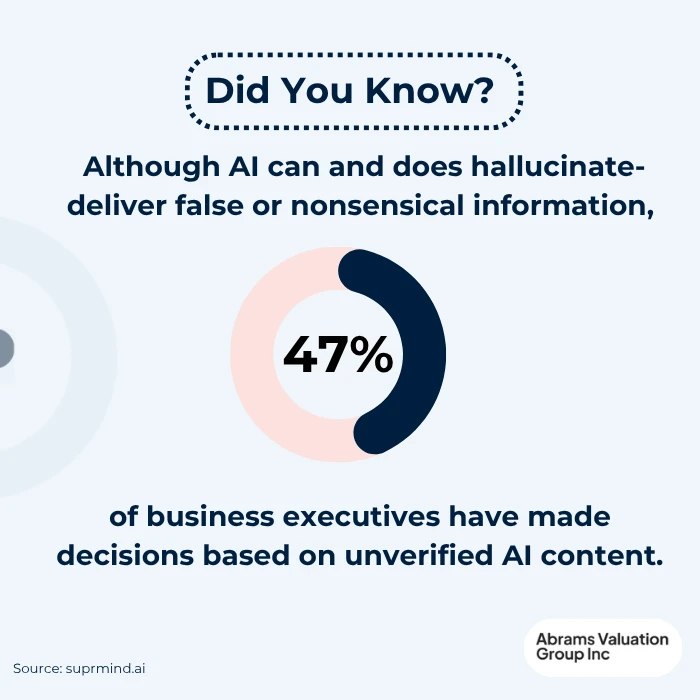
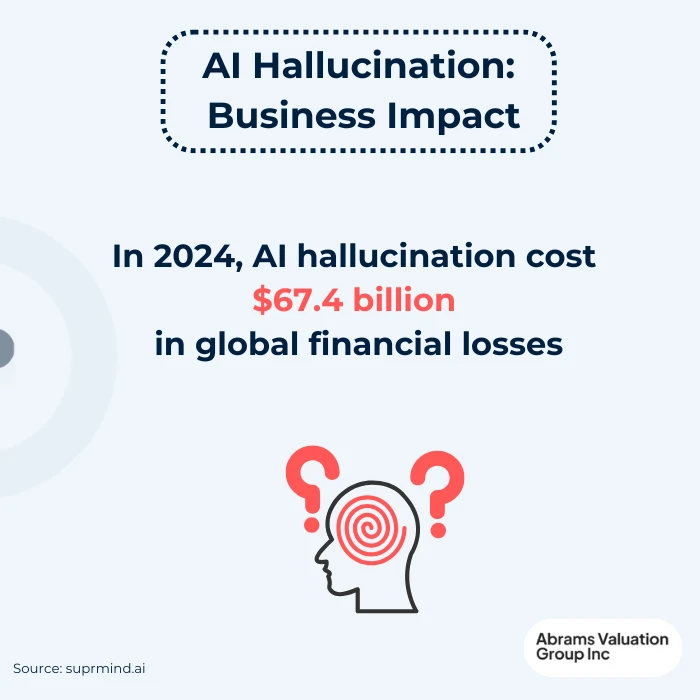
There are several potential problems and concerns when asking an AI agent like ChatGPT, Claude, Gemini, or similar models to perform a business valuation. While AI can help reduce human error compared to traditional methods, it is not infallible. Here are the most pressing concerns for business owners to keep in mind:
1. Accuracy: AI models rely on user-provided data and general market information gathered up until their last training to perform their analysis and draw conclusions. These models do not have access to up-to-date or private financial information about your business, competitors, or market conditions unless you supply it. Providing the AI agent with incomplete or inaccurate data about your business or competitors can considerably skew outcomes, leading to AI valuations that are inaccurate, misleading, or both.
2. Lack of Context and Nuance: AI tools can’t fully account for qualitative features such as management strength, customer relationships, or intellectual property. Intangible assets are notoriously difficult to value, even amongst human professionals, and AI agents are simply not up to the task. These nuances can significantly affect a company’s true value, particularly when a large share of its value is tied to intangible assets. Human insight is essential for interpreting these qualitative factors and providing the context that AI cannot fully capture.
3. Data Privacy Considerations: Entering sensitive financial data into an AI platform may carry privacy risks, particularly if the provider collects the data and uses it to train the AI model in the future. Each AI agent and platform has its own privacy and data agreements, which owners should review carefully before deciding whether to submit confidential company data.
4. No Professional Judgment or Accountability. Unlike certified valuators who are qualified to perform business valuations, AI tools are not subject to professional standards, regulatory supervision, or liability. They lack the formal training and industry best practices that other professionals offer right from the start. Furthermore, if a business owner is not satisfied with the valuation results, there is simply no recourse if the valuation is incomplete or incorrect. Traditional methods rely on human expertise and professional judgment, which provide accountability and regulatory compliance that AI tools currently cannot match.
5. Not Recognized for Official Purposes: AI-generated valuations are usually not acceptable for official legal or high-regulation purposes, such as banks, investors, courts, or tax authorities. AI business valuation reports are not as detailed or well-documented as professional valuation reports, which are highly defensible. Using AI for business valuation can be a great time- and money-saver for a low-stakes internal review, but if an owner needs a valuation for banking, tax, or legal purposes, an expert human appraisal is highly recommended.
In Conclusion: Use AI as a Starting Point, Not a Substitute for Human Expertise
AI agents offer business owners a convenient, fast, and affordable way to get a rough sense of business value and learn about the valuation process. They can be a helpful tool for initial information gathering and strategizing. However, AI cannot match the nuance, precision, expertise, documentation, or compliance provided by a professional business valuation expert. In any situation requiring accuracy, accountability, or regulatory acceptance, a human professional is indispensable.
If you want to know your company’s true value, contact AVGI for a comprehensive, human expert business valuation you can trust.


