

Valuation Dates: Why Timing Matters in Gifting, Estate, and Income Tax Reporting
Valuation dates are the specific points in time used to determine an asset’s value for appraisal purposes, and they are a cornerstone of reliable reporting in the nuanced arenas of gift, estate, property, and income tax matters. Selecting the correct valuation date is critical because it determines value as of a specific point in time, which in turn affects the amount assigned to assets for tax reporting, the resulting tax liability, and overall compliance.
Misalignment between the appraisal date and the event triggering taxation can result in flawed reporting, tax disputes, penalties, or even litigation. For appraisers, advisors, executors, legal professionals, and tax practitioners, the concept goes beyond choosing a date on a calendar: it requires attention to the governing valuation standard, market conditions on that date, the treatment of subsequent events, documentation practices, and planning timelines. A clear understanding of the concept supports defensibility and accuracy in appraisals, especially when values are examined in an audit or disputed in court.
Date Matters: Core Concepts Around the Valuation Date
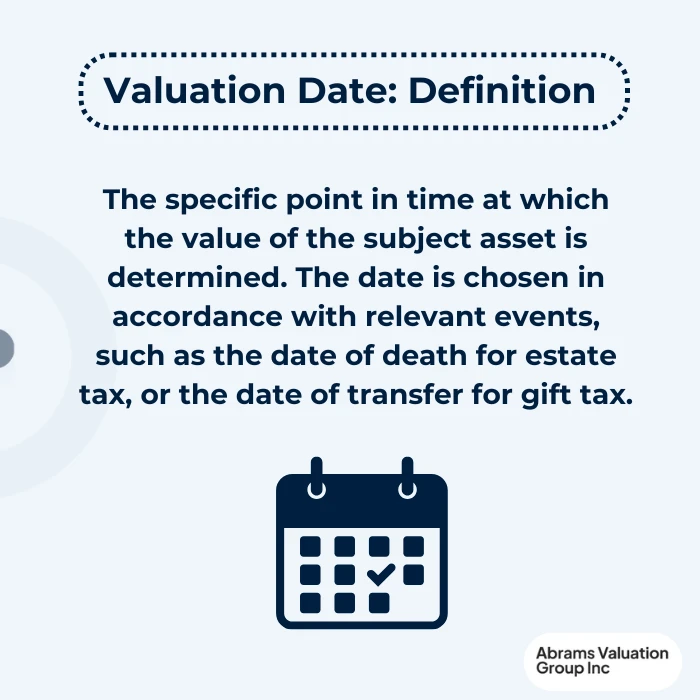
The appraisal date is the specific point in time at which the value of the subject asset is determined. It is not an arbitrary choice, but one dictated by the facts of the engagement—such as the date of death for estate tax, the date of transfer for gifts, or a statutory date for property tax—and the date established by statute or other applicable law. The applicable standard of market value (often fair market value) is always linked to this specific date. Importantly, appraisals generally must reflect a single-point-in-time conclusion, capturing market conditions, economic factors, and any information that was known or knowable as of that date.
Valuation Date in Tax Contexts
Estate Tax: Date Of Death and Alternate Valuation Date
For federal estate tax, the default appraisal date is the decedent’s date of death. However, executors may elect to use an alternate valuation date—a later date, six months after death—only in certain circumstances for estate tax purposes if this election reduces both the value of the gross estate and the resulting tax. The election applies across the estate and cannot selectively apply to securities, real estate, or other property. If the decedent’s estate includes securities or other assets that declined sharply or declined substantially after the date of death, that later date may reduce estate tax. When such an election is possible, appraisers should be prepared to provide valuation conclusions for both dates, supporting the executor’s choice and ensuring IRS compliance. Assets sold during that six-month period are valued on the sale date when sold.
Gift Tax: Appraisal Date Alignment With Transfers
The valuation date for gift tax is the actual date the transfer of property occurs. Appraisals should be performed as close as possible to the gift date to avoid staleness. Advance valuations risk becoming outdated if market conditions fluctuate or if the transfer is delayed. In such cases, rolling forward the valuation to the actual date of transfer is recommended to maintain accuracy and defensibility. In a divorce, the valuation date is usually the commencement date of the divorce action, and that timing can materially affect asset division. Depending on state law or party agreement, some states let the court choose a fair valuation date, including the trial date or the date of the divorce decree.
Property Tax: Fixed Appraisal Date Practices
Many jurisdictions mandate a fixed statutory valuation date for property tax purposes—often January 1st of the assessment year. Appraisers must collect comparable sales and other market data specifically tied to this date to produce compliant reports.
Market Conditions and Market Value at the Valuation Date
Appraisers must capture prevailing market conditions as they existed on the valuation date, including interest rates, macroeconomic trends, and local market nuances. That assessment also requires professional judgment to decide whether market shifts around the date were meaningful changes or only temporary conditions. Discount rates should reflect any macro shifts relevant at that moment. The most persuasive support comes from contemporaneous comparable transactions and timely market evidence, all carefully documented to reinforce the appraisal’s credibility.
When Valuations Become Stale: Subsequent Events
After the valuation date, material subsequent events—such as market crashes, regulatory changes, or business developments—may occur. Appraisers must distinguish whether such events were known or knowable as of the valuation date. If subsequent events materially affect valuation assumptions and were knowable, an updated valuation may be warranted. Otherwise, these events should be disclosed but excluded from the core opinion.
Known or Knowable Principle and Hindsight Risk
Reliable appraisals hinge on the principle of what was known or knowable at the valuation date. Appraisers should gather and reference contemporaneous evidence to support forecasts and assumptions, and while facts still govern, many advisors use roughly a 60-day window as a practical benchmark before an appraisal may be viewed as stale. Unforeseeable developments that arise post-date should not alter the core valuation. When including foreseeable subsequent events, the rationale must be thoroughly documented.
Shareholder Oppression: Valuation Date Disputes
In shareholder disputes, the presumptive date is typically immediately before the alleged wrongful act. However, parties may propose alternate dates based on unique circumstances. Courts may depart from that point if the corporation’s wrongful act occurred when the stock price was historically high or reflected a low stock price, if there was not sufficient market information, or if a contingency or potential liability distorted value; a temporarily increased price may be treated differently from a depressed price depending on the facts, including unresolved potential liability. Appraisers must assess the merits of these arguments and document any market-data limitations that support using an alternate date.
Date Matters in Litigation and Arbitration
Tribunals or courts generally follow the applicable law when prescribing specific rules regarding valuation dates. Where legal uncertainty exists, and in some disputes the court may need evidence for both the date of the challenged event and a later judgment-related date, appraisers should prepare dual-date valuations to assist the court and preserve defensibility. Maintaining contemporaneous workpapers is essential for defending the appraisal under scrutiny.
Integrating Valuation Date Discipline Into Practice
Appraisers should specify the valuation date clearly in engagement letters and require clients to confirm all relevant transaction dates. All market research should be tied to the valuation date, and any material events during the engagement period must be flagged. The valuation should be updated if the client provides new, date-relevant information.
Documentation, Disclosure, and Defensibility
Maintaining a timeline of all information received and reviewed, disclosing the use of subsequent events, and attaching supporting contemporaneous exhibits to the appraisal report are best practices. These steps enhance transparency and defensibility in the event of a challenge.
Timelines, Filings, and Practical Deadlines
Tax filing deadlines are typically tied to valuation dates. Fieldwork should be scheduled to align with statutory dates, and extensions should be planned when valuation updates are likely to be needed. Proper planning ensures timely, compliant filings.
Appraisal Date Actions: A Practical Checklist
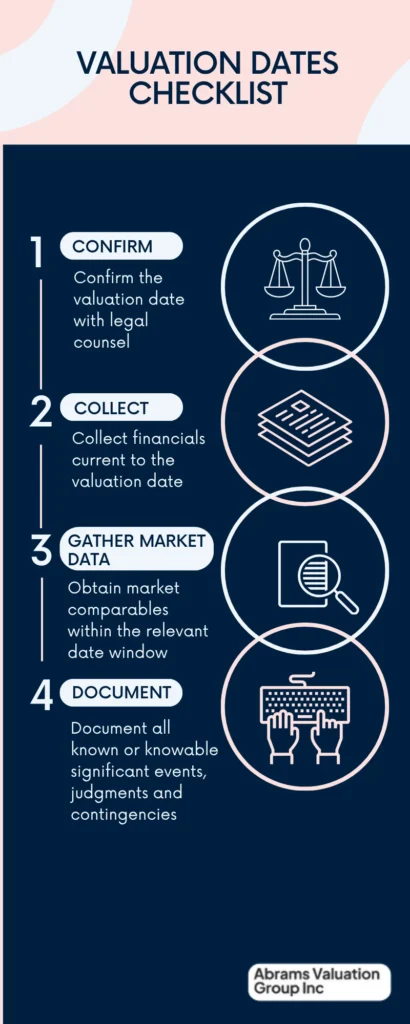
Confirm the valuation date with legal counsel
Collect financials current to the valuation date
Obtain market comparables within the relevant date window
Document all known or knowable significant events, judgments and contingencies
Closing Recommendations
Regular revaluation is advisable in volatile markets to maintain appraisal reliability as significant events change the valuation reality. Handling subsequent events effectively by issuing a new valuation report or amending the original considering the new event ensures that the report remains consistent, defensible, and compliant for tax purposes.


