

Valuing Cryptocurrency: How Crypto Asset Valuation Works
Valuing cryptocurrencies and digital assets poses novel challenges for investors, analysts, and regulators. Unlike traditional securities, crypto assets often lack conventional cash flows, established regulatory frameworks, and clear economic rights. This article presents core valuation frameworks, compares their applicability across asset categories, and highlights practical recommendations for investment and compliance decisions. The primary audience includes investment professionals, compliance officers, and advanced individual investors seeking robust and transparent crypto asset valuation methods. The key recommendation is to triangulate crypto asset value using multiple complementary models, document core assumptions, and regularly update analyses in response to market and regulatory developments.
Digital Assets and Crypto Assets
Digital assets, for the purposes of this discussion, refer broadly to assets represented in digital form and transferable via distributed ledger technologies (DLT). Crypto assets are a subset of digital assets that use cryptography and blockchain networks to prove ownership and enable transfer. Within crypto assets, tokens can represent a wide range of economic and governance rights, from native cryptocurrencies (e.g., Bitcoin) to application-specific utility tokens and blockchain-based securities. The scope of this valuation framework spans major categories of fungible tokens, with particular focus on those with material trading volume and observable on-chain activity. Limitations arise in valuing illiquid, non-fungible, or wholly experimental tokens, which may require bespoke approaches or qualitative overlays.
Types of Crypto Asset and Their Valuation Needs
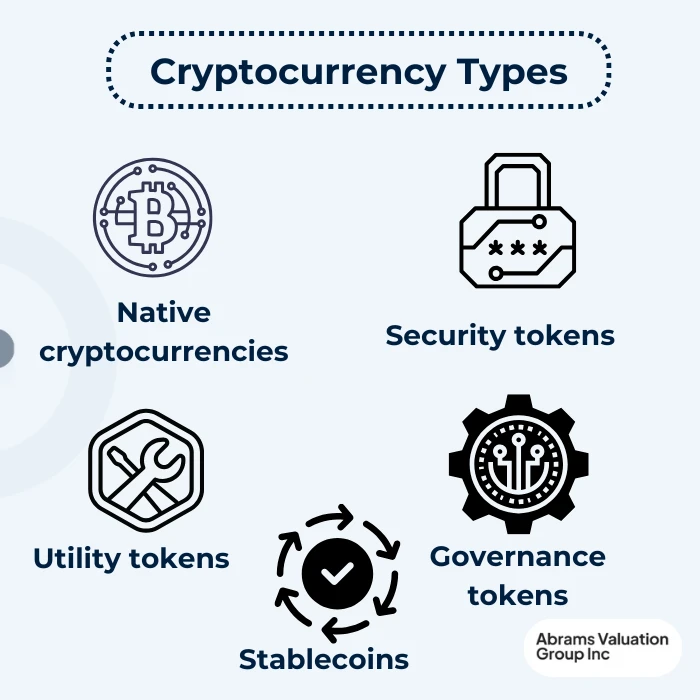
Crypto assets can be grouped into several broad categories:
Native cryptocurrencies (e.g., BTC, ETH): Serve as the unit of account and medium of exchange for their respective blockchains.
Security tokens: Represent legal claims on cash flows, equity, or debt, often regulated as securities.
Utility tokens: Provide access to a platform or service, but generally do not entitle holders to direct cash flows.
Governance tokens: Grant voting rights over protocol changes or upgrades, sometimes paired with fee-sharing rights.
Stablecoins: Pegged to fiat currencies or baskets of assets, with unique value stability mechanisms.
Each category confers different rights and thus demands tailored valuation methods. For example, security tokens align more closely with equity or debt valuation frameworks, while utility tokens often require relative or usage-based models. Certain tokens (e.g., those entitling holders to protocol revenues) may require bespoke hybrid approaches.
Categorize Crypto Assets by Economic Rights
Security tokens: Classified by their distribution rights—dividends, interest, redemption, or residual claims.
Utility tokens: Classified by their platform usage—access rights, fee discounts, or priority services.
Native cryptocurrencies: Classified by their monetary role—medium of exchange, store of value, or network gas.
This classification helps map each token to the most relevant valuation logic and highlights the need to recognize when standard financial models may not apply.
Valuation Approaches: Intrinsic vs. Relative
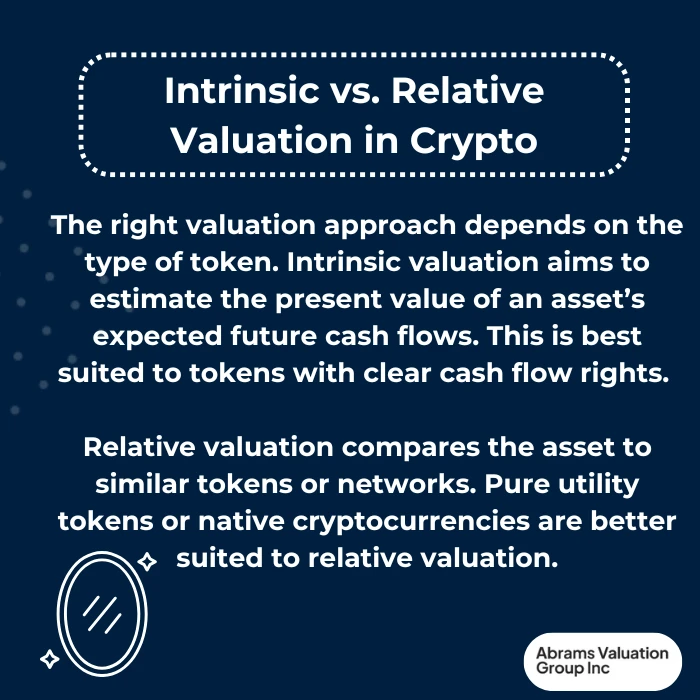
Intrinsic valuation aims to estimate the present value of an asset’s expected future cash flows. In crypto, this method is best suited to tokens with clear, contractual, or algorithmic cash flow rights (e.g., protocol fee shares). Relative valuation compares a given asset to similar tokens or networks based on observable metrics, such as usage, activity, or adoption. For non-cash-flow assets—such as pure utility tokens or native cryptocurrencies—relative valuation and network metrics are often more applicable.
When to use each approach:
Use intrinsic valuation where transparent, predictable cash flows exist.
Use relative and network-based models where value is derived from usage, adoption, or speculative demand.
Always make model assumptions explicit and require full transparency for key parameters (e.g., discount rates, comparables chosen).
Discounted Cash Flow (DCF) for Crypto Assets
Adapting DCF to crypto assets involves projecting token-denominated cash flows (e.g., protocol revenues, staking rewards) and discounting them at rates that reflect crypto market volatility and risk. Key steps include:
Projecting token cash flows based on network usage, fee structures, and protocol parameters.
Converting token cash flows to fiat currency under plausible scenarios (e.g., price paths, inflation).
Stress-testing discount rates to reflect extraordinary volatility and regulatory uncertainty.
Network Value and Market Capitalization Methods
Network value is computed using on-chain activity such as transaction volume, number of active addresses, or fees generated.
Market capitalization is calculated by multiplying token price by circulating supply.
Comparing network value to market capitalization provides insight into whether an asset is under- or over-valued relative to its usage.
Relative Models and Market Sentiment
Select comparable networks/tokens for relative valuation (e.g., price-to-transaction, price-to-fee multiples).
Measure market sentiment using on-chain indicators (e.g., token velocity, address growth).
Adjust multiples for regulatory clarity, liquidity, and idiosyncratic risks.
Applied Examples: Bitcoin’s Price and Smart-Contract Platforms
Bitcoin: Serves as a case study in store-of-value valuation. Models such as stock-to-flow (scarcity-based) and MVRV (Market Value to Realized Value) contextualize price cycles and adoption.
Ethereum: As a smart-contract platform, Ethereum can be valued with a combination of DCF (projecting fee-based revenues) and network value multiples. Modeling must account for token issuance, staking, and protocol upgrades.
Data sources for these analyses must be clearly cited, leveraging both on-chain analytics and reputable market data providers.
Bitcoin’s Price: Relative Models and Network Effects
Apply stock-to-flow or scarcity models to assess the impact of finite supply.
Compute MVRV ratios to understand price relative to “realized value” (aggregate cost basis).
Evaluate network effects by projecting adoption curves and their impact on long-term demand.
Ethereum: Discounted Cash Flow and Network Value
Estimate protocol fee revenues and project forward based on transaction growth and protocol upgrades.
Model network value-to-fees as a multiple, analyzing how much value is capitalized per unit of protocol revenue.
Simulate the effects of token issuance changes (e.g., the transition to proof-of-stake) and the impact of staking on supply dynamics.
Quantitative Tools and Metrics
NVT (Network Value to Transactions): ( NVT = \frac{Market\ Cap}{Daily\ Transaction\ Volume} ). Indicates whether a network is over- or under-valued relative to usage.
MVRV: ( MVRV = \frac{Market\ Value}{Realized\ Value} ). Used for cycle analysis.
TVL (Total Value Locked): Assesses the value of assets staked or locked in smart contracts.
Fee-revenue reconciliation: Compare reported protocol revenues to on-chain transactions and activity logs.
Recommended tools: Glassnode, Messari, Token Terminal, Dune Analytics for data extraction and metric calculation.
Challenges and Risks in Valuing Digital Assets
Reflexivity: Token price itself can influence network activity and future cash flows, complicating causal inference.
Data limitations: Many assets have short histories and limited reliable data.
Protocol risk: Smart-contract vulnerabilities or protocol upgrades can materially affect value unexpectedly.
Lessons from the Dot Com Bubble for Digital Assets
History warns against relying on hype-driven heuristics or simple user-count multiples. Economic fundamentals—actual cash flows, sustainable network usage, and competitive positioning—should anchor any valuation model.
Avoiding a Single Model for Investment Decisions
Always use multiple, complementary valuation frameworks.
Conduct sensitivity analysis on key assumptions (e.g., growth rates, discount rates).
Document the rationale for how different models are weighted in reaching an investment conclusion.
Implementation Checklist for Valuation Reports
Cite data sources and provenance for every metric used.
Include scenario tables for alternative market and regulatory outcomes.
Summarize key findings and risks in a clear executive summary.
Conclusion and Recommendations for Analysts
Valuing cryptocurrency and other digital assets can be complex with the many moving factors involved. The best-practice approach to crypto asset valuation is a hybrid one: combine intrinsic, relative, and network-based models, update assumptions regularly in light of market sentiment and regulatory changes, and remain vigilant to the unique risks and reflexivity inherent in digital asset markets. Regularly revisiting and documenting model choices ensures both transparency and adaptability in this rapidly evolving asset class. Contact AVGI for expert intangible asset valuation.


