

Company Valuation Methods: Spotlighting Market Approach for Accuracy
A comprehensive company valuation determines the economic value of a business, considering many factors like tangible and intangible assets, revenue, and market position. This is a crucial assessment to make before any major business decisions, such as buying or selling a business, investing in a startup company, or creating an exit plan. But how do appraisers come up with these numbers and how accurate are they? Abrams Valuation Group, Inc. breaks down the most common company valuation methods, focusing on the market approach to explain how it works, expose some limitations, and define the key factors that count in making a company valuation accurate.
Introduction to Business Valuation
Business valuation is the process of determining the economic value of a business, providing essential insights for owners, investors, and stakeholders. This valuation process involves a thorough analysis of the company’s financial statements, market position, and growth prospects to arrive at an accurate estimate of the value of a business. There are several business valuation methods, each tailored to different business types and valuation purposes. The most common approaches include the income approach, which estimates value based on future cash flows; the market approach, which compares the business to similar companies; and the asset-based approach, which values a business based on its tangible and intangible assets.
Selecting the right valuation method depends on the business’s profile, the availability of data, and the specific goals of the valuation. A comprehensive understanding of these valuation methods is crucial for making informed decisions, whether you are buying, selling, or investing in a business.

Three Valuation Approaches
There are three main valuation approaches, each of which approach the task of defining the value of a company from a different angle. These three approaches are:
income-based approach
asset-based approach
market-based approach
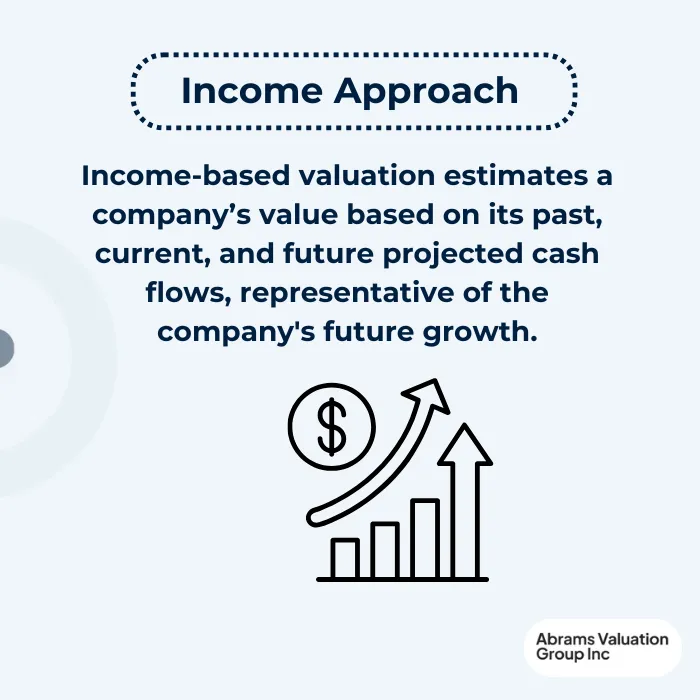
Income-based valuation estimates a company’s value based on its past, current, and future projected cash flows, representative of the company’s future growth. Market-based valuation compares a company to similar publicly traded companies or recent transactions in the same industry. Asset-based valuations value the company as a sum of the value of its assets.
These three approaches each branch out further into several more specific company valuation methods. Each method has its strengths and limitations, and the choice of method depends heavily on the company’s profile and valuation purpose. Sometimes two out of three approaches will be applicable, while in other cases it would be more accurate to calculate all three methods and weight the results appropriately. Generally, AVGI’s appraisers utilize all applicable company valuation methods and weight the results for empirical accuracy.
Income-Based Valuation
The primary method under income-based valuation approach is the discounted cash flow analysis, which estimates a company’s value based on its future earnings and cash flows. The discounted cash flow method discounts these projections to calculate the present value of future cash flows. The discount rate in this method reflects the time value of money and risk.
This approach is widely used in business valuation, as it provides a comprehensive picture of a company’s ability to generate income and cash flows. Income-based valuation methods are most accurate for companies with stable and predictable cash flows. However, this strength is also its limitation, as it is not an accurate predictor of value for early-stage startup companies and companies with limited financial data.
Asset-Based Valuation
Asset-based valuation determines a company’s value based on its tangible and intangible assets, minus its liabilities. Asset-based valuation often uses book value, which is calculated by subtracting total liabilities from total assets. Net assets are determined by taking the total value of a company’s assets and subtracting its liabilities, and this figure plays a central role in asset-based valuation methods.
Asset-based valuation is useful for companies with significant tangible assets, such as manufacturing or real estate companies, where recognizing the company’s assets is crucial for accurate valuation. This approach can also be used to value companies with significant intangible assets, such as intellectual property or brand recognition. Lastly, an asset-based approach is an important part of preparing a business for a sale of assets, where only the assets or some of the assets will be purchased. Asset-based valuation can also be used to estimate liquidation value, which is the net cash a business could realize if its assets were sold off and liabilities settled.

Intangible Assets and Valuation
Intangible assets, such as intellectual property, patents, trademarks, and brand reputation, are increasingly important in determining the value of a business. Unlike tangible assets, intangible assets do not have a physical presence and may not be fully reflected on the balance sheet, yet they can significantly influence a company’s future earnings and growth prospects. Valuing intangible assets requires specialized valuation techniques, such as the relief-from-royalty method or the multi-period excess earnings method, which estimate the value of these assets based on their expected future cash flows and the cost to replace them.
Accurately assessing intangible assets is especially critical in industries like technology and pharmaceuticals, where intellectual property and innovation drive much of the business’s value. Understanding the impact of intangible assets is essential for a comprehensive business valuation and for capturing the true value of a business in today’s economy.

Market-Based Valuation Approach
The market-based valuation approach is a valuation technique that estimates a business’s worth by comparing it to similar businesses and analyzing market data. It uses comparable company analysis of Guideline Companies (GCs) to estimate a target company’s value based on the market values of similar companies. This approach branches out into several market-approach company valuation methods, including comparable company analysis and precedent transactions analysis, which evaluates past acquisition deals within the same industry to determine valuation multiples.

Guideline Public Company Method (GPCM)
In this method, the appraiser uses transaction data for small minority interests of public companies traded on the public stock market as the guideline for valuation. Market capitalization, which represents the total value of a company’s outstanding shares, is a key metric used to assess and compare the valuation of these public companies.
Guideline Merger & Acquisition Method (GMAM)
The appraiser uses transaction data of control interests of both private and public companies in this method to give a well-rounded picture of guideline companies in both the public and private sectors.
Direct Market Data Method (DMDM)
In the DMDM method, the appraiser uses transaction data of control interests of private companies. This approach can be used to estimate the sale value of a business by analyzing transaction data from similar private company sales.
Prior Sales of Company Stock Method (PSCS)
This method is only applicable if the company being valued has previously sold shares in the past, as it involves using transactional data of the subject company itself as the guideline company. Specifically, this approach uses the company’s stock price from prior transactions as a benchmark for valuation.
The control interest data for these various market methods is available from different market transaction databases such as DealStats.
Market Value Ratios
Market value ratios are essential tools for estimating the value of a business by comparing its market value to key financial metrics. One of the most widely used ratios is the price-to-earnings (P/E) ratio, which compares a company’s stock price to its earnings per share, offering insight into how much investors are willing to pay for each dollar of earnings. Other important market value ratios include the price-to-sales (P/S) ratio and the enterprise value-to-EBITDA (EV/EBITDA) ratio. Learn more about valuation multiples in our guide.
These ratios help investors and analysts assess a company’s valuation relative to its industry peers and the broader market. By examining these ratios, stakeholders can quickly gauge whether a business is undervalued or overvalued based on its cash flows, enterprise value, and overall financial performance. Market value ratios provide a valuable snapshot of a company’s position in the market and are a key component of the valuation process.
Comparable Company Analysis
Comparable company analysis (CCA) is a widely used valuation method that estimates the value of a business by benchmarking it against similar companies. This approach involves identifying a set of comparable companies—those with similar business models, size, growth prospects, and risk profiles—and calculating their valuation multiples, such as P/E, EV/EBITDA, or P/S ratios. These multiples are then applied to the target company’s financial metrics to derive a relative valuation.
The effectiveness of CCA depends on the careful selection of truly comparable companies, as differences in industry, scale, or market conditions can impact the accuracy of the analysis. CCA is especially popular in investment banking, private equity, and venture capital, as it provides a quick and market-based perspective on the value of a business. By leveraging comparable company analysis, stakeholders can gain a clearer understanding of a business’s value in relation to its peers and make more informed strategic decisions.

Two Ways to Analyze the Market Approach Data
There are two main ways that the appraiser can analyze the Guideline Companies data in order to value the subject company. Either by
Average Valuation Multiples, or
Regression Analysis
Both methods help estimate the total market value of the subject company by using market data from comparable companies.
Average Valuation Multiples Analysis: Limitations
Most appraisers use the average valuation multiples method, in which they observe the central tendencies of the guideline companies valuation multiples like P/E, P/S, and P/EBITDA and then apply them to the subject company.
While this market-based analysis can be useful in understanding the company’s value relative to other similar companies, the most significant limitation is the lack of readily available data to make these comparisons. When using GPCM, the data is more readily available, as we are examining publicly traded companies, but that information is much harder to access when researching private companies.
It is important to note that public companies tend to have higher valuations compared to private companies, primarily due to greater marketability and liquidity. This difference must be considered when valuing private businesses, as directly applying multiples from public companies without adjustment can lead to overvaluation.
The comparisons between those GCs and the subject company may be strained, as there isn’t always sufficient information available to ensure the GCs are in the same or similar industries, let alone share other characteristics. Therefore, this analysis may not be founded on solid comparisons and might not provide a good base from which to draw conclusions for accurate valuation.
Furthermore, solely analyzing valuation multiples of GCs without examining the whole picture can lead the appraiser to draw faulty comparisons between two companies that may have similar P/E on paper, but in reality have completely different profit margins or risk profiles, and may not be a good match from which to draw comparisons. Consequently, the degree to which the GCs differ from the subject company will be the same degree to which the valuation is inaccurate.
The data for other methods dealing with private companies is much more limited and may not be good comparisons either. When dealing with such limited data, the appraiser must use good judgement to determine if the GCs used are indeed good guidelines, and if the comparisons are limited, the appraiser must weight the results accordingly to reach a precise conclusion.
Using Regression Analysis with the Market Data
When there is enough data available, using regression analysis results in the most accurate analysis of the GCs to use in valuation. Regression analysis observes the mathematical relationship between a dependent variable (usually either the company’s selling price or a valuation multiple) and one or more independent variables (generally value drivers gleaned from the financial statements, such as sales, financial leverage that could influence the company’s value).
By analyzing the relationship between value drivers and recent market data, regression analysis can be used to estimate the current market value of a company, reflecting its present worth based on comparable company benchmarks. This statistical relationship method of analyzing data lends itself to far more fine tuned result for several reasons.
Advantages of Regression Analysis over Average Valuation Multiple
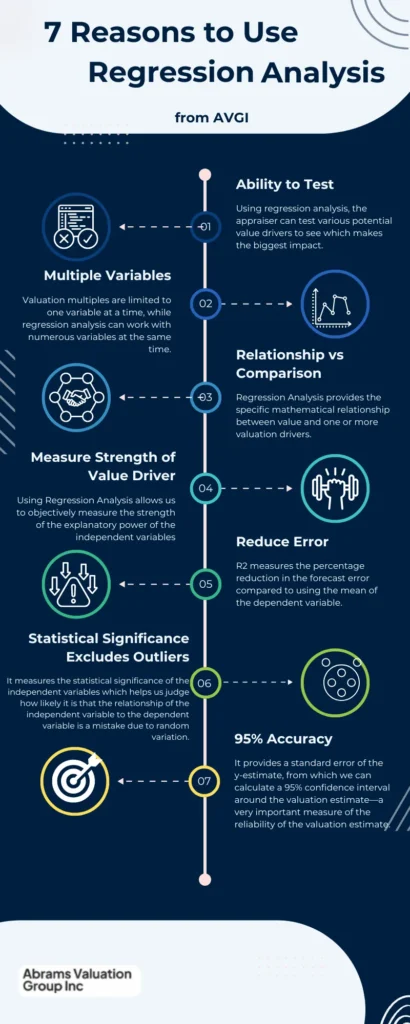
Using regression analysis, the appraiser can test various potential value drivers to see which makes the biggest impact. It may be a more common value driver, such as net income, or something more unique, such as location, stock sale vs. asset sale, or even SIC code, that moves the needle. With Average Valuation Multiple, the appraiser is limited to the two-dimensional valuation multiple data they can access about the GC.
Valuation multiples are limited to one variable at a time, while regression analysis can work with numerous variables at the same time. The appraiser might discover that there are three variables that work together to drive significant value.
Regression Analysis provides the specific mathematical relationship between value and one or more valuation drivers.
Using Regression Analysis allows us to objectively measure the strength of the explanatory power of the independent variables, measured by R2.
R2 measures the percentage reduction in the forecast error compared to using the mean of the dependent variable. Thus, an R2 of 90% would mean that variation in the guideline company independent variables explains 90% of their variation in fair market value (the dependent variable) compared to using the average fair market value of the guideline companies.
It measures the statistical significance of the independent variables with the p-value. This enables us to judge how likely it is that the relationship of the independent variable to the dependent variable is a mistake due to random variation.
It provides a standard error of the y-estimate, from which we can calculate a 95% confidence interval around the valuation estimate—a very important measure of the reliability of the valuation estimate.
Altogether, these make a strong case for using regression analysis for market-approach valuations. By objectively analyzing the impact of multiple value drivers, regression analysis leads to more accurate valuations that reflect a company’s true worth. However, there needs to be a minimum of 3 strong GCs to perform regression analysis, and ideally many more than that for the results to be very precise. When there is that data available, AVGI appraisers use regression analysis to arrive at the most accurate valuation possible.
How AVGI Synthesizes Company Valuation Methods
AVGI’s experienced and expert appraisers apply a combination of valuation methods to arrive at a precise calculation of a company’s value. Our approach is a comprehensive valuation that combines multiple methods and considers key factors such as market data, financial performance, risks, and intangible assets. Without relying on weak comparisons, we delve deep into the company and market data to uncover the true value drivers in the business and how those play out in the competitive landscape. Our valuation methods and logic are clear, empirical, transparent, and heavily documented, so company owners and other interested parties can easily follow our reasoning, assumptions, and methodology.
Precision is key when it comes to company valuations, and a large error margin can mean millions of dollars lost in an improperly priced transaction or other use case. It is essential to accurately estimate a company’s worth and business’s value for decision-making in scenarios such as mergers, acquisitions, and investment planning.
Valuation results are used for strategic planning, establishing partner ownership, and determining fair value in transactions. AVGI also considers industry trends and a company’s future growth when projecting future value and selecting appropriate valuation methods. You can learn more about how AVGI values businesses here. When you work with AVGI appraisers, you can be sure of the quality, precision, and transparency of our work. Contact us today to start the conversation! We look forward to valuing your company.


