

5 Key Concepts of Valuation: Practical Financial Insights
Introduction to Valuation
Valuation is a crucial process in finance that determines the fair market value of a company or asset, serving as the foundation for business valuations, investment decisions, and corporate finance activities. The primary goal of valuation is to estimate a company or asset’s intrinsic value by considering key factors such as cash flow, financial statements, and the current market price.
Understanding the core concepts of valuation is essential for making informed financial decisions, and widely used methods include discounted cash flow valuation, comparable company analysis, and contingent claim valuation. Various valuation approaches, such as asset-based and equity valuation, enable investors and businesses to assess the fair value of assets and companies accurately. Central to these assessments is the concept of fair market value, which represents the price a willing buyer would pay in a fair market, reflecting reasonable knowledge and absence of compulsion to buy or sell.
Business Valuation Concept #1: Money now is more valuable than money later

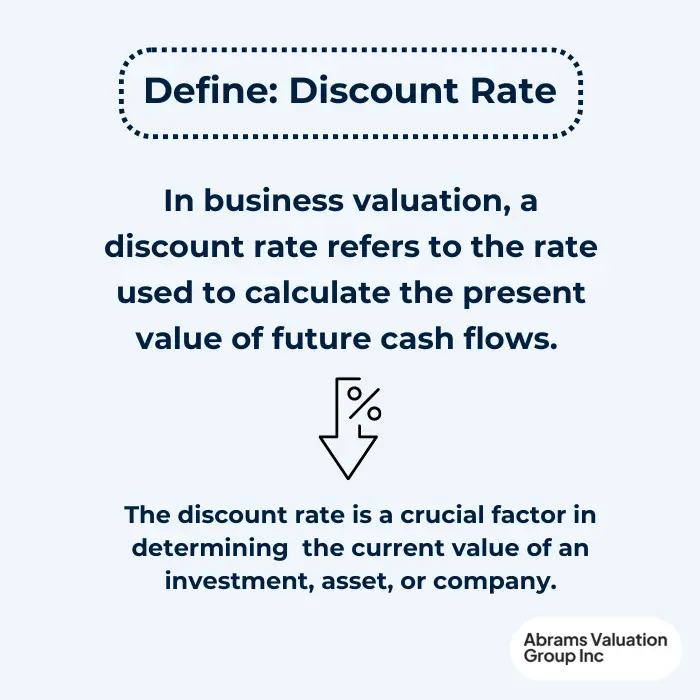
Money in the bank now is worth more than money that is expected to arrive in the bank account in the future. Future risk is a huge factor in discounting the future value of money. When we talk about present value, we’re translating the value of future growth/sales/income into dollars and cents today, as if it were in your bank account.
This concept has pros and cons in practical applications, depending on the valuation’s purpose. For tax purposes, this concept can help drastically reduce the taxpayer’s taxable income and, by extension, their tax bill due to the IRS. This is particularly true of unrealized gains and capital gains tax. After all, future money that is worth less presently should also be taxed less, right?
However, this same concept can be a hard sell for founders when pitching a startup idea to investors. While yes, this idea may have the potential to generate billions in sales down the line, the value on the ground today will be much lower, since, as of now, there aren’t billions sitting in the bank account. This is where the discounted cash flow valuation method comes in.
Cash Flow Analysis & Discounted Cash Flow
Cash flow analysis is a fundamental aspect of valuation because it estimates the present value of future cash flows, reflecting the core principle that money available now is more valuable than money expected later. Free cash flows, which represent the cash available to investors after covering operating expenses and growth investments, are central to this analysis. Accurate forecasting of these cash flows is essential, as it enables a realistic estimation of a company’s or asset’s future financial performance.
The discounted cash flow (DCF) model applies a discount rate to future cash flows to translate their value into present terms, accounting for risk and the time value of money. Moreover, cash flow analysis plays a crucial role in comparable company analysis, helping assess a company’s value relative to peers by comparing expected cash flows and financial metrics. Together, these approaches underscore the importance of understanding and quantifying predictable cash flows to arrive at an accurate and meaningful valuation.
Business Valuation Concept #2: An Accurate Valuation Requires Multiple Approaches
Determining a company’s value is a complex process that takes many factors into account. Each company has a unique operating model, market position, customer base, and cash flow projections, to name just a few of the variables. Valuing a company with a single method provides a much more limited, two-dimensional picture of its value, as the appraiser may not give sufficient weight to other factors. Because there are so many moving parts to the puzzle, it often makes sense to approach the valuation from multiple angles, using at least two different valuation methods and then weighting the results logically. This ensures that the valuation results are much more accurate and most closely reflect real-world conditions.
For example, a company may have very strong financial statements, with excellent sales revenue and cash flow. Using solely a Discounted cash flow valuation Method, an appraiser could come to a very high valuation. However, a closer look at its market position and the broader market sector shows declining growth, reduced investment, and a shrinking client base. A comparable company analysis would likely yield a valuation much lower than the DCF. The appraiser would then logically weight the two results to reach a more accurate final number.

Comparable Company Analysis
Comparable company analysis is a valuation technique that estimates a company’s value by comparing it to similar companies within the same industry. This method utilizes valuation multiples, such as the price-to-earnings ratio and enterprise value-to-EBITDA ratio, to derive an estimated value. It considers factors such as growth rates, profit margins, and return on equity to select appropriate comparable companies. Comparable company analysis helps key players make informed investment decisions, and it is widely used in investment banking and corporate finance. Additionally, it serves as a foundation for precedent transaction analysis by using recent transactions within the same industry to estimate a company’s value.
Business Valuation Concept #3: Classify Carefully — The Impact of Business Structure on Valuation and Taxation
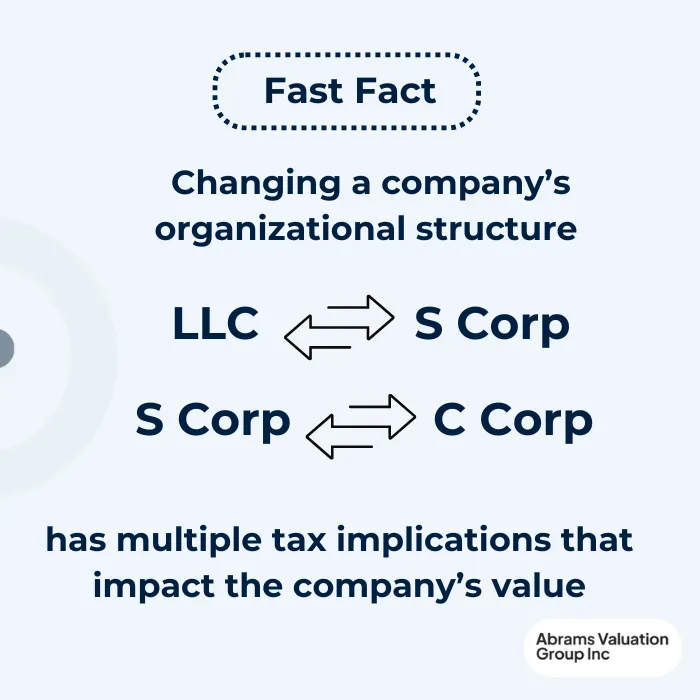
Choosing the right business classification—LLC, S Corporation, or C Corporation—is a critical decision for business owners that can have profound implications on valuation, taxation, and long-term financial planning. Each classification carries distinct tax treatments and legal considerations that affect not only day-to-day operations but also future events such as business sales, exit strategies, Employee Stock Ownership Plan (ESOP) formation, and long-term investment returns.
Tax Implications on Future Business Sales and Exit Planning
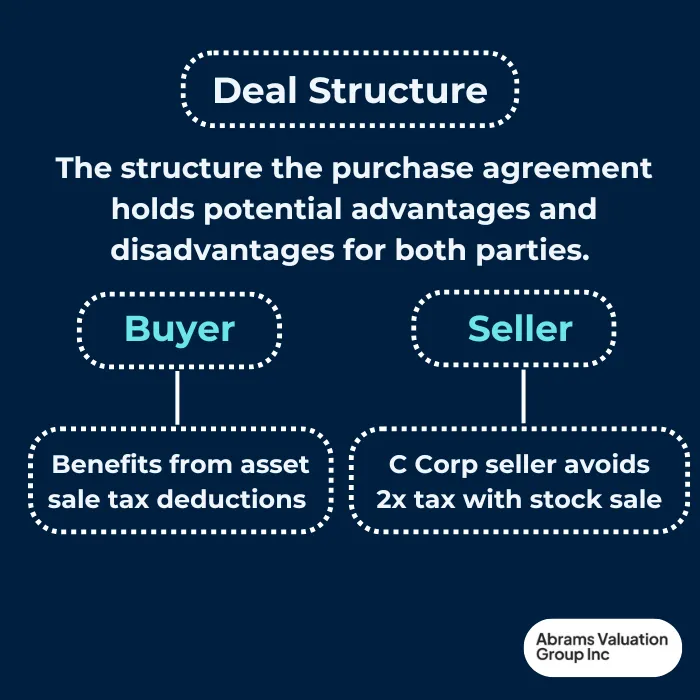
The tax structure of your business classification directly influences how proceeds from a sale or exit are taxed. For example, C Corporations are subject to double taxation: the corporation pays taxes on its profits, and shareholders pay taxes again on dividends or capital gains upon sale. Conversely, S Corporations and LLCs typically allow income to pass through directly to owners, avoiding double taxation but with different limitations on ownership and stock classes. Business owners must carefully evaluate these tax consequences as they plan exits to maximize after-tax proceeds and align with their financial goals.
ESOP Formation Considerations
Employee Stock Ownership Plans (ESOPs) offer unique benefits for succession planning and employee motivation, but their feasibility and tax advantages depend heavily on business classification. C Corporations are often preferred for ESOPs because of favorable tax deductions and the ability to issue stock, whereas S Corporations and LLCs face restrictions or require complex conversions. Understanding these nuances is essential for owners considering ESOPs as part of their long-term strategy.
Long-Term Investment and Growth Impact
The choice between LLC, S Corp, and C Corp also affects reinvestment strategies and the ability to attract investors. C Corporations can issue multiple classes of stock, making them attractive for raising capital, but they face corporate-level taxes. LLCs and S Corps provide pass-through taxation, which can benefit owners seeking to avoid corporate taxes but may limit investment options. Business owners must weigh these factors to ensure their classification supports sustainable growth and investment return objectives.
The Impact of Different Business Classifications
Feature | LLC | S Corporation | C Corporation |
|---|---|---|---|
Taxation | Pass-through taxation | Pass-through taxation | Double taxation |
Ownership Restrictions | Flexible | Up to 100 shareholders, U.S. only | Unlimited shareholders |
Stock Classes | Not applicable | One class of stock | Multiple classes allowed |
ESOP Eligibility | Limited/complex | Limited | Preferred |
Ability to Raise Capital | Limited | Limited | High |
Tax on Sale Proceeds | Pass-through to owners | Pass-through to owners | Corporate + shareholder tax |
Suitable for Long-Term Growth | Small to medium businesses | Small to medium businesses | Larger businesses |
In summary, the classification of a business entity is not merely a legal formality but a strategic decision with lasting effects on valuation, taxation, and financial planning. Consulting with tax professionals and valuation experts is crucial to understanding the full implications and selecting the structure that aligns best with your business goals and exit plans.
Business Valuation Concept #4: Details in Documents Matter!
In valuation, the fine print in contracts, legal documents, and agreements can have a profound impact on the value of a company, asset, or estate. Specific wording and terms within these documents often dictate rights, obligations, and contingencies that directly influence cash flows, risk profiles, and ultimately, valuation outcomes. Overlooking or misinterpreting these details can lead to significant miscalculations in value estimates.
For example, clauses related to lease agreements, purchase options, contingent liabilities, or escalation clauses can either enhance or diminish the expected economic benefits from an asset. Even seemingly minor contractual provisions can alter the valuation by millions of dollars, primarily when they affect the predictability of cash flows or the timing and amount of payments.
A compelling case study illustrating this concept is the lease-dispute valuation conducted by Abrams Valuation Group, Inc. (AVGI). In this case, the specific fine print terms of the lease contract led to a $10 million difference in the final valuation of the subject business. This example highlights how critical it is for appraisers, investors, and business owners to carefully analyze and understand all contractual details during the valuation process to ensure accurate and reliable value estimates.
For further insight into this case and the importance of contract details in valuation, see the AVGI case study on the lease dispute: Lease Dispute Case Study.
Concept #5:Accurate Valuation is the Starting Point in Corporate Finance
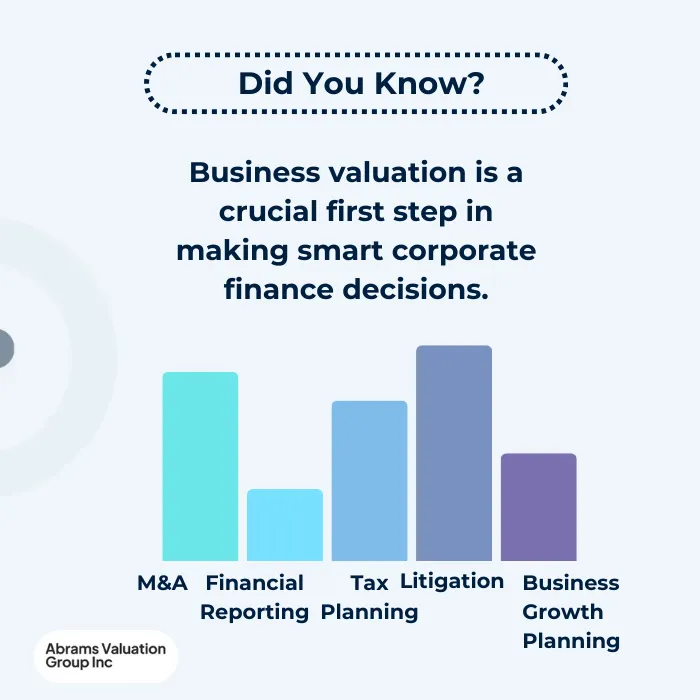
Business valuation plays a pivotal role in corporate finance by guiding companies in making informed investment, financing, and dividend decisions by answering the key question: “How much is the business worth right now?” Accurately defining the starting-point valuation clarifies the path towards what should come next. This is essential not only for managing a company’s financial performance but also for facilitating strategic activities such as mergers and acquisitions, where accurate valuation informs investment choices.
Conclusion
In summary, understanding the five key concepts of valuation—recognizing the time value of money, employing multiple valuation approaches, carefully considering business structure, paying attention to contractual details, and using accurate valuation as a foundation in corporate finance—provides business owners with practical financial insights to strategically enhance their company’s value. These concepts empower owners to make informed decisions about business growth, exit strategies, and estate planning, ensuring that their efforts translate into real economic benefit.
By applying these valuation principles, business owners can better navigate complex financial landscapes, optimize tax outcomes, and position their businesses competitively in the marketplace. Whether preparing for a sale, seeking investment, or planning long-term succession, a sound understanding of valuation concepts is essential for maximizing value and achieving financial goals.
For a commitment-free, professional business valuation consultation tailored to your unique circumstances, contact Abrams Valuation Group, Inc. (AVGI) today. Let our experienced team guide you through the valuation process and help you unlock the full potential of your business.


