

The Ultimate Guide to Business Acquisitions for Strategic Growth
Business acquisition can be an excellent growth strategy for propelling a company forward and increasing its value, market share, and reach. Over the last 30+ years, Abrams Valuation Group, Inc. has been a key advisor for many successful acquisitions. In this guide, we’ll delve into the ins and outs of business acquisition as well as some major pitfalls to avoid.
Understanding Business Acquisition
Acquisition occurs when one company acquires a second target company, usually as part of a larger growth strategy. Like any investment, acquisition comes with associated risks, and choosing the wrong target company, financing option, deal structure, or legal entity can have a serious negative impact on your business. However, with the proper market and target company research and due diligence, acquiring another business can be an excellent investment in increasing your company’s value and growth.

Benefits of strategic growth through acquisition
Acquisitions have a unique set of advantages as a business growth strategy. Acquisitions can provide access to new markets, customers, and technologies, and acquiring an established company with a hold on a new market, for example, can be a shortcut to accelerated growth.
An acquisition can also increase efficiency, reduce operational costs, and improve competitiveness. For example, if a company spends a large amount of money on supplying parts for their products, it may be more cost-efficient to acquire the supplier and then produce those parts in-house.
Pre-Acquisition Planning
There are several key steps to laying the foundation for a successful acquisition. Let’s examine the ideal pre-acquisition process.
1. Establishing a motive for the acquisition
Clearly defining the driving motive for the acquisition before beginning the process helps remove confusion and propel a successful acquisition forward. This motive, be it expanding market share, acquiring new technology, or another reason, will be the leading focus throughout the acquisition and influence negotiations and key decisions. Ensure that all internal members of the company who will be involved in the acquisition are aware of the motive to facilitate a unified approach.
2. Creating search criteria for the target company
Once you have established the motive in an acquisition, you must define the qualities of the ideal company you are seeking to acquire. This target company profile should include
- amount you are willing to spend
- financial position of the target company
- industry and market sector
- company maturity (i.e. startup or established company)
- workforce size
- tangible asset profile (real estate, machinery, truck fleet)
- intangible asset profile (intellectual property, patents, licenses
Deciding what you are ideally looking for in each of these categories can speed up the search for the ideal target company, improve the elimination process, and expedite the actual acquisition.

3. Research and outreach strategies
Now comes the research stage. Finding the right raw pool of target company candidates to work with can be one of the most time-consuming parts of the process. However, if approached methodically, it can be more efficient. M&A databases can be useful in finding businesses for sale, and you can often narrow down the results by industry, price, and other criteria. Researching the market can help build your sense of what is a reasonable amount to expect to pay for acquiring companies in your ideal range.
Generally, the contact for the company listed on an M&A database will be a banker or business broker who acts as a gatekeeper to the business. If the company looks relevant enough to add to the raw pool, reach out to the initial contact to discuss initial pricing and to see if the company’s details are relevant for your consideration as an acquisition target.
4. Selecting the Target Company
Now you are set with the important task of narrowing down the target company options to the best one. Comparing market prices and starting to obtain acquisition appraisals can be very helpful in making the final decision. Thefefore, it may be more useful to narrow down the options to two or three possibilities to investigate more deeply before determining the final target company for acquisition.
Acquisition Valuation and Financing
Once the pre-acquisition foundations have been laid, the next stage is determining the acquisition price and financing the transaction.
Calculating the target company’s worth
Obtaining an independent business valuation for the target company is essential to determine its true value before agreeing to a sale. This lays the groundwork for a reasonable, targeted, and streamlined negotiation process and facilitates realistic expectations on both ends of the deal.
There are several ways to value a business, including the price-to-earnings ratio (P/E ratio), enterprise-value-to-sales ratio (EV/sales), and discounted cash flow (DCF) analysis. Our AVGI valuation experts maintain that while valuation multiples are good for quick estimates, they are inaccurate and unreliable for more in-depth analysis. Read more about the valuation approaches and methods we use in valuing companies accurately and empirically. AVGI brings over 30 years of valuation experience to each appraisal. Contact us today for an expert acquisition valuation.

Financing options for company purchases
The next question to tackle is how your company will finance the purchase of the target company.
Financing options for company purchases include
- cash
- stock
- assumption of debt (loans, convertible securities)
- or a combination of some or all of these.
When choosing a financing option, the acquiring company should consider its financial situation and the target company’s financial position to determine the best course of action.
Legal entity considerations for the acquiring company
The acquiring company should consider its legal entity structure, including whether it will operate as a parent company, integrate the target company completely into current operations, or operate as separate legal entities.
Choosing the legal entity structure for the acquisition will impact how the target company is taxed, so it will directly affect take-home profits. As with any tax topic, AVGI strongly encourages business owners to seek personalized tax advice from a qualified tax consultant, preferably one with specific experience in strategic tax planning for mergers and acquisitions.

Acquisition Strategies
There are several strategies in how to execute an acquisition. The right strategy for your company will depend heavily on both your company’s and your target company’s positions pre-acquisition. Consider the following options to help you make a more informed decision.
1. Improve the target company’s performance
Improving the target company’s performance and accelerating revenue growth is one of the most common acquisition strategies that can significantly increase the target company’s value. This is a common strategy for more established companies acquiring startups, as the established company often has the business experience and resources to scale the startup’s great ideas and grow it successfully.
2. Consolidate to remove excess industry capacity
Rather than competing neck and neck with fierce competition in a crowded market, it might make the most sense to consolidate and present a more robust product with less competition. Consolidation can reduce excess capacity and result in a better product for a more primed market.
Pfizer’s acquisition of Wyeth Pharmaceuticals in 2009 was an example of a successful consolidation acquisition.
3. Accelerate market access for the target’s (or buyer’s) products
Often, small companies with innovative products have difficulty reaching the entire potential market for their products due to lack of resources and ineffective marketing. Larger companies, often in the same industry, may purchase these smaller companies to accelerate the sales of their products.
4. Gain skills or technologies faster or cheaper than they can be built
This is a common acquisition strategy in the tech industry, as many technology-based companies buy other companies that have the technologies they need to enhance their own products. It is often faster and more cost-effective for them to acquire the company with the necessary technology than it would be to develop that same technology in-house.
An example of a successful tech-oriented acquisition was Google’s acquisition of Motorola in 2014. The main purpose of the acquisition was for Google to gain access to Motorola’ R&D team, patent portfolio, and android technology to further Google’s own forays into the mobile phone industry.

Merger and Acquisition Agreements
Key terms and conditions for a successful deal
A sales agreement is necessary to move forward with the sale or merger. A sales agreement is more binding than a Letter of Intent (LOI) and should be reviewed by both an attorney and valuation expert to ensure accuracy and comprehensiveness.
The agreement should list all inventory in the sale, names of the businesses and owners, and relevant background details.
A valuation expert should review the sale terms as well to ensure that one company is not accidentally transferring more value than is fair or agreed upon. Such inadvertent transfers of wealth can occur easily by adding or omitting single words or terms from the contract. An attorney on their own may not pick up on these high-value impact nuances, so it is advisable for both professionals to review the relevant documents.
Due Diligence and Integration
Conducting due diligence on the target company
Due diligence is the last chance to find skeletons in the business’ closet and uncover any underlying information that would make the acquisition a “bad buy.” The process can take anywhere from three weeks to three months. It is important to perform due diligence thoroughly to make sure this is the best deal to move forward with.
If any negative information is uncovered in the due diligence process, it will have to be weighed against the value of the rest of the company. In some cases, it will be better to renegotiate certain parts of the acquisition agreement based on the new information. In other cases, however, the new information may be significant enough to dissolve the acquisition before it comes to fruition.
Integration strategies for a successful acquisition
Integration involves combining the operations and systems of the two companies involved and is crucial for a successfully executed merger. A successful integration strategy is essential for achieving the desired benefits of the acquisition. Failing to integrate both companies well can result in wasted time, effort, resources, and frustration.

Acquisition Implementation
Purchase mergers and consolidation mergers
A purchase merger occurs when one company purchases another company. This type of merger is often used by larger companies to acquire smaller businesses, allowing them to expand their market reach, increase their product lines, or gain access to new technologies. The acquiring company takes control of the acquired company’s assets and operations, often leading to increased efficiency and reduced costs.
A consolidation merger involves two or more business entities combining to form a new business entity. This approach is typically used when companies of similar size and market presence decide to join forces to create a stronger, more competitive entity. The newly formed company often benefits from a larger customer base, improved market share, and enhanced resources, which can lead to significant growth opportunities and increased profitability.
Tender offers vs Acquisition of Assets
A tender offer is when one company offers to purchase the outstanding stock of the other firm at a specific price. This approach is often used in hostile takeovers, where the acquiring company bypasses the target company’s management and goes directly to the shareholders. Tender offers can be an effective way to gain control of a company quickly, but they may also lead to resistance from the target company’s management and employees.
In contrast, an acquisition of assets occurs when one company directly acquires the assets of another company. This method allows the acquiring company to select specific assets that align with its strategic goals, such as intellectual property, real estate, or technology. Asset acquisitions can be advantageous for companies looking to expand their capabilities without taking on the liabilities or obligations of the entire target company. Both deal structures have advantages and disadvantages, depending on the company’s motives and profiles. Careful consideration and strategic planning are essential to ensure that the chosen approach aligns with the overall business objectives and leads to a successful acquisition.
Management acquisitions and other structures
A management acquisition, also known as a management-led buyout (MBO), is when a company’s executives purchase a controlling stake in another company. This structure often occurs when the management team believes in the potential of the target company and wants to take direct control to drive growth and efficiency. MBOs can be advantageous as the management team already understands the business’s operations, culture, and market dynamics, which can facilitate a smoother transition and integration process.
Other acquisition structures include horizontal acquisitions, vertical acquisitions, conglomerate acquisitions, and congeneric acquisitions.
Horizontal Acquisitions

Horizontal acquisitions occur when a company acquires another company operating in the same industry with a similar product line, aiming to increase market share and reduce competition. For example, if two companies producing similar consumer electronics merge, they can leverage economies of scale and enhance their competitive edge.
Vertical Acquisitions

Vertical acquisitions involve a company acquiring another company within its supply chain, either upstream (suppliers) or downstream (distributors). This strategy can lead to improved control over the supply chain, reduced costs, and enhanced production efficiency. For instance, a car manufacturer acquiring a tire company to secure a steady supply of tires is an example of a vertical acquisition.
Conglomerate Acquisitions
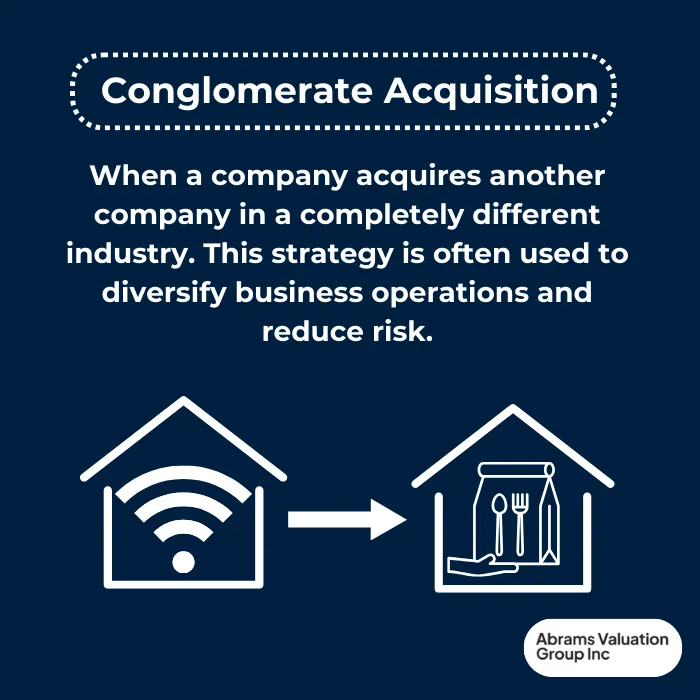
Conglomerate acquisitions happen when a company acquires another company in a completely different industry. This strategy is often used to diversify business operations and reduce risk by spreading investments across various sectors. A classic example is a technology company acquiring a food and beverage company.
Congeneric Acquisitions

Congeneric acquisitions occur when a company acquires another company in the same or related industry, but the companies offer different products to the same target customer base. The purpose of a congeneric acquisition is usually to expand the acquiring company’s product lines and market reach, encouraging existing customers to make more purchases from the same company as they expand their offerings. Often, the two existing companies are highly compatible for synergies, and the post-acquisition company is in a much more powerful position for growth.
Each of these potential acquisition structures can be extremely effective; choosing the right one depends on the circumstances, industry, and acquisition motives of your company. Discuss all potential options with key decision makers and professional council to determine the best course of action for your company.
Overcoming Challenges
Common pitfalls and risks in business acquisition
Acquisitions are complex business moves and certainly not without risks. Here are some common pitfalls to avoid to ensure a smooth and seamless transition.
Cultural differences
Some workplaces develop a unique internal culture, which can be either positive or negative. Trying to integrate two divergent cultures with little warning will be challenging at best and an HR nightmare at worst.
Keep employees at both the acquiring and target companies informed and involved throughout the process, making it clear at each step what the practical impact is for them. Will teams be restructured? What is the chain of command now? Will the office be relocating? These are all important questions to answer, and the sooner, the better to combat potential rumors and misinformation that can scare employees unnecessarily.
Integration challenges
1+1=2, unless it doesn’t. Integration can often come with difficult interpersonal challenges, particularly in middle management and leadership roles. Plan effectively for what the acquisition leadership will look like and clarify this in advance as much as possible to avoid unpleasantness.
Financial risks
An acquisition can be costly for a company, and it certainly takes time to prove its worth. Financing the acquisition properly can diversify some of the financial strain on the acquiring company and ensure they have breathing room to allow the acquisition to integrate, mature, and flourish.
Strategies for Overcoming Obstacles and Ensuring Success
To successfully navigate the complexities of a business acquisition, it is crucial to conduct comprehensive due diligence and establish a well-defined integration strategy. Effective communication and cultural alignment are also vital components in ensuring a smooth transition. By focusing on meticulous planning and fostering open communication, companies can overcome potential challenges and pave the way for a successful acquisition.
Post-Acquisition Growth
How M&A activity affects shareholders
M&A activity can affect shareholders in various ways, including a temporary drop in share value. The initial announcement of a merger or acquisition can lead to market uncertainty, causing stock price fluctuations. Shareholders may react based on perceived synergies, potential risks, or changes in the company’s strategic direction, affecting the stock value in the short term.
However, a successful acquisition can lead to long-term growth and increased shareholder value. When executed effectively, mergers and acquisitions can enhance a company’s competitive edge, streamline operations, and create significant cost savings. These improvements can drive up the company’s stock price over time, rewarding shareholders with increased returns. Additionally, shareholders may benefit from dividends if the acquisition leads to higher profitability.
The role of the acquiring company in the target company’s growth
The acquiring company plays a crucial role in the target company’s growth, including providing resources and support for expansion. The acquiring company can minimize disruptions and facilitate a successful acquisition by striving to ensure a smooth integration process. Keeping the acquisition purpose at the forefront of the process can serve as a continuous point of reference for management and stakeholders and can help recalibrate when acquisition dynamics begin to unfold. Staying focused on the goal singelmindedly can drive a successful integration and profitable acquisition, benefitting both companies in the long run.
Conclusion: Setting Up Business Acquisitions for Success
Business acquisitions serve as a powerful strategy for achieving strategic growth, enhancing revenue, and expanding market share. To ensure a successful acquisition, engaging in meticulous planning, maintaining effective communication, and implementing a well-defined integration strategy is essential. By approaching acquisitions with a clear vision and structured process, companies can unlock new opportunities and drive significant growth.
If you’re considering an acquisition and want to ensure its success, contact AVGI’s valuation experts today. With over 30 years of experience, our team can provide you with a comprehensive acquisition valuation, setting the foundation for a prosperous and informed investment.


