

Valuation Expert Witness Testimony Can Make or Break Your Case: How to Choose the Right Expert
With 30+ years in the valuation industry, AVGI valuation experts have seen our fair share of litigation. Our appraisers have been called upon to give expert witness testimony in trials spanning the range of industries and complaints, from business damages in sporting goods to patent infringement in computer programming to IRS tax disputes. More than any other takeaway, the expert witness is of utmost importance. The witness’s qualifications, methodology, and courtroom delivery can make or break the case. When the stakes are high, it pays to know how to choose the right expert witness for your case. Abrams Valuation Group, Inc. explores what to look for in a valuation expert witness and how to utilize expert witness testimony to solidify your case.
What is an Expert Witness?
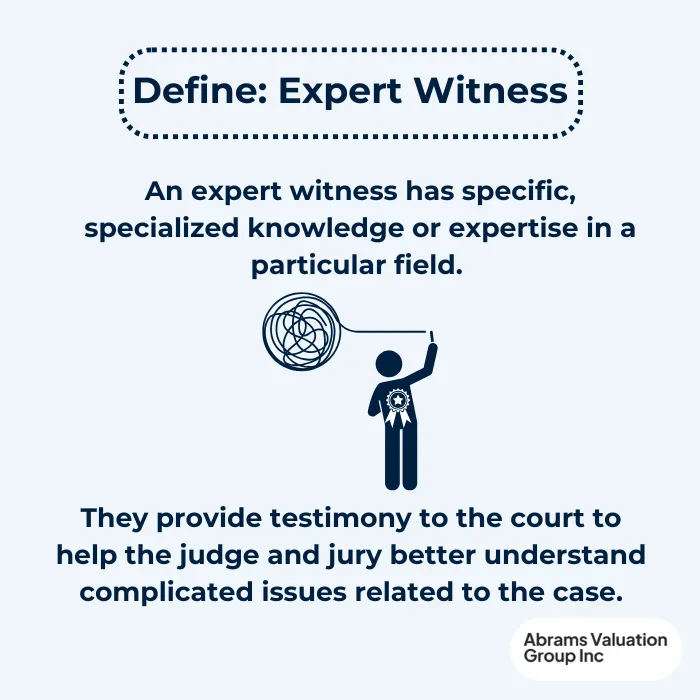
First, a definition. An expert witness has specific, specialized knowledge or expertise in a particular field. They provide testimony to the court to help the judge and jury better understand complicated issues pertaining to the legal case. This enables the judge and jury to make better-informed decisions regarding the case.
In business litigation, the complex topic is often quantifying the damages- how much damage was done, and what is just compensation to right the wrong? As valuation experts, our role is to give the court an objective better understanding of the valuation considerations at hand. For example, in a patent infringement case, our expert witness testimony would provide a professional calculation of the damages the plaintiff suffered as a result of the infringement and support the plaintiff in seeking compensation for that business damage.
Without a valuation expert, the amount of compensation sought and awarded becomes vague and arbitrary, left to the court’s understanding of value to decide. However, by bringing a valuation expert witness to the stand, the plaintiff solidifies their position in demanding a specific amount of compensation. If the expert witness can effectively communicate the value impact of the infringement to the court, it can directly influence the jury’s decision as well as the judge’s final ruling.
Who Qualifies to Give Expert Witness Testimony in Court?
Expert witnesses must satisfy the 4 main qualifications defined in the Federal Rules of Evidence 702 in order to testify in court:
Relevant Expertise: The expert must have expertise relevant to the case.
Sufficient facts or data: Their expert testimony must be based on sufficient facts or data.
Reliable methodology: The expert must use reliable principles and methods to come to their conclusion.
Application: The expert must be able to apply the principles and methods to the facts of the case at hand.
The expert’s testimony must meet the Daubert Standard for evidence admissibility. Most importantly, this means that the expert can use non-standard methods to reach their conclusion as long as they meet a scientific standard of reliability. The methods must be testable, peer-reviewed, and have a reasonable error rate. There must be clear standards for using the particular method, and it must be generally accepted in the valuation field.

So, a highly qualified business appraiser can use reliable valuation methodology to produce an expert witness report calculating the damages a business experienced due to patent infringement.
4 Tips to Choose the Right Expert Witness
A few critical factors make an excellent expert witness. Choosing a professional who meets all of these qualifications can make all the difference between a successful or unsuccessful outcome in court.
1. Professional Credentials
This is perhaps the most important aspect to examine when selecting an expert witness. The more peer-recognized qualifications they have, the more credible their testimony is in court. When choosing a valuation professional, there are several generally accepted qualifications within the valuation field. Some valuation professionals, including those at Abrams Valuation Group, Inc. boast multiple credentials. Selecting a highly qualified professional gives significant weight to their testimony.
2. Valuation Methodology
It is essential to examine the professional’s methodology- i.e. how do they reach the professional conclusions they will be presenting in court? As we mentioned earlier, using reliable methodology is crucial for their testimony to be used in court. Furthermore, their methods are likely to be cross-examined and must be able to withstand intense scrutiny. Therefore, it is best to engage a professional well-versed in standard valuation methods and base their calculations upon various methods to come to an accurate conclusion.
Depending on the case, AVGI experts often perform the initial appraisal by utilizing the income, market, and asset approaches, then further refining the most relevant results with valuation adjustments. However, in our years of litigation experience, our appraisers have come across opposing “experts” who rely on over-simplified valuation methods (like taking the mean of similar company valuations) and bury their mediocre methodology in complex jargon that confuses the court. An adept expert witness is well-versed in various valuation methods and can accurately apply them to the case.
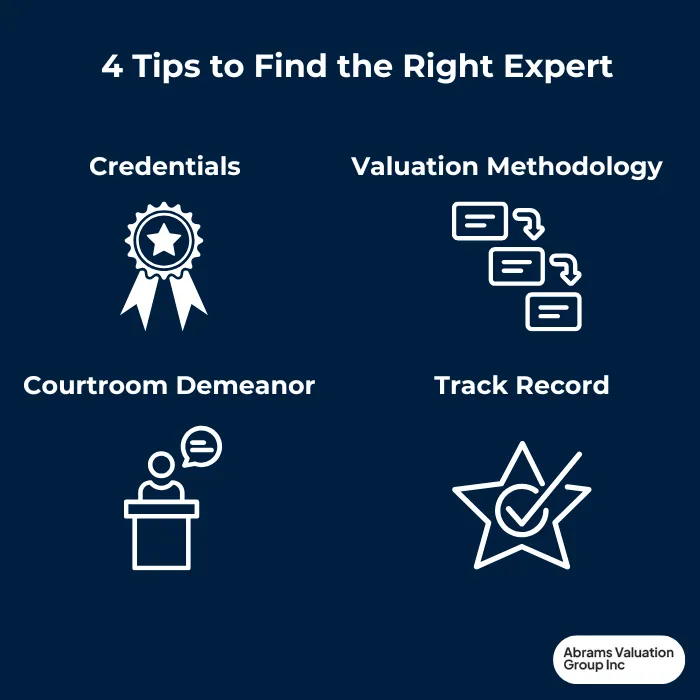
3. Courtroom Demeanor and Delivery
While this may be considered a “soft skill” in selecting an expert witness, do not undermine its importance. The expert must be able to calmly and confidently present their professional testimony to the court. They must not only be able to reach a sound professional conclusion, but also be able to communicate their findings to the court in simple layman’s terms. One of the key functions of the expert witness is to clarify complex topics for the court that are not readily understood without expertise. A professional who relies on complicated jargon and overly theoretical phraseology will fail to clarify anything for the court and may damage the case by confusing the judge and jury. An excellent witness presents their professional conclusions clearly and succinctly and can communicate the importance of their findings to the court effectively.
Furthermore, they must stay cool and collected despite intense cross-examination. In litigation, the opposing attorney will look for opportunities to trip up the expert witness and point out flaws or inconsistencies in their testimony. An appraiser who becomes flustered by cross-examination cannot effectively testify to the validity of their conclusions. However, a witness who remains calm and professional, answering questions clearly, can effectively prove their expert testimony to be valid. How the witness handles cross-examination significantly impacts how a jury and judge view the testimony.
4. Proven Track Record
Look for a valuation professional with a proven track record of courtroom successes. They might charge higher expert witness fees, but it is for good reason. If they successfully deliver testimony in court that contributed to a favorable outcome, they will likely be able to do so again. In a high-stakes case, it pays to invest in experienced expert testimony.
Expert Witness Testimony: What to Avoid
Don’t place too much stock in specific industry experience. It might sound wonderful to present an expert witness with niche experience valuing computer programs for a case involving a computer program patent. However, if the professional’s valuation expertise is average, the industry experience will not outweigh that limitation. It would be much more beneficial to select a valuation expert who perhaps lackst the specific experience in valuing computer programs, but has vast experience in the field of valuation. Although it may be counterintuitive, AVGI appraisers have faced many opposing “industry experts” with weak or below-average valuation skills. Usually, the industry experience did not help them reach a more accurate valuation.
What to do When the Testimony is Challenged?
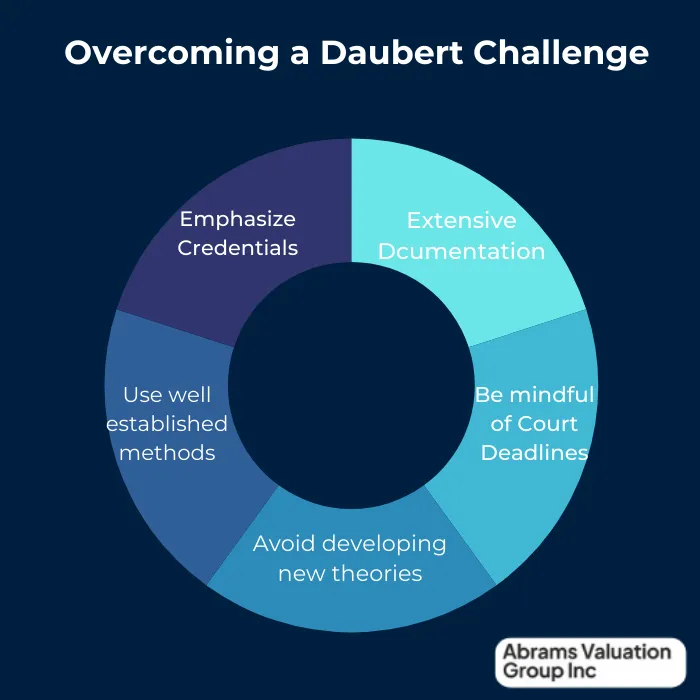
In litigation, it is to be expected that the opposing side will challenge the expert’s opinion. In the case of a Daubert Challenge, the opposing side may try to challenge the validity of the expert’s testimony in a motion to have the testimony excluded from the trial. The following tips can help overcome a Daubert Challenge:
Reiterate the expert’s qualifications, educational background, training, credentials, specialized knowledge, and experience as the foundation for reaching their professional conclusions.
Provide meticulous documentation of the methods they used to reach their expert opinion.
Ensure the expert’s methodology is well-tested, established, and peer-reviewed
Comply with court dead
lines to respond to Daubert Challenges
If you have selected a qualified expert using reliable principles and methods, you should be able to overcome a Daubert Challenge easily.
Conclusion
Expert witnesses play a crucial role in the legal system, providing specialized knowledge and expertise to help the court understand complex concepts. Particularly in complicated business litigation cases, selecting a qualified valuation expert can help the court understand the facts of the case more efficiently. AVGI brings over 30 years of expert testimony experience to every case. Book a consultation to discuss your case’s particulars and whether we are the right expert witnesses for you.


