

What is a Discount Rate and Its Importance in Business Valuation
In the world of finance and business valuation, the term “discount rate” holds significant importance. Understanding what a discount rate is and how it is utilized in business valuation is crucial for investors, analysts, and business owners. In this article, AVGI’s experts answer “what is a discount rate?” in depth. We’ll explore the concept of discount rates, their calculation methods, and their significance in business valuation.
What is a Discount Rate?
Discount Rate Definition
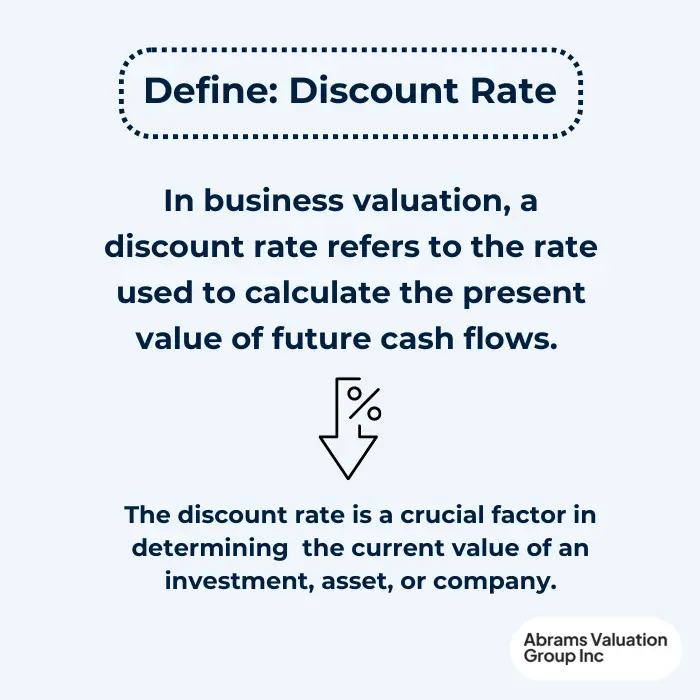
In business valuation, a discount rate refers to the rate used to calculate the present value of future cash flows. It is widely utilized in various financial models and valuation techniques to determine the current value of an investment or a company based on its projected future cash flows.
The Importance of Discount Rate in Business Valuation
When valuing a business, liquid cash in the bank now has a higher value than projected future income due to several factors. The discount rate allows appraisers to adjust the value of future cash flows to represent its current value accurately. This is essential part of quantifying how much a business is worth; without applying a discount rate to projected future earnings, a business valuation would be incomplete and inaccurate. Here we explore several points that illustrate the importance of the discount rate.
Time Value of Money
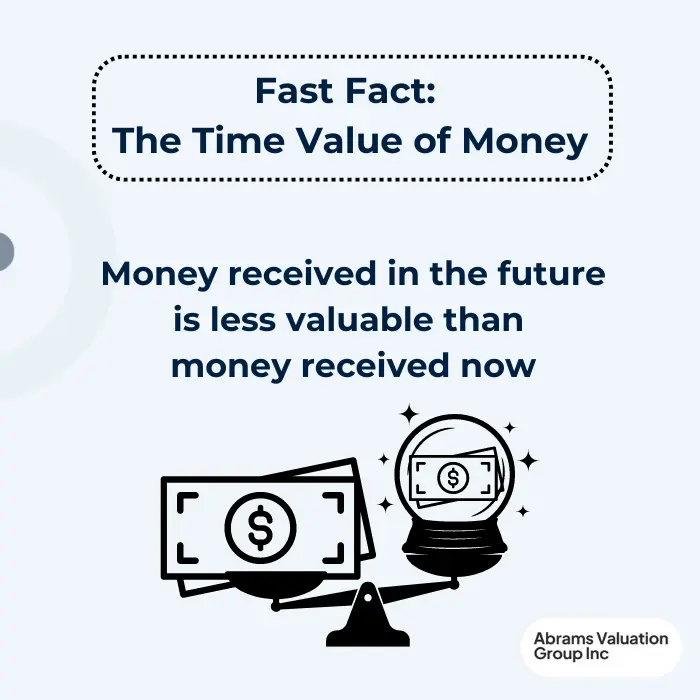
The concept of the time value of money is fundamental to understanding the importance of the discount rate in business valuation. Money received in the future is worth less than money received today due to factors such as inflation and the opportunity cost of not having the money available now for other uses. Therefore, a discount rate is applied to future cash flows to reflect their present value.
Investment Decision Making
For investors and businesses evaluating potential investments, the discount rate serves as a critical factor in assessing the viability of an opportunity. By discounting future cash flows to their present value, decision-makers can compare investments with differing cash flow timings on an equal footing.
Risk Assessment
The discount rate also accounts for the level of risk associated with future cash flows. Investments with higher perceived risk will warrant a higher discount rate to reflect the higher level of uncertainty and risk premium required by investors.
What is a Reasonable Range for Discount Rates?
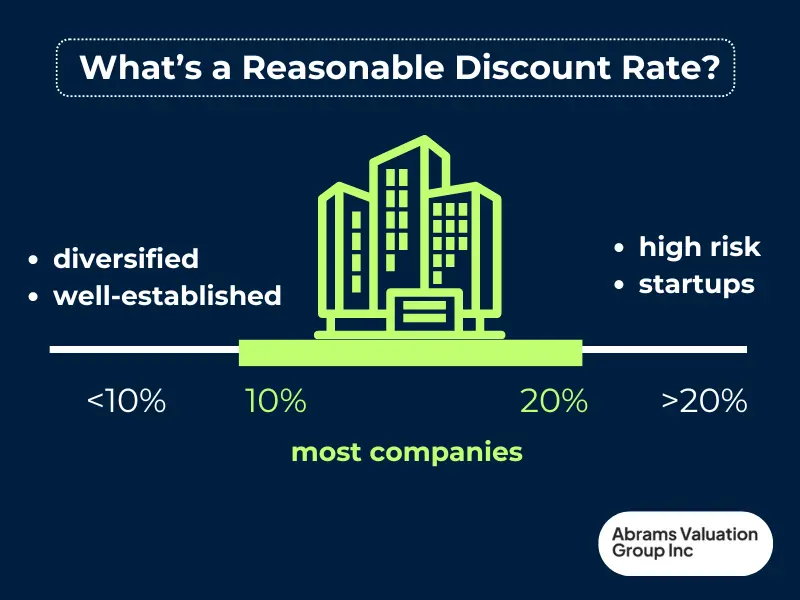
The reasonable range for discount rates can vary depending on factors such as the industry, the specific investment or project being evaluated, and the prevailing economic conditions. However, very generally, discount rates typically range from 10%-20%. This range accounts for the time value of money, inflation, risk, and opportunity cost.
However, a much higher discount rate (above 20%) may be reasonable for companies with significant risk profiles, such as startups with little financial performance history. Conversely, a much lower discount rate (under 10%) may be appropriate for a very large, diversified company with a strong growth and low risk profile.
A very high or low discount rate can and often does attract extra scrutiny, especially in a legal or tax setting, so it is crucial for the appraiser to explain their logic, assumptions, and estimations, and calculations that resulted in an atypical discount rate. Ultimately, the appropriate discount rate for a particular valuation should be carefully determined based on a thorough analysis of the relevant factors impacting the investment or business being evaluated.
Methods of Calculating Discount Rates
Income Approach Discount Rate Methods
1. Weighted Average Cost of Capital (WACC)
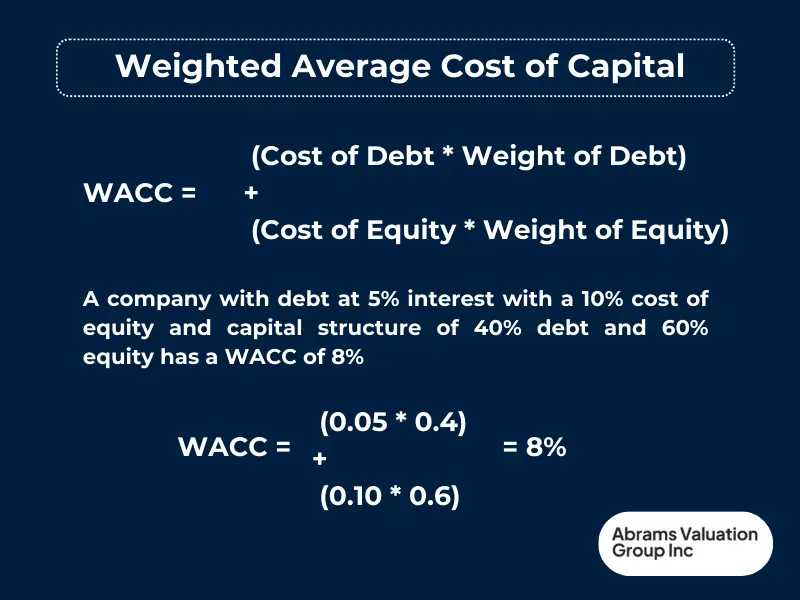
WACC is a commonly used method for calculating the discount rate for business valuation. It takes into account the cost of debt and equity based on the company’s capital structure.
Example of WACC Discount Rate Calculation
Let’s consider a hypothetical company XYZ. To calculate the WACC, we need to determine the cost of each component of capital and then weight them based on their proportion in the company’s capital structure.
- Cost of Debt: Let’s assume that the company has issued debt at an interest rate of 5%. This represents the cost of debt for the company.
- Cost of Equity: The cost of equity can be calculated using the Capital Asset Pricing Model (CAPM) or other methods. Let’s assume that the cost of equity for company XYZ is 10%.
- Weight of Debt and Equity: Let’s say the company’s capital structure is 40% debt and 60% equity.
Now, we can calculate the WACC using the formula:
WACC = (Cost of Debt * Weight of Debt) + (Cost of Equity * Weight of Equity)
WACC = (0.05 * 0.4) + (0.10 * 0.6)
WACC = 0.02 + 0.06
WACC = 0.08 or 8%
So, the WACC for company XYZ using the given hypothetical data is 8%. This can be used as the discount rate for evaluating potential investment projects or for other financial analyses.
Pros & Cons of the WACC Method
Pros: Reflects the company’s overall cost of capital; suitable for valuation of a company as a whole.
Cons: Complexity in determining the cost of equity and debt; may not be suitable for valuing specific projects or divisions within a company.
2. Capital Asset Pricing Model (CAPM)
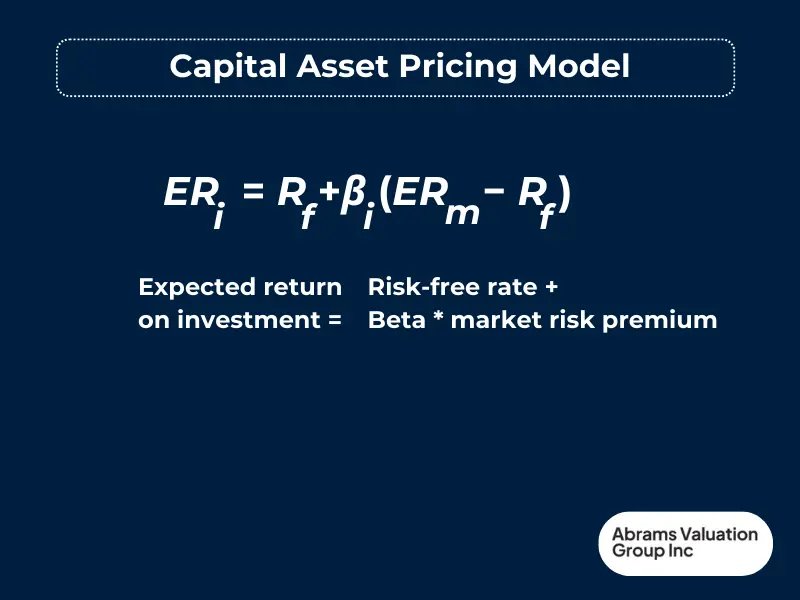
CAPM calculates the cost of equity based on the risk-free rate, the market rate of return, and the company’s beta, representing its systematic risk.
The risk-free rate refers to the theoretical return on an investment with no risk of financial loss, typically represented by short-term government bonds. The market rate of return is the anticipated rate of profit from an investment in the overall stock market, often approximated by an index such as the S&P 500. The company beta, in the context of CAPM, is a measure of a stock’s volatility in relation to the market as a whole. It provides an indication of how much a stock’s returns typically fluctuate in response to swings in the market index.
Example using the CAPM Discount Rate Formula
To calculate the discount rate using the Capital Asset Pricing Model (CAPM), you would use the following formula:
[{Cost of Equity} = {Risk-Free Rate} + beta *({Market Rate of Return} – {Risk-Free Rate}) \]
Let’s say the risk-free rate is 3%, the beta of the company is 1.2, and the expected market rate of return is 8%.
Using these values, we can calculate the cost of equity as follows:
\[ \text{Cost of Equity} = 0.03 + 1.2 \times (0.08 – 0.03) = 0.03 + 1.2 \times 0.05 = 0.03 + 0.06 = 0.09 \]
So, the cost of equity is 9%. This means that the discount rate for the hypothetical company, according to the CAPM, would be 9%.
Pros & Cons of the CAPM Method
Pros: Provides a systematic approach for estimating the required return on equity; widely used in equity valuation.
Cons: Relies on assumptions such as market efficiency and the relationship between systematic risk and expected return.
Market Approach Discount Rate Methods
1. Build-Up Method:
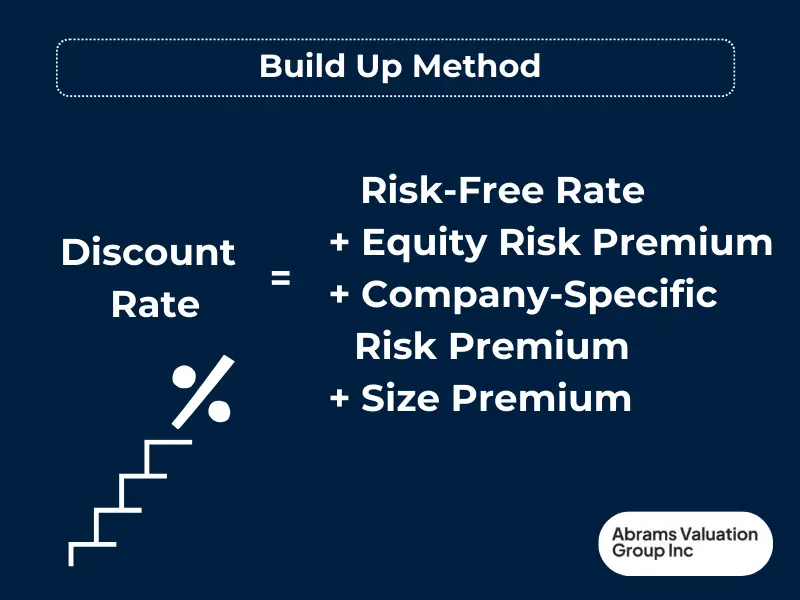
This method involves adding a risk-free rate to various risk premiums, such as equity risk premium, small company premium, and specific company risk premium.
Example Calculating the Discount Rate using the Build-Up Method
To calculate the discount rate using the build-up method for a hypothetical company, we would start by considering the risk-free rate, which could be represented by the yield on a 10-year Treasury bond. Let’s assume the risk-free rate is 3%.
Next, we would incorporate a measure of equity risk premium, which could be based on historical market returns and the company’s specific industry. Let’s assume an equity risk premium of 5%.
Additionally, we would consider the company-specific risk premium, which reflects the additional risk associated with the company itself. This could be determined based on the company’s beta and other relevant factors. Let’s assume a company-specific risk premium of 4%.
Finally, we would account for the size premium, reflecting the additional return potential of small-cap stocks compared to larger companies. Let’s assume a size premium of 3%.
By adding these components together, we can calculate the discount rate using the build-up method:
Discount Rate = Risk-Free Rate + Equity Risk Premium + Company-Specific Risk Premium + Size Premium
Discount Rate = 3% + 5% + 4% + 3% = 15%
So, based on this hypothetical example and the build-up method, the discount rate for the company would be 15%.
Pros & Cons of the Build-Up Method
Pros: Tailored to the specific risk profile of a company; allows for a granular approach to risk assessment.
Cons: Highly subjective and reliant on accurate risk premium estimation.
Asset Approach Discount Rate Methods
1. Risk-Free Rate Plus Risk Premium
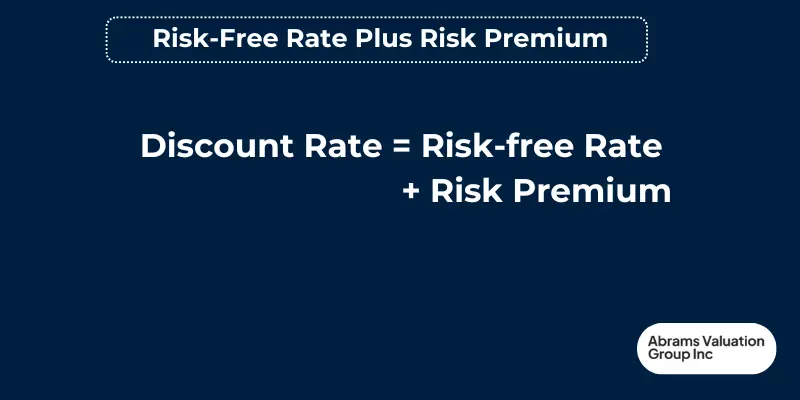
In certain cases, an asset’s discount rate may be calculated simply by adding a risk premium to the risk-free rate to reflect the asset-specific risk.
Discount Rate Calculation Example using Risk-Free Rate Plus Risk Premium
Let’s say the risk-free rate is 3% and the risk premium for the hypothetical company is 5%. The discount rate using the Risk-Free Rate Plus Risk Premium method would be 3% (risk-free rate) + 5% (risk premium) = 8%. This 8% discount rate can then be used in the company’s valuation or investment appraisal.
Pros & Cons of Risk-Free Rate Plus Risk Premium Method
Pros: Simplicity and ease of application; particularly useful for certain types of assets with well-defined risk profiles.
Cons: Oversimplified for complex valuation scenarios; may not capture the full range of risks associated with an asset.
Other Risk Factors in Calculating the Discount Rate
Beyond the initial formulaic calculation, there are 2 additional risk factors that must be factored in appropriately to arrive at a discount rate that accurately reflects the company’s value.
1. Company Size Premium
Smaller companies are riskier, facing more issues overall with capital, diversification. Appraisers often add an additional percentage to the discount rate, depending on the company size, to account for this risk.
2. Specific Company Risk Premium
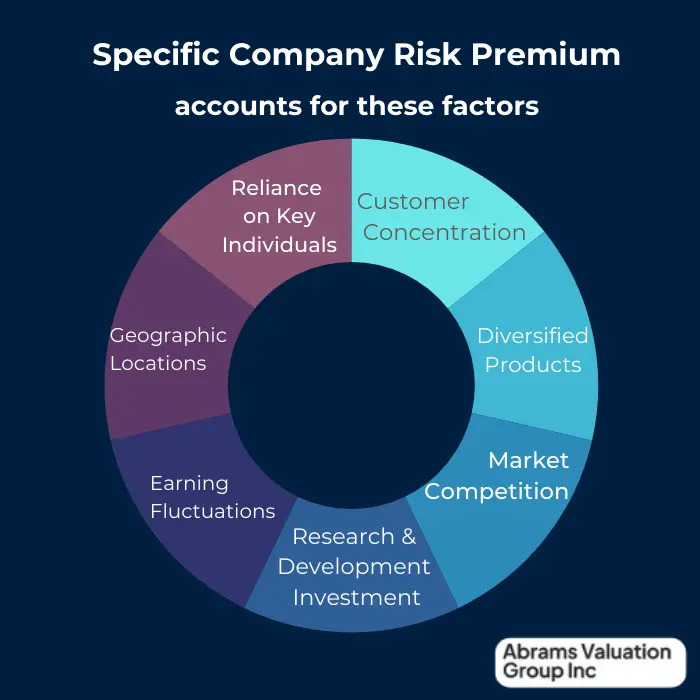
Every company has a specific risk profile, and this premium quantifies the additional risk to add into the discount rate based on the following factors:
- Reliance on Key Individuals
- Concentration of Customers/Suppliers
- Diversification of Products
- Investment in Research & Development
- Geographic Locations
- Fluctuations in Earnings
- Market Competition
Choosing the Right Calculation Method
Each calculation method comes with its own set of advantages and drawbacks, and the choice of method depends on the specific circumstances and needs of the valuation. The ultimate decision of which calculation method to use is in the appraiser’s hands. A professional appraiser will select the discount rate calculation method that most accurately represents the current value of the business or business interest. Here we will discuss some of the factors that might play into the decision of which method to use, depending on the particulars of the valuation assignment.
WACC vs. CAPM
When valuing an entire company or a business with varying capital structure and risk profiles, WACC is often preferred due to its broader scope. On the other hand, for valuing individual projects or divisions, and when the company’s capital structure is expected to change significantly, CAPM may offer a more suitable approach.
Build-Up Method
The build-up method is suitable when valuing smaller companies or niche industries with unique risk factors that may not be adequately captured by general market data. However, it demands careful consideration and accurate estimation of risk premiums to yield reliable results.
Asset-Specific Risk
For assets with relatively straightforward risk profiles, adding a risk premium to the risk-free rate may suffice. This method is commonly used for valuing certain tangible assets or simple financial instruments.
Discount Rates: In Conclusion
In conclusion, the discount rate plays a central role in business valuation, aiding investors, stakeholders, and decision-makers in assessing the worth of investments and companies. Through the various calculation methods and careful consideration of risk factors, a well-founded discount rate contributes to more accurate and informed valuation decisions. Understanding the intricacies of discount rates empowers stakeholders to navigate the complexities of financial valuation with greater confidence and precision.


