

Uncovering Financial Manipulation in Business: Insights from AVGI Business Valuation Experts
Financial manipulation is a major concern for business owners, attorneys, and financial planners. Whether it arises in shareholder disputes, divorce proceedings, or partnership dissolutions, identifying and proving manipulation is essential to ensuring justice for all parties. At AVGI, our business valuation experts have seen firsthand how sophisticated financial engineering can obscure a company’s true economic reality. In this article, we explore how courts uncover and prove financial manipulation, and how business valuation helps quantify damages and secure fair remuneration.
What Is Financial Manipulation and Financial Abuse?
Financial manipulation refers to deliberate actions that misrepresent a business’s financial position or performance. This could include inflating expenses, understating revenue, hiding liabilities, or shifting profits between periods. Such tactics are often employed to suppress the value of ownership interests, particularly in contentious situations like shareholder oppression or buyout negotiations.
Common Scenarios: Economic Abuse, Shareholder Suppression and Beyond
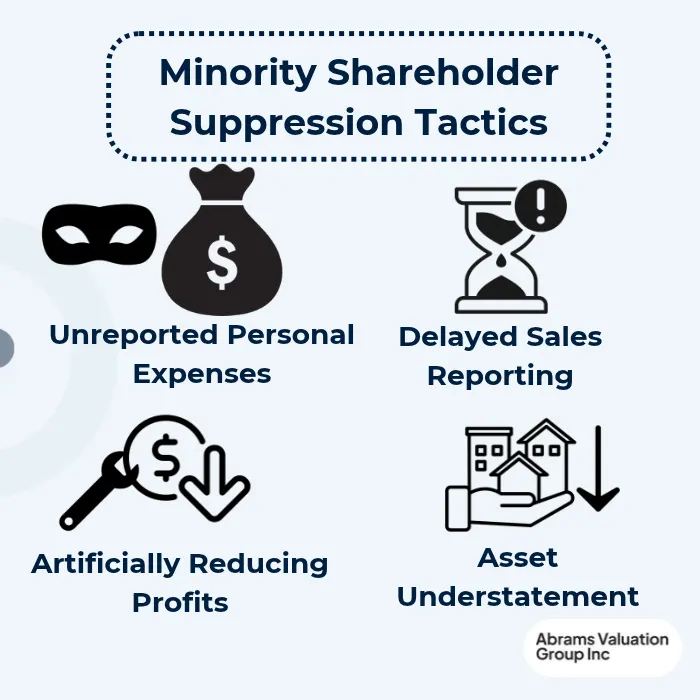
In shareholder suppression cases, majority owners may try to minimize the business’s value to disadvantage minority shareholders. Techniques include:
- Artificially Reducing Profits: Overstating expenses or underreporting income.
- Unreported or Personal Expenses: Charging personal expenses to the business.
- Deferred Revenue Recognition: Delaying the recording of legitimate sales.
- Asset Understatement: Omitting valuable assets from financial statements.
Other scenarios include marital dissolution, where one spouse may try to devalue the company, or fraud investigations involving misappropriated funds.
Detecting Financial Manipulation and Coercive Control: The Role of Forensic Analysis
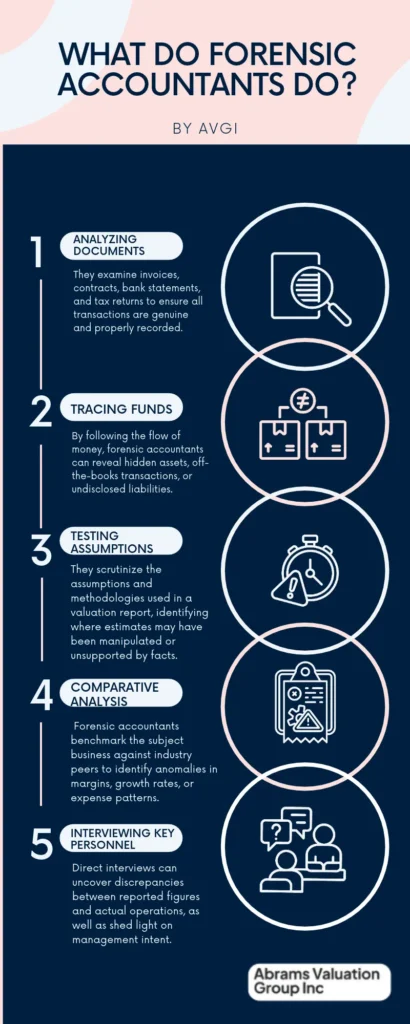
Uncovering manipulation requires a meticulous and methodical approach:
Detailed Financial Statement Analysis: Compare historical financials to spot unusual trends or discrepancies.
Benchmarking: Compare performance with industry peers to identify outliers.
Transaction Testing: Examine supporting documentation for key transactions.
Cash Flow Reconciliation: Ensure reported cash flows align with bank records and business activities.
Related Party Transactions: Scrutinize transactions with owners or affiliates for preferential treatment or diversion of assets.
Proving Manipulation in Court
Legal proceedings demand more than suspicion—they require concrete evidence. Business valuation experts play a vital role by:
- Providing Expert Testimony: Explaining findings in a clear, objective manner.
- Reconstructing True Earnings: Normalizing financials to reflect the business’s actual value.
- Tracing Funds: Identifying the movement of money through complex structures.
- Supporting Claims with Documentation: Presenting detailed workpapers and reconciliations.
Courts rely on valuation experts’ credibility and analytical rigor to distinguish legitimate business practices from manipulative tactics. However, following the proper legal procedures is also critical to ensure that the oppressed minority shareholders can make their case successfully; these two NY-based minority oppression cases were held up for procedural technicalities.
Quantifying Damages: Bank Accounts and Valuation as the Foundation
Business valuation is essential for determining the financial impact of manipulation. This process involves:
- Normalizing Adjustments: Removing the effects of manipulation to estimate real earnings or asset values.
- Determining Fair Value: Calculating what a shareholder’s interest would have been worth absent manipulation.
- Estimating Lost Profits or Diverted Assets: Quantifying direct economic harm.
- Future Damages: Projecting the long-term effect on value, where applicable.
Valuation experts use accepted methodologies—such as discounted cash flow, market approach, and asset-based valuation—and apply sound judgment backed by empirical evidence. The goal is to present a defensible quantification of damages that withstands legal scrutiny.
Why Early Involvement Matters
Engaging valuation experts early in a dispute is critical. Early analysis can preserve evidence, shape legal strategy, and often facilitate settlement before litigation escalates. Qualified professionals’ proactive investigation helps business owners, attorneys, and financial planners safeguard interests and achieve fair outcomes.
Conclusion
Financial manipulation undermines trust and fairness in business relationships. Detecting and proving such misconduct requires deep expertise in forensic accounting and valuation. At AVGI, we stand ready to help stakeholders uncover manipulation, quantify damages, and support claims with integrity and precision. If you suspect financial manipulation or are preparing for a dispute involving business value, consult experienced valuation professionals to protect your interests and help ensure justice is served.


