

The Role of Forensic Accounting in Disputing Business Valuations: Insights from AVGI Valuation Experts
Business valuations are often at the center of high-stakes legal disputes—divorce proceedings, shareholder disagreements, partnership dissolutions, and even regulatory investigations. In these situations, the accuracy and integrity of a valuation can make or break a case. This is where forensic accounting becomes critical. At AVGI, we have seen firsthand how forensic accountants play a pivotal role in disputing business valuations and ensuring that justice—and fair value—prevails.
What Is Forensic Accounting, and How Does It Differ from Regular Accounting?
Forensic accounting is the specialized practice of investigating financial records for use in legal contexts. Unlike traditional accounting, which is focused on preparing financial statements and ensuring compliance with accounting standards, forensic accounting is investigative in nature. Forensic accountants look beyond the numbers to trace transactions, identify anomalies, and uncover evidence of fraud, misrepresentation, or financial manipulation.
Key differences include:
- Purpose: Regular accounting aims to provide accurate financial information for management and compliance. Forensic accounting aims to uncover the truth behind financial records, often for use in litigation.
- Approach: While regular accountants maintain records and perform audits, forensic accountants apply investigative techniques, interview stakeholders, and reconstruct financial events.
- Output: Forensic accountants prepare reports designed for use in court and are often called to testify as expert witnesses.
Why Are Forensic Accountants Typically Hired in Litigation?
Forensic accountants are most commonly engaged in legal disputes where:
- The accuracy of financial statements or business valuations is questioned.
- There are suspicions of fraud, embezzlement, or misappropriation of assets.
- Parties allege that financial data has been manipulated to influence the outcome of a business valuation or financial settlement.
- Complex financial transactions make it difficult for non-experts to discern the true financial picture.
Their objective, unbiased analysis is critical for attorneys and courts to understand the underlying financial reality.
How Forensic Accountants Uncover Irregularities or Misstatements
In the context of business valuations, forensic accountants employ a variety of methods to uncover financial irregularities or intentional misstatements:
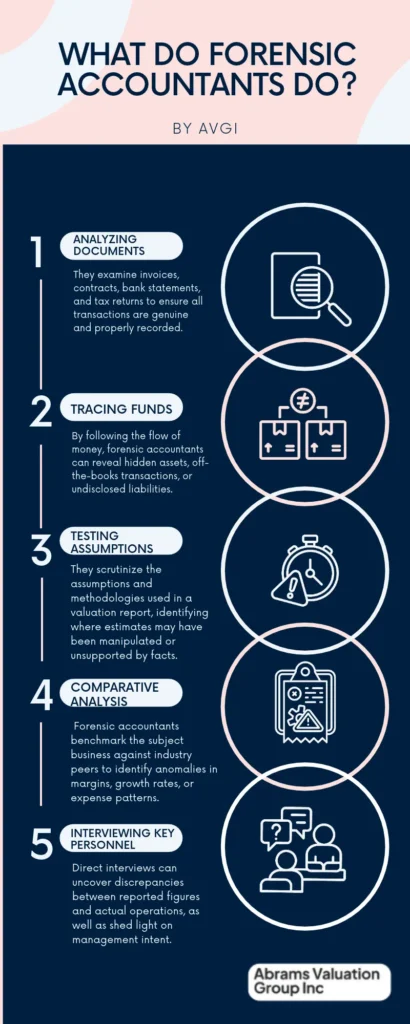
- Analyzing Source Documents: They examine invoices, contracts, bank statements, and tax returns to ensure all transactions are genuine and properly recorded.
Tracing Funds: By following the flow of money, forensic accountants can reveal hidden assets, off-the-books transactions, or undisclosed liabilities.
Testing Assumptions: They scrutinize the assumptions and methodologies used in a valuation report, identifying where estimates may have been manipulated or unsupported by facts.
Comparative Analysis: Forensic accountants benchmark the subject business against industry peers to identify anomalies in margins, growth rates, or expense patterns.
Interviewing Key Personnel: Direct interviews can uncover discrepancies between reported figures and actual operations and shed light on management intent.
Forensic Accountants in Disputing Valuation Reports in Court
When a business valuation is contested in court, forensic accountants serve several critical functions:
- Expert Testimony: They present findings clearly and objectively, helping judges and juries understand complex financial issues.
- Challenging Opposing Experts: Forensic accountants can identify weaknesses or errors in the opposing party’s valuation, such as flawed assumptions, omitted data, or methodological inconsistencies.
- Quantifying Damages: When financial manipulation is proven, forensic accountants help quantify the economic impact, supporting claims for compensation or adjustment.
- Supporting Negotiation and Settlement: Even before trial, their findings can provide leverage in settlement discussions, often leading to more favorable outcomes for their clients.
Why Business Owners, Attorneys, and Financial Planners Should Care
For business owners, an unfair or inaccurate valuation can have disastrous consequences—lost wealth, unfavorable settlements, or even reputational harm. Attorneys rely on forensic accountants to build robust, evidence-based cases. Financial planners depend on accurate valuations for succession planning, mergers, or estate administration.
At AVGI, we believe that engaging a qualified forensic accountant early in the dispute process can uncover hidden red flags, ensure a fair valuation, and provide the strategic advantage necessary to achieve optimal results.
Conclusion
Forensic accounting is a vital tool for anyone disputing a business valuation. By uncovering financial irregularities, exposing intentional misstatements, and providing credible expert testimony, forensic accountants ensure that the true value of a business is revealed—even under the intense scrutiny of the courtroom. If you’re facing a valuation dispute, partnering with experienced forensic experts can make all the difference.

