

How Much Does a Business Valuation Cost? (+ How to Decide How Much to Spend)
So you’ve determined that you need a business valuation to assess your business’s value. But as a conscious business owner, you want to know how much a business valuation costs. Of course, it depends on a few factors, which we will examine in detail.
It is crucial to use qualified professionals, such as those with the accredited senior appraiser (ASA) designation, to ensure you receive reliable and credible business valuations.
The underlying question is how much you should invest in business valuation services. What scope of work is appropriate for your valuation needs? To answer these questions, you’ll need to determine your valuation exposure. In this brief article, Abrams Valuation Group, Inc. breaks down everything you need to know about business valuation cost and determining your valuation exposure.
The Quick Answer: How Much Does a Business Valuation Cost?
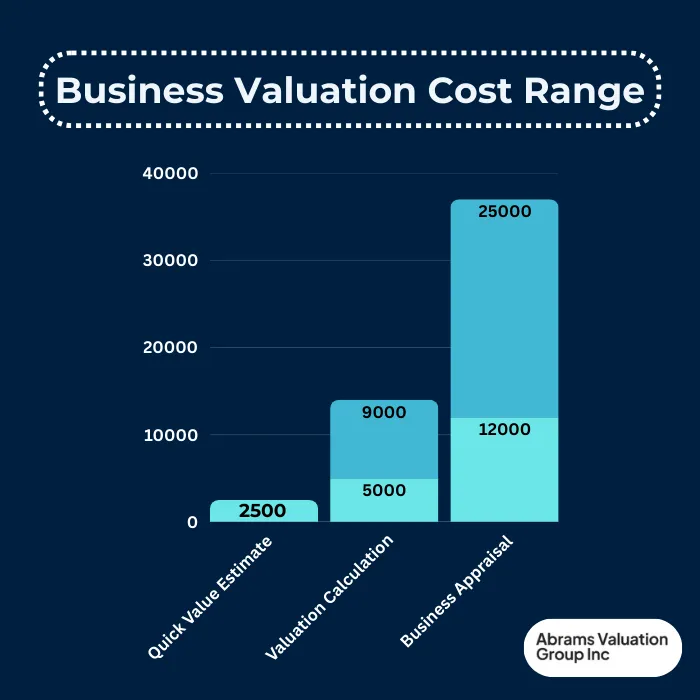
To give some fast numbers, a “quick-and-dirty” valuation estimate can cost as low as $2,500 from AVGI. However, this type of assignment might sacrifice empirical accuracy in favor of fast turnaround times, relying on more estimates and assumptions than a more methodical approach. Business brokers or other practitioners can potentially provide quick valuation estimates for even less, but the quality and accuracy may vary as they are not certified in the valuation field.
How much does a valuation calculation cost?
Generally, a lower-level business valuation calculation from AVGI costs between $5,000-$9,000.
How much does a business appraisal cost?
Higher-level operating business appraisals usually cost between $12,000-$25,000. However, an appraisal of a large, complex, billion-dollar company will cost more in the range of $250,000 to $1 million. These numbers are general estimates, and the final cost of any valuation assignment will depend on the specific details of that assignment.
Need help determining which level of valuation service your client needs? Give us a call so we can help you determine the tier of business valuation service that best suits your client’s case.
Now, we will examine the factors that influence the cost of valuation.
Which Factors Influence the Valuation Cost?
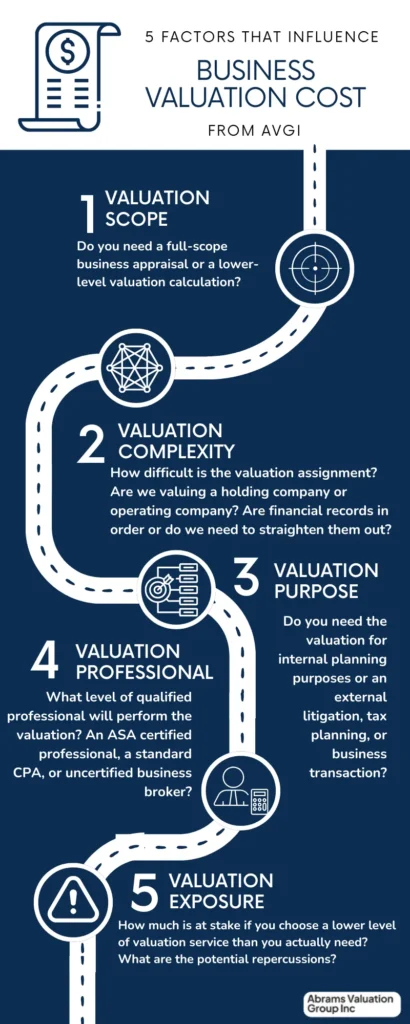
The cost of a business valuation can vary greatly depending on a few main factors:
The scope of the assignment (how much valuation work will be performed)
The complexity of the assignment (how difficult that work will be)
The Valuation Purpose (why do you need the valuation)
The appraiser’s level of expertise, credentials, and experience, such as holding a Certified Valuation Analyst (CVA) designation or other valuation license.
Your valuation exposure (how much is at stake by not paying for the correct level of valuation services)
Determining the Scope of the Valuation Assignment
There are two levels of service when performing a valuation assignment.
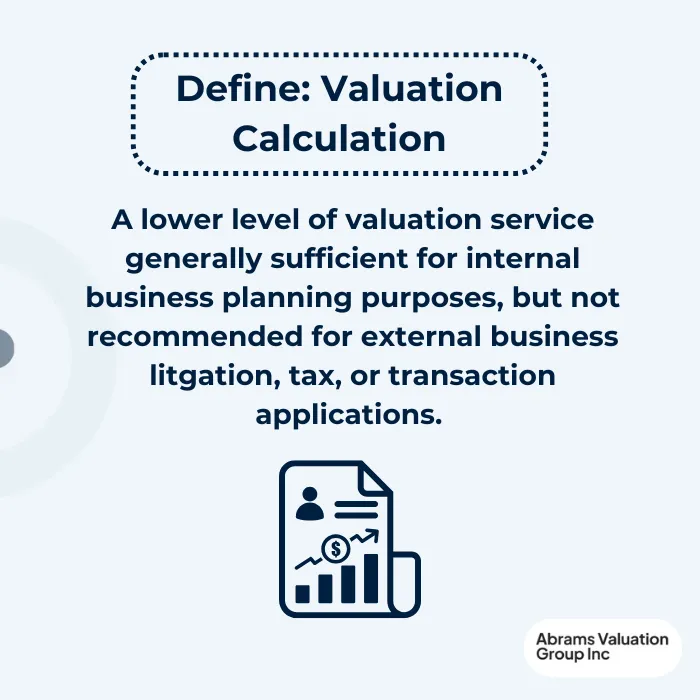
Valuation Calculation is the lower level of service (more commonly referred to as business valuations). This service level has a narrower scope and generally costs less.
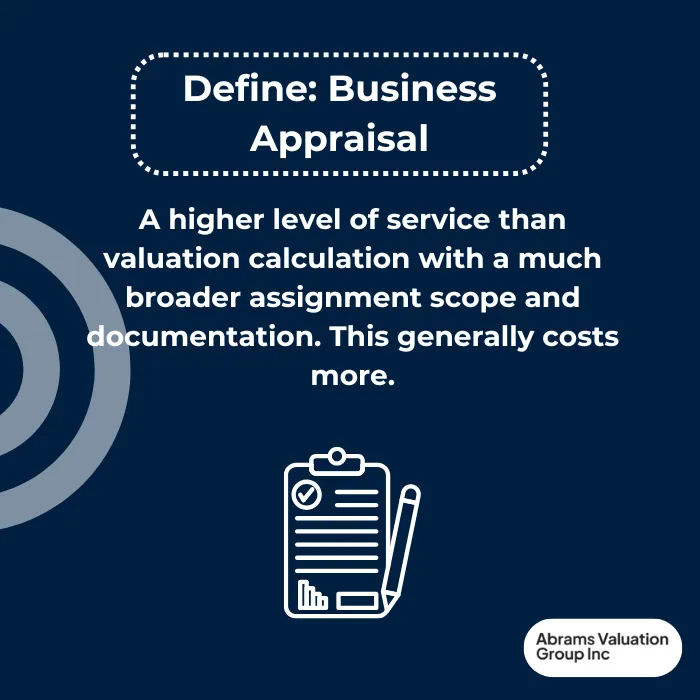
A Business Appraisal is the higher level of service. This has a much broader assignment scope and generally costs more.
Although colloquially, the two terms are often used interchangeably, business appraisal and valuation refer to the same industry but two separate service tiers, translating into different fees and scopes of valuation work.
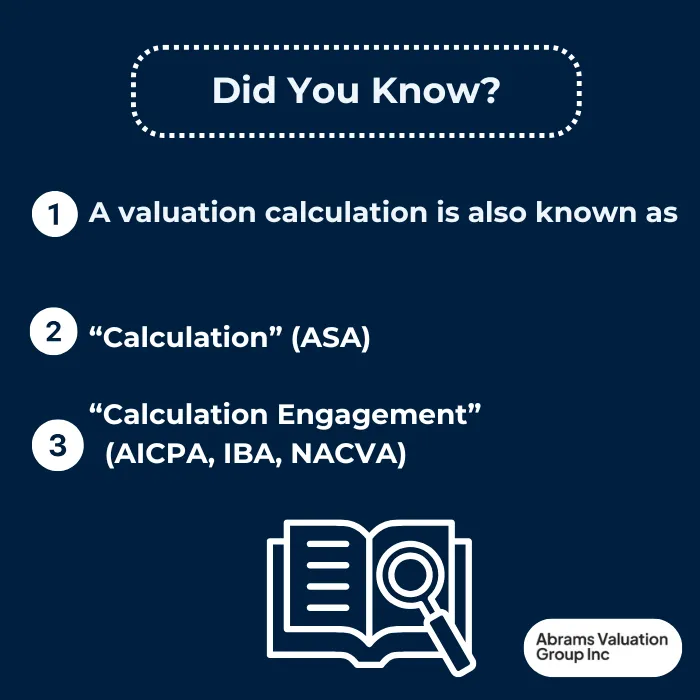
A business valuation, also called “Calculation” (American Society of Appraisers-ASA) or “Calculation Engagement” (AICPA, IBA, NACVA), is a lower-level analysis generally intended for a client to use for internal planning purposes.
A business appraisal (ASA) or valuation engagement (AICPA, IBA, NACVA) is a much more complex and in-depth analysis process of determining the firm’s economic value, often based on deeper market research and more meticulous documentation. Appraisals are better suited for external purposes such as tax, litigation, and financial reporting, as the extensive documentation can withstand intense scrutiny.
What Factors Influence the Complexity of a Business Valuation?
As we mentioned before, the business valuation costs depend on the scope and complexity of the assignment as well as the expertise of the certified business appraiser. It is crucial to employ multiple valuation methods, such as the asset, market, and income methods, to ensure credibility. Here are the factors that influence the complexity of the valuation:
1. Operating Business vs. Holding Company
Is the company to be valued as a holding company or an operating company? Operating businesses are more complex to value and, therefore, cost more.
2. Mature Business vs. Startup Business
It is easier to value a stable, mature company with a few years of historical financial data versus a startup company with little history and much volatility.
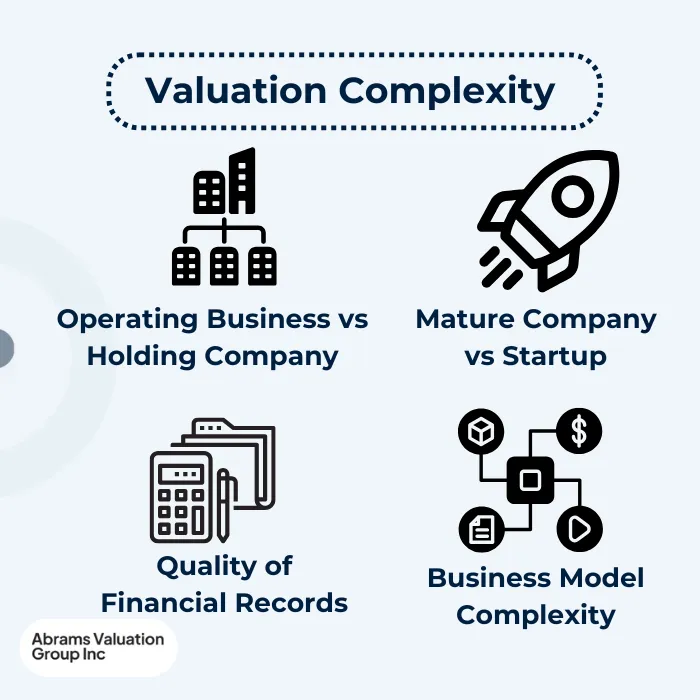
3. Quality of Financial Statements and Records
It is more difficult to value a business with incorrect or incomplete books, financial history, or inaccurate financial forecasts. Therefore, valuations for companies with poor quality or incomplete financial statements will cost more.
4. Complexity of the Business Model
Does your company have multiple product lines, markets, or geographic locations? Each of those adds a layer of complexity to the assignment and will increase the business valuation cost.
The Valuation Purpose
The purpose of getting a valuation will factor into how much the valuation will cost. Different valuation purposes will require different levels of accuracy and defensibility, resulting in the client selecting a higher or lower valuation scope. Often, a valuation calculation is sufficient for internal business planning. However, if the valuation purpose is for litigation, estate, and gift tax planning, or another external purpose where it will face much scrutiny, a higher-level business appraisal is often more appropriate.
Why Do You Need a Business Valuation?
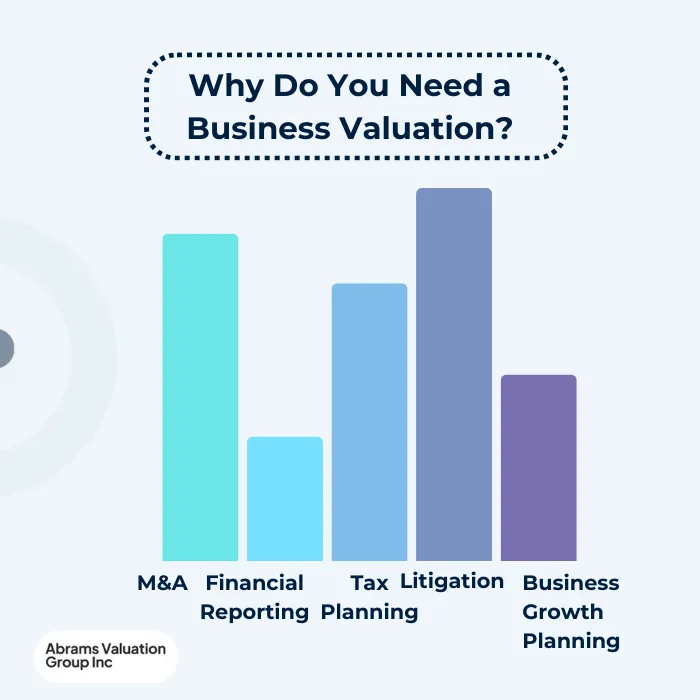
Business valuations are essential for various reasons, including:
- Mergers and Acquisitions: Business valuations help determine the fair market value of a company, ensuring that buyers and sellers negotiate a fair price. Accurate valuations are crucial for successful transactions, providing a basis for informed decision-making.
- Financial Reporting: Business valuations are required for financial reporting purposes, such as determining the value of assets and liabilities. Accurate valuations ensure compliance with accounting standards and provide stakeholders with a clear understanding of the company’s financial health.
- Tax Planning: Business valuations help determine the value of a company for tax purposes, such as gift or estate tax planning. Business owners can effectively plan for tax liabilities and optimize their tax strategies by establishing a fair market value.
- Dispute Resolution: Business valuations are used to resolve disputes between shareholders, partners, or other stakeholders. Accurate valuations provide an objective basis for negotiations, helping to settle conflicts and reach fair agreements.
- Strategic Planning: Business valuations provide valuable insights for strategic planning, such as identifying areas for improvement and measuring the effectiveness of business decisions. By understanding the company’s value, business owners can make informed choices that drive growth and enhance profitability.
By understanding the different business valuation approaches and the reasons why business valuations are needed, business owners and stakeholders can make informed decisions and ensure that their company is accurately valued.
The Business Valuation Expert’s Credentials

There are several types of business appraisers who can potentially perform the valuation assignment. Not all of them are certified by an official valuation organization. Obviously, uncertified practitioners are not recommended, particularly for valuation purposes with high stakes, such as litigation. However, a low-risk valuation purpose may benefit from a lower-cost, more generic valuation calculation performed by a CPA rather than an ASA appraiser’s more expensive expert appraisal.
Determining Your Valuation Exposure: What Level of Valuation Service Do You Need?
You might assume that a higher level of valuation service is better, but you might not have the need or funds for an expert business appraisal. On the other hand, you might think you can get by with a lower-cost Valuation Calculation, but that might fall short of what you actually need. Let’s take a look at your Valuation Exposure to help you determine the level of valuation service you need. Then we can answer how much your valuation will cost more accurately.
What is Valuation Exposure?
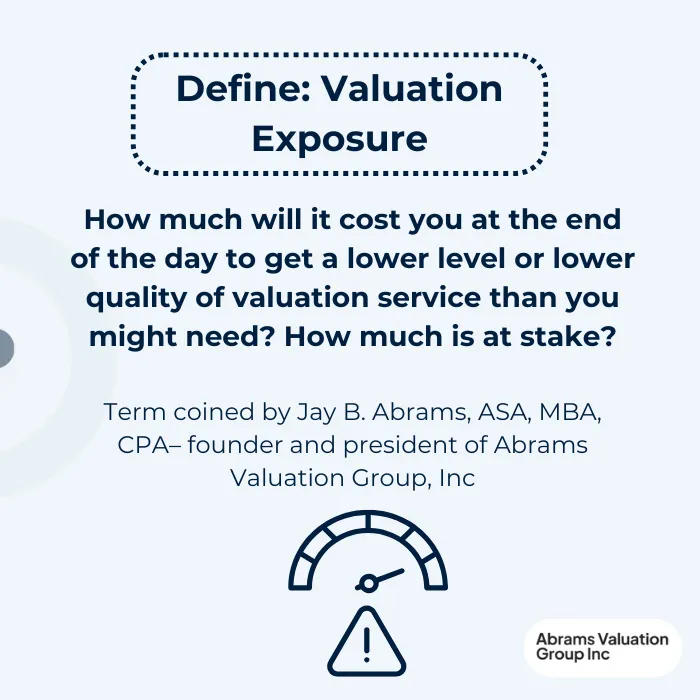
Valuation Exposure is a term coined by Jay B. Abrams, ASA, MBA, CPA– founder and president of Abrams Valuation Group, Inc. It refers to the probable cost of getting too little valuation work done or too low-quality valuation work. In other words:
How much will it cost you at the end of the day to get a lower level or lower quality of valuation service than you might need? How much is at stake?
You’ll need to evaluate your valuation exposure to make an informed decision about how much valuation service you actually need. You should be ready to spend as much on a valuation as you have to lose by spending less than that.
Consider the following examples:
Calculating Valuation Exposure: Estate and Gift Tax Example
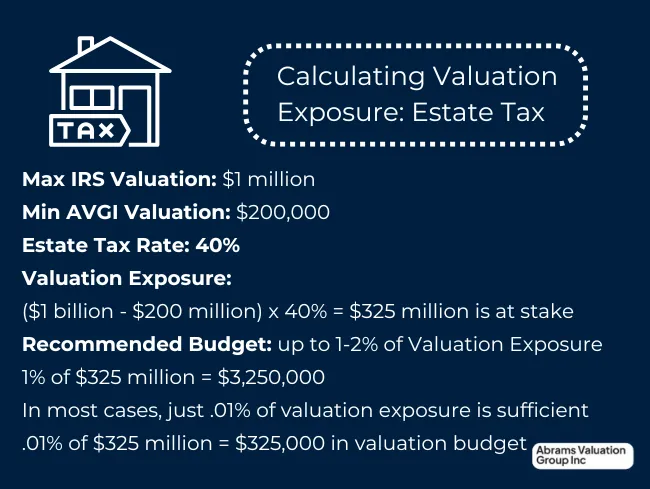
When creating a business valuation report for tax purposes, we define the Valuation Exposure as the difference between the maximum and minimum valuations times the tax rate.
Let’s say the maximum the IRS would set the client’s fair market value at is $1 billion, and the minimum AVGI would value the client at $200 million. The estate tax rate is 40%.
So the client’s valuation exposure of the potential range of estate and gift tax would be:
($1 billion – $200 million) x 40% = $325 million is at stake in this assignment.
When a lot is at stake, spending between 1-2% of the valuation exposure on valuation fees makes sense. So in this case, the client should be willing to spend
1% of $325 million = $3.25 million in valuation fees to lower their valuation exposure.
In this case (as usual), 0.1% of the valuation exposure (just $325,000) in valuation fees would likely be more than sufficient to perform the full-scope high-quality appraisal that this client requires.
On the other hand, a client with a small local business, such as a “mom-and-pop shop” in a non-taxable estate, has a 0% estate tax rate. Their valuation exposure is zero, so they should not invest much money into a full-scope expert appraisal. An inexpensive Valuation Calculation by a local CPA or other qualified professional would suffice for compliance purposes.
Calculating Valuation Exposure: A Litigation Example
Litigation is a field that tends to have very high valuation exposure, as there is often a lot at stake with fierce opposition and a wide range of outcomes. While a higher quality valuation expert doesn’t necessarily equal a higher award, a higher quality expert can help protect against an award that is unfairly low. That can happen if the opposing expert is either unethical or incompetent but presents their case smoothly.
Let us suppose that each higher level of expertise would result in a 10% higher award outcome, with the potential outcomes ranging from $0 to $100 million. If you were to select a level 2 expert (out of 10, with 10 being a world-class expert), your potential outcome would be:
2 x 10% × $100 million = a $20 million award, potentially losing $80 million to valuation exposure.
In this case, with so much at stake, it would make the most sense to hire as close to a level 10 expert as possible and budget accordingly for the higher valuation fees. Hiring a lower-level expert may make more sense for smaller litigation with less at stake.
Evaluating your Valuation Exposure: In Conclusion
As we’ve explored, the cost of a business valuation can vary greatly depending on the scope, complexity, and level of expertise. To help you decide how much you should spend on a business valuation, you’ll need to determine your valuation exposure and how much is at stake.
If you are unsure about your valuation exposure, just give us a call. Our team of valuation experts is happy to help you assess your valuation exposure and clarify your valuation needs. If Abrams Valuation Group, Inc. is a good fit for your valuation exposure and needs, then we’ll be happy to assist you with the valuation. If we determine that you have a lower valuation exposure or we are not a good fit for your valuation needs, we’ll be happy to refer you to a network of other trusted professionals. Give us a call today for a free consultation.


