

Leveraging Valuation Discounts in 7 Real-World Business Contexts
When valuing ownership interests in privately held businesses, not all ownership stakes are created equal. A 20% interest in a $10 million company is rarely worth exactly $2 million in the real world. This is because business valuation must account for the practical realities that affect what a willing buyer would actually pay for that interest.
Two of the most significant factors that reduce the value of ownership interests below their pro-rata share of enterprise value are lack of control and lack of marketability. These limitations are so fundamental to business valuation that they have spawned two primary valuation adjustments recognized by courts, tax authorities, and valuation professionals:
2 Main Valuation Discounts: Lack of Control & Lack of Marketability
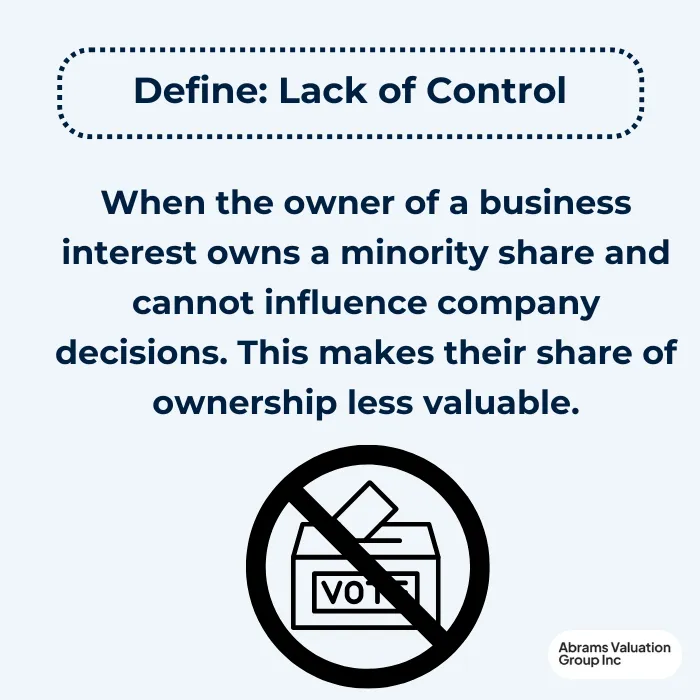
Discount for Lack of Control (DLOC): This discount reflects the reduced value of a minority ownership interest that cannot unilaterally direct business strategy, force distributions or dividends, approve major transactions, hire or fire management, or compel a sale or liquidation of the business. A minority shareholder is essentially at the mercy of the majority owners’ decisions. DLOC typically ranges from 15% to 40%, depending on the degree of control absent and the specific rights attached to the interest.
Discount for Lack of Marketability (DLOM): This discount accounts for the illiquidity of ownership interests that cannot be readily sold on a public market. Unlike publicly traded stocks that can be sold within seconds, private company interests may take months or years to sell, require costly legal and accounting work to transfer, face contractual restrictions (such as rights of first refusal or transfer limitations), and have a very limited pool of potential buyers. DLOM typically ranges from 20% to 50%, though it can be higher in certain circumstances.
These discounts are not merely theoretical—they reflect genuine economic disadvantages that affect real transactions. A rational buyer will pay less for an asset that provides no control and cannot be easily resold. Understanding when and how to apply these discounts can provide significant strategic and financial advantages in various business contexts.
The following scenarios demonstrate how business owners, litigants, and advisors can leverage expert valuations incorporating DLOC and DLOM to achieve favorable outcomes in mergers and acquisitions, estate planning, litigation, ESOP formations, and other critical situations.

Real-World Scenarios Leveraging Valuation Discounts for Lack of Marketability and Control
1. Merger & Acquisitions: Minority Shareholder Buyout
Scenario: A technology company with three founders holds ownership stakes of 60%, 25%, and 15%. The majority owner wants to buy out the 15% minority shareholder to consolidate control before pursuing a strategic acquisition.
How Discounts Help: An expert valuation applying both the lack-of-control discount (DLOC) and the discount for lack of marketability (DLOM) can establish a fair market value that is significantly below the pro rata enterprise value. The minority stake has no control over business decisions, dividend distributions, or sale timing, and there’s no ready market for the shares. This professionally supported lower valuation helps the majority owner negotiate a reasonable buyout price while providing defensible documentation that the minority shareholder received fair value, reducing litigation risk.
2. Estate Planning: Gifting Business Interests to Heirs
Scenario: A 68-year-old business owner with a $20 million manufacturing company wants to transfer ownership to her three children over time while minimizing estate and gift taxes, staying within annual gift tax exclusions and lifetime exemption limits.
How Discounts Help: By restructuring the business and gifting minority, non-voting interests to her children, the owner can obtain expert valuations that apply substantial DLOC (typically 20-35%) and DLOM (typically 25-40%) discounts. A 10% interest in a $20 million company might be valued at only $1.2-1.4 million instead of $2 million on a pro-rata basis. This allows the owner to transfer more actual ownership while staying within gift tax limits, potentially transferring millions in value over time while minimizing tax liability. The expert valuation provides IRS-defensible support for the discounted values.
For more information on IRS requirements for estate and gift tax valuations, see the IRS Instructions for Form 706.

3. Litigation: Shareholder Oppression/Dissenter’s Rights Case
Scenario: A 30% minority shareholder in a family-owned restaurant chain is being squeezed out by majority shareholders who refuse to distribute dividends, deny access to financial information, and pay themselves excessive compensation. The minority shareholder files an oppression lawsuit seeking a buyout.
How Discounts Help: The majority shareholders’ expert can apply significant DLOC and DLOM to argue for a lower buyout price, emphasizing that the minority position has no control and limited marketability. However, the minority shareholder’s expert might argue for reduced or eliminated discounts based on oppression doctrines or fair value standards (which in many jurisdictions exclude discounts for minority oppression cases). The competing valuations establish negotiating boundaries. If the minority shareholder is the one seeking to suppress value (perhaps for tax purposes in a different context), the discounts work in their favor.
4. ESOP Formation: Establishing Initial Share Value
Scenario: A 62-year-old owner of a profitable $15 million engineering firm wants to sell 30% of the company to an Employee Stock Ownership Plan (ESOP) as a succession strategy, with plans to sell the remaining 70% over the next five years. The owner wants to defer capital gains taxes under IRC Section 1042.
How Discounts Help: An expert valuation of the initial 30% minority stake sold to the ESOP can apply DLOC and DLOM, reducing the value the ESOP must finance and the debt the company must service. A lower initial valuation makes the transaction more feasible and reduces the immediate financial burden on the company. This is particularly advantageous because: (1) the company often finances the ESOP purchase, so a lower price means lower debt service, (2) the owner can still defer capital gains under Section 1042 even on the discounted value, and (3) it establishes a conservative baseline for future valuations as the ESOP purchases additional shares. The expert valuation must satisfy Department of Labor adequacy requirements and be applied in accordance with appropriate discounts.

5. Divorce Proceedings: Dividing Marital Business Assets
Scenario: A divorcing couple must divide assets, including the husband’s 20% interest in a private equity-backed medical device company where he serves as VP of Operations but has no board representation or control rights.
How Discounts Help: The husband’s expert valuation applies substantial DLOC and DLOM to the 20% minority interest, arguing it’s worth significantly less than 20% of the enterprise value. The interest cannot force a sale, has no control over distributions, has restrictions on transfer (typical in PE-backed companies), and has no ready market. A discounted valuation reduces the marital estate value attributable to this asset, potentially meaning the husband retains the full business interest while paying less in offsetting assets to his spouse, or reducing any equalization payment required. The wife’s expert may challenge the magnitude of discounts, but their applicability is generally accepted in divorce valuations.
6. Tax Planning: Charitable Donation of Business Interests
Scenario: A successful entrepreneur wants to donate a 15% non-voting interest in her $30 million professional services firm to a charitable foundation, seeking a tax deduction for the donation.
How Discounts Help: An expert valuation applying DLOC and DLOM establishes the fair market value of the donated interest for tax deduction purposes. While this results in a lower tax deduction than pro-rata value, it provides IRS-defensible documentation and reduces audit risk. Interestingly, the charity receiving the donation benefits from the same illiquid asset, but the donor’s tax deduction is based on the legitimately discounted value. This is particularly useful when the donor wants to support a cause while retaining majority control of the business, and the discounted valuation ensures compliance with tax regulations while maximizing the defensibility of the deduction claimed.

7. Buy-Sell Agreement Valuation: Triggering Event Occurs
Scenario: A four-partner medical practice has a buy-sell agreement requiring buyout of any partner who becomes disabled. One partner suffers a stroke and can no longer practice. The agreement specifies valuation will be determined by an independent expert using “fair market value.”
How Discounts Help: The remaining partners benefit from an expert valuation that applies DLOC (the departing partner held only 25%) and DLOM (no market exists for medical practice ownership interests) to establish the buyout price. This reduces the financial burden on the remaining partners or the practice itself in funding the buyout. A 25% interest in a $4 million practice might be valued at $700,000-$800,000 instead of $1 million, making the buyout financially feasible. The expert valuation also provides protection against future disputes by documenting that the methodology was professionally applied and the price was objectively determined.
Conclusion: Strategic Value of Understanding Valuation Discounts
The seven scenarios above illustrate a fundamental principle: valuation discounts for lack of control and lack of marketability are not abstract accounting concepts—they are powerful financial tools with real-world consequences worth hundreds of thousands or even millions of dollars in specific transactions.
Across diverse contexts—from M&A negotiations and ESOP formations to estate planning, divorce proceedings, and litigation—these discounts consistently serve to bridge the gap between theoretical pro-rata value and the economic reality of what minority, illiquid interests are actually worth in the marketplace. A 20% stake in a business is genuinely worth less than one-fifth of the enterprise value when that stake carries no control rights and cannot be readily sold.

The strategic advantages of obtaining expert valuations that properly apply DLOC and DLOM include:
– Reducing tax liability in estate planning and charitable giving situations
– Making buyouts and ESOP transactions financially feasible by lowering purchase prices
– Establishing defensible negotiating positions in disputes and litigation
– Providing IRS-compliant and court-recognized documentation that withstands scrutiny
– Minimizing financial burdens on businesses and remaining owners during transitions
– Creating opportunities to transfer more actual ownership while staying within legal and tax limits
However, it’s critical to recognize that these discounts must be applied appropriately and supported by rigorous analysis. Courts, tax authorities, and opposing parties will scrutinize the magnitude and justification for discounts. This is why engaging a qualified, credentialed business valuation expert is essential—not merely to calculate a number, but to provide defensible, professionally supported analysis that can withstand challenge. Professional valuation credentials, such as the Accredited Senior Appraiser (ASA) designation from the American Society of Appraisers or the Certified Valuation Analyst (CVA) from the National Association of Certified Valuators and Analysts, ensure practitioners adhere to recognized professional standards and maintain the expertise required for credible valuations. See our comprehensive article on the types of valuation professionals and who should do your valuation.
Furthermore, the applicability and magnitude of these discounts vary significantly based on jurisdiction, specific circumstances, contractual arrangements, and the purpose of the valuation. Some legal contexts (such as certain shareholder oppression cases) may limit or eliminate discounts, while others fully embrace them.
Ultimately, whether you’re planning your estate, negotiating a buyout, structuring an ESOP, navigating a divorce, or engaged in litigation, understanding how DLOC and DLOM affect business valuations can mean the difference between a favorable outcome and leaving significant value on the table. The key is to engage qualified experts early in the process, before positions harden and opportunities are lost.


