

Pre vs Post Money Valuation: What’s the Difference for Startups?
Both a pre money and post money valuation are measurements of a company’s value. The difference lies in the timing of the valuation. A pre money valuation is the value of the company at that particular point in time before any additional cash investments by venture capitalists, angel investors, owner investments, or other sources of funding. A pre money valuation is a raw snapshot of the company’s value as a standalone-how much value they bring to the table right now with the idea, development, team, processes and growth they have developed up until now. In contrast, a post money valuation indicates the value of the company after receiving additional outside funding.
Pre money vs post money valuation: Why does it matter?
The most impactful difference between using a pre or post money valuation when discussing startup funding is how much ownership the entrepreneur and investor will each get. This is best illustrated by example.
Pre vs Post Money Valuation Examples
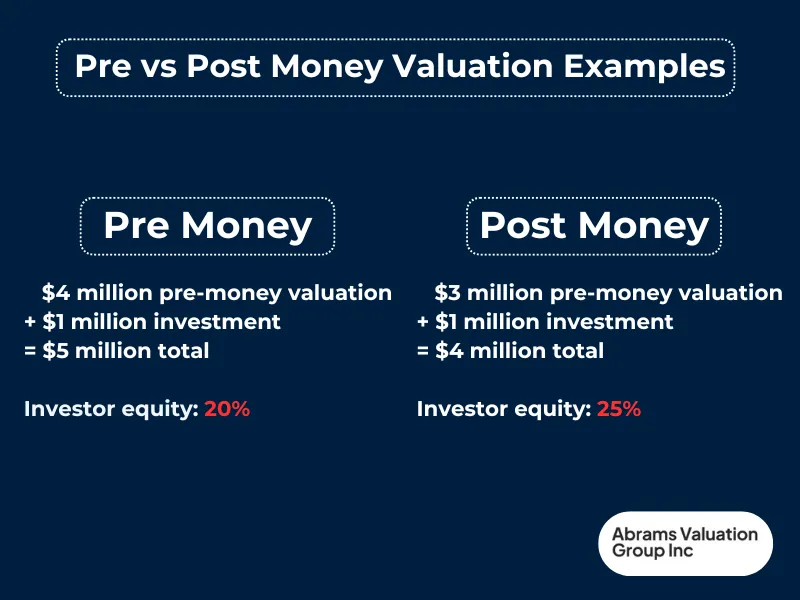
Great Idea, LLC is a startup looking to raise $1 million in additional capital in exchange for a percent of equity in the company. The startup entrepreneur and investor both agree the company is worth $4 million. The how much equity the investor will receive depends if the $4 million valuation is pre or post money.
If the $4 million is a pre money valuation, then the total is $4 million + $1 million = $5 million. $1 million is 20% of $5 million, so the investor receives a 20% equity stake in the company in exchange for their investment.
If the $4 million is a post money valuation, then the total is $3 million (pre money valuation) +$1 million (investment amount)= $4 million total. $1 million is 25% of $4 million, so the investor would receive 25% equity stake in the company in exchange for their investment.
These slight differences in equity percentages at the investment stage can make a large difference, to the tune of millions of dollars, once the startup makes an IPO. Therefore, it makes a big difference to both the investor and entrepreneur whether they are assessing a company to invest in based on a pre- or post-money valuation.
It is important to note that this is a very simplified example for illustration.
Pre money valuation: when is it used?
Founders and investors often use both pre and post money valuations, but since each reveals different perspective on the startup’s growth, some prefer to use pre money valuations.
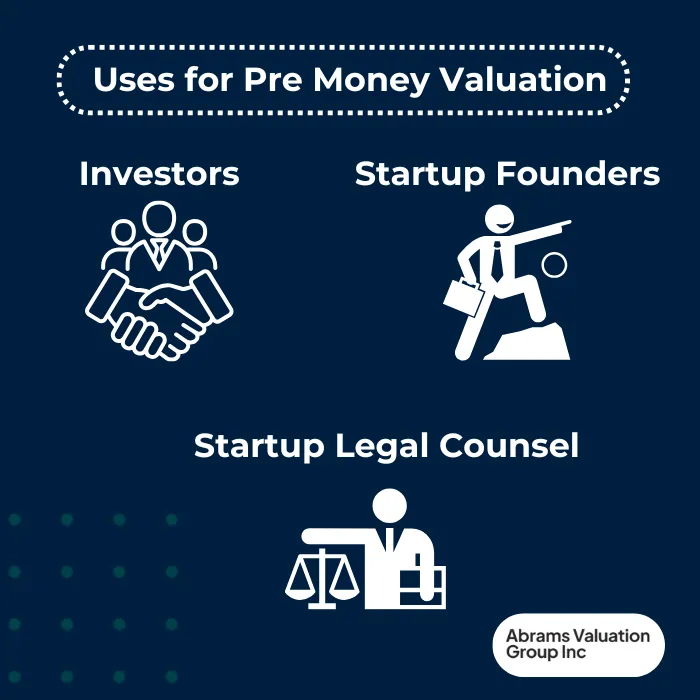
Venture capital and angel investors use pre money valuations to understand the startup’s current marketing positioning before injecting their additional funding into the company. Examining the pre money valuation helps investors determine a fair equity stake to negotiate in exchange for startup investment.
Startup Founders use pre-money valuations to set the terms for investment rounds, understand how much dilution they might face, and gauge how much capital they can realistically raise.
Startup lawyers and legal counsel use pre-money valuations to draft contracts and deal terms that reflect the startup’s accurate value and advise startups before giving away irresponsible amounts of equity in exchange for investment.
Post Money Valuation: Who Uses It?
Founders & Startup Leadership use post money valuations to assess funding goals and benchmark whether the startup is on track for growth expectations or if another round of funding is necessary.
Company stakeholders including private investors, employees with stock options, and owners use post money valuations to assess the real value of their stock, as the additional funding calculated in the post money valuation directly impacts the stock’s value.
Financial advisors and investment firms use post money valuation to keep an eye on the value of startup investments in their clients’ portfolios.

Pre vs Post Money Valuations: Determining Up Round vs. Down Round Financing
Another important function of comparing pre and post money valuations is helping investors determine whether a subsequent round of startup funding is an up round or a down round. If the pre money valuation before the new round of financing is higher than the post money valuation from the last round, then it is an up round. That usually demonstrates company growth and is an enticing investment for Venture capitalists. However, if the pre money valuation for the new round is lower than the post money valuation of the last round, then it is deemed a down round of financing. Investors are at a significant advantage during a down round, as the startup company appears desperate for funds. Investors may therefore be able to negotiate much more advantageous terms for themselves in exchange for investment funds.
How do VC’s Determine a Pre Money Valuation?
Venture capitalists (VCs) determine a pre-money valuation using a mix of quantitative and qualitative assessments, but it’s important to note that their methods aren’t always the most precise or standardized. Here are some key factors they typically consider:
1. Comparable Companies: VCs often look at similar companies in the same industry that have recently received funding. They analyze their valuations to derive a benchmark for the startup in question.
2. Financial Metrics VCs examine revenue, growth rates, profitability, and valuation multiples based on industry standards to estimate a company’s value.
3. Traction and Performance: The startup’s traction—measured through customer acquisition, usage metrics, or partnerships—can significantly influence valuation. A company demonstrating strong traction may command a higher valuation.

4. Team and Technology: The founding team’s experience and the uniqueness of the product or technology are crucial. VCs typically invest in people as much as they do in ideas, so a strong team can lead to a higher perceived value.
5. Market Potential: VCs assess the total addressable market (TAM) and the startup’s ability to capture market share. A large and growing market can lead to higher valuations.
6. Risk Assessment: VCs evaluate the risk associated with the investment, including market risks, execution risks, and competition. Higher perceived risks can lead to lower valuations as investors seek to protect their investments.
The Problem: VC Valuations Tend to be Subjective
Despite VCs examining these factors in assessing business value, their valuation process can often be subjective and influenced by personal bias or negotiation dynamics. VCs may not always employ the most standard, rigorous, or transparent methodologies, which can lead to discrepancies in perceived value. Particularly when negotiating equity and investment terms, this subjectivity in valuation terms can often be to the owner’s detriment.
2 Main Problems with Relying on Subjective VC Pre and Post money Valuations
VCs will tend to undervalue startups without funding, as you “need money to make money,” and the startup lacks the funds to make any money. From a valuation perspective, this is inaccurate, as value is created in the unique market positioning of the startup company’s concept, product, or service, and realistic financial projections for the profitability of that idea in the real world. In short, the startup’s idea that holds potential is inherently valuable, even without a single dollar in funding.
Because VCs tend to undervalue startups, they may try to negotiate larger percentages of company equity in exchange for startup funding than is fair or reasonable.
Uncovering Another Hidden Factor: Equity Dilution
Traditional pre and post money valuations both have a significant limitation in that they fail to demonstrate the impact of equity dilution. As a startup company raises more investment funding, the influx of investors taking more company equity dilutes the initial investors’ equity value. Although there are a number of strategies to mitigate this issue, it’s important for both startup entrepreneurs and investors to have a clear understanding of the impact of dilution on their investment and company equity. A qualified business appraiser can take the pre or post money valuation one step further to demonstrate the impact of investment dilution for current and future investors, assisting all parties in making informed investment decisions.
The Solution: An Independent Pre and Post Money Valuation
For startup owners, obtaining an independent and objective pre-money valuation can be highly beneficial. An unbiased valuation clarifies the company’s worth, helps founders negotiate better terms, and mitigates the risk of giving away too much equity during funding rounds. By knowing the fair value of their company, founders are better equipped to engage in negotiations, ensuring they maintain a desirable ownership stake while securing the necessary capital to grow their business. This can ultimately contribute to more equitable funding arrangements and foster a stronger partnership with investors.
AVGI strongly encourages startups to engage an independent appraiser to perform an impartial pre money valuation, which brings valuation expertise and mitigates bias in the valuation process. Without an independent valuation, the startup is at the mercy of the venture capitalists’ assessment of value, which may turn out to be less than accurate.
AVGI’s clients enjoy the peace of mind knowing that their valuation is precise and backed by over 30 years of valuation expertise and experience. Empower your startup to secure more funding and negotiate fair equity terms based on an objective valuation. Contact AVGI today to discuss an accurate pre or post money valuation for your startup company.


