

Pro Rata Rights: A Founder and Investor Guide for Startups
Executive Summary: Pro Rata Rights and Startups
Pro rata rights give existing investors the option to maintain their percentage ownership by participating in future funding rounds. Particularly in industries where capital needs and competitive advantages can shift quickly, pro rata rights impact control, relationships, and the capacity to scale. Founders and investors alike must understand the consequences on the cap table and the broader value chain.
Why Pro Rata Rights Matter for Businesses
Startups often face complex capital requirements and rapid scaling. Pro rata rights:
- Help investors double down on winners as new opportunities emerge (e.g., new contracts, expansions).
- Give founders a pool of reliable follow-on capital to support growth and signal stability to new investors.
What Is a Pro Rata Right?
A pro rata right is the contractual option for an existing investor to participate in future financing rounds to maintain their percentage ownership, typically specified in the company’s term sheet.
Investor Language Definition:
“Pro rata rights let you buy enough shares in a new round to keep your same ownership percentage.”
- Where it appears: Usually in the ‘Investor Rights’ or ‘Financing’ section of a term sheet.
- Pro rata vs. pre-emption: General pre-emption rights allow participation in future rounds, whereas pro rata rights specify the participation amount based on current ownership.
Rata Rights Terminology and Variations
- Percentage-basis pro rata: The investor can buy enough shares to maintain their existing percentage.
- Dollar-for-dollar and fixed-sum: The investor can invest up to a set dollar amount or a fixed number of shares in future rounds.
- Super pro rata: An investor can buy more than their percentage share—usually a red flag for founders, as it can crowd out other investors.
Pro Rata Rights vs. Pre-Emption Rights
Pre-emption rights constitute a broader category of shareholder protections that give investors the first opportunity to purchase newly issued shares before they are offered to outsiders, thereby helping prevent dilution of their ownership. Within this broader framework, pro rata rights are a specific, negotiated subset that entitle investors to purchase shares in future financing rounds in proportion to their existing ownership percentage, allowing them to maintain that stake precisely. While pre-emption rights can apply to a variety of equity issuances—including those for strategic partnerships or acquisitions—pro rata rights are typically focused on participation in the company’s subsequent fundraising rounds.
This distinction is important for founders during negotiations because granting broad pre-emption rights can limit flexibility by obligating the company to offer shares to a wide group of shareholders, potentially complicating future capital raises. In contrast, pro rata rights are typically granted selectively to key investors, ensuring they can maintain their ownership without unduly restricting the company’s ability to attract new investors. Understanding the nuances between these rights helps founders strike a balance between protecting existing investors’ interests and preserving the company’s long-term fundraising agility.
How Pro Rata Rights Work in Practice
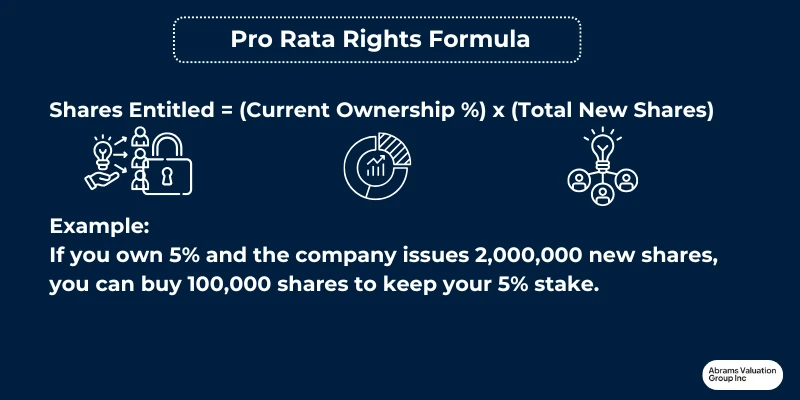
Pro Rata Calculation Formula:
Investment Allowed = (Current Ownership %) x (New Shares Issued in Round)Numeric Example:
- Investor owns 10%
- New round issues 1,000,000 shares
- Investor can buy: 10% x 1,000,000 = 100,000 shares
- Offer notice and response window: Term sheets specify how and when investors are notified and how long they have to decide.
- Model outcomes: Always run cap table scenarios before launching a raise.
When Investors Exercise Pro Rata Rights
- Common triggers: Hot/up rounds, new strategic investors joining, maintaining influence.
- Constraints: Fund lifecycle (VCs may be out of capital), reserve policies, and LP requirements.
- Lead investor influence: Lead investors often set the tone for participation.
Term Sheet Language and Negotiation Tips
- Placement: Pro rata clauses belong in the ‘Investor Rights’ or ‘Financing’ section.
- Eligibility thresholds: Require a minimum investment size to qualify.
- Time/round limits: Consider setting rights to be valid for a fixed number of rounds or years.
- Trading rights: Offer pro rata in exchange for a higher valuation or other concessions.
Pro Rata Participation and Cap Table Impact
Shareholder | Pre-Series A (%) | Post-Series A (%) (No Pro Rata) | Post-Series A (%) (With Pro Rata) |
|---|---|---|---|
Founders | 60% | 48% | 48% |
Early Investor | 10% | 8% | 10% |
New Investor (A) | 0% | 20% | 18% |
Employee Pool | 10% | 8% | 8% |
Other Investors | 20% | 16% | 16% |
Total | 100% | 100% | 100% |
- Dilution scenarios: Without pro rata, early investors’ stakes shrink. With pro rata, they maintain their position.
- Multiple rounds: Over successive rounds, pro rata rights help early investors retain meaningful ownership.
- Guardrails: Founders should cap the number of investors eligible and monitor the pool to avoid cap table overcrowding.
Best Practices for Founders
- Grant pro rata rights selectively to strategic, value-adding investors.
- Use side letters for custom pro rata arrangements if term sheet space is constrained.
- Align pro rata grants with supply-chain partners or industry allies to support company goals.
Common Pitfalls and How Pro Rata Rights Can Backfire
- Super pro rata: Accidentally granting super pro rata can crowd out other key participants.
- Oversubscribed rounds: Pro rata rights may limit flexibility to bring in new or strategic investors.
- Cap table overhang: Regularly audit the cap table to avoid unexpected investor overhang from accumulated rights.
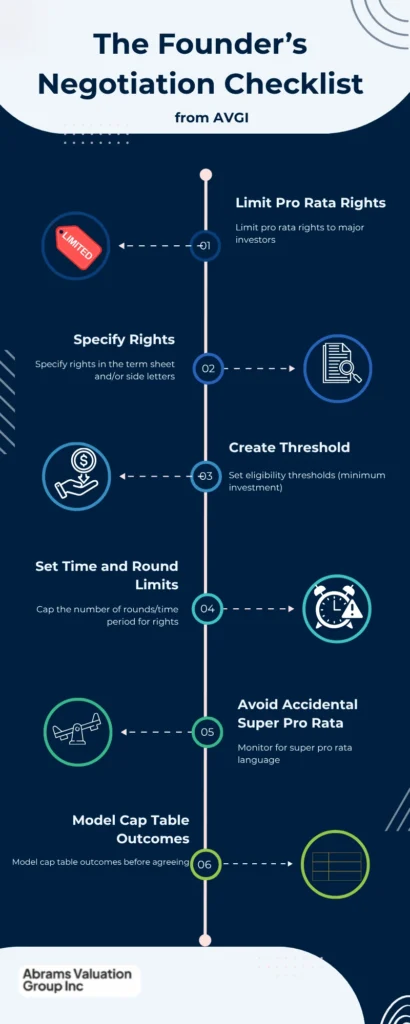
Negotiation Checklist for Founders
- Limit pro rata rights to major investors
- Specify rights in the term sheet and/or side letters
- Set eligibility thresholds (minimum investment)
- Cap the number of rounds/time period for rights
- Monitor for super pro rata language
- Model cap table outcomes before agreeing
Quick FAQ
Q: Must investors exercise pro rata rights?
A: No. Pro rata rights are an option, not an obligation. Investors can choose to participate or not.
Q: Who typically qualifies for pro rata rights?
A: Lead and major strategic investors, or those investing above a set threshold.
Q: How long do pro rata rights last?
A: Typically, for a set number of financing rounds or years, specified in the term sheet.
This guide provides packaging founders and investors with a comprehensive framework for understanding, negotiating, and leveraging pro rata rights to support growth and partnerships. Do you want to discuss the best pro rata strategy for your startup or investment negotiations? Give us a call, and our AVGI valuation experts will be happy help you determine the best course of action.


